If you and your partner are deciding between rail, coach, ferry, or a mixed route for Los Angeles to San Francisco transport, prioritize ticket flexibility that matches your travel style. For many couples the practical question is less about travel time alone and more about how easy it is to change plans, handle luggage together, and recover from delays. Choose a flexible fare if you expect schedule uncertainty, want simple exchanges or cancellations, or prefer switching modes mid-route. This article lays out quick tradeoffs — where each mode fits terminals and transfers, what luggage and walking demands look like, how timing flexibility varies, and a basic disruption backup plan so you can pick the option that keeps your trip comfortable and low-stress.

Terminal fit: where your journey actually starts and ends
Start by mapping terminals to real origin and destination addresses. A train station or coach terminal closer to your Los Angeles neighborhood can save hours of roundabout travel even if the ride itself is slower. Equally, consider which arrival point in the Bay Area makes the most sense for your plans—staying near the waterfront, in the city center, or near a family home changes whether a direct terminal matters. For couples traveling together, reduce stress by picking options with easy, short transfers to your first accommodation or meeting point so neither of you has to carry bags long distances.
Terminal fit also affects how flexible tickets serve you. Some flexible fares apply only at specific stations or require a phone call to change; others allow web edits over a range of terminals. If a flexible ticket requires ticket-office exchanges, factor that into your decision — arriving late in Los Angeles or dealing with crowds on both ends can erase the benefits of a low-change-fee fare. Before booking, list your door-to-door plan and verify whether the flexible fare supports changes at the particular terminals you intend to use.
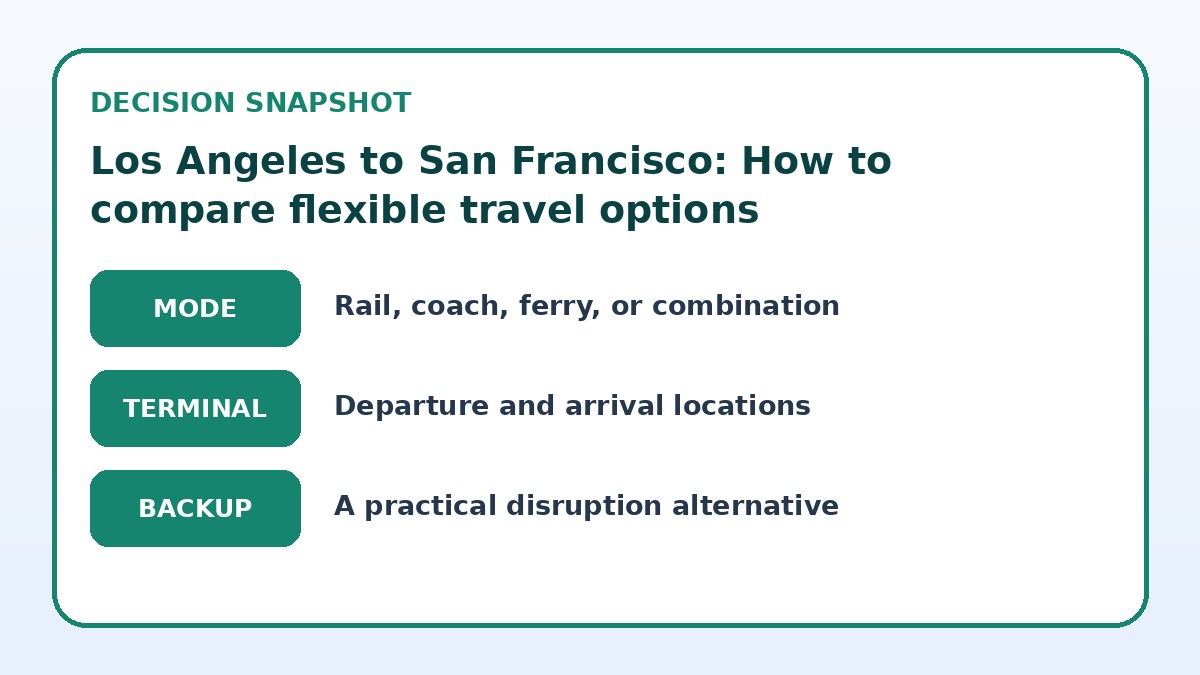
Choose the end-to-end journey plan
| Journey approach | Best for | Friction to check |
|---|---|---|
| Rail-first: train for comfort with flexible fare | Couples valuing seat comfort, on-board space, and predictable walk times at stations. | May require higher fare class for full refundability; check online change tools and luggage rules. |
| Coach-first: bus-based travel with easily swapped tickets | Pairs who want low-cost, last-minute switch options and simple direct stops in city centers. | More exposed to traffic delays and transfer points that can add walking with luggage. |
| Mixed route: combine train or coach with ferry or local transit | Couples who want scenic segments and flexible arrival points near water or specific neighborhoods. | Adds transfers and time buffers; verify each leg’s change policy and luggage handling separately. |
| Drive-and-park: rental or personal car door-to-door | Couples prioritizing total door-to-door control, stops at will, and privacy during travel. | Responsibility for parking, tolls, and route disruption; rental change/cancellation rules must be checked. |
Check live intercity options
Look beyond the ride itself and compare terminals, transfers, luggage, and arrival fit.
Luggage and transfer friction for two travelers
Couples often underestimate how transfers amplify friction. A single long, smooth train ride keeps luggage handling minimal, while a coach-to-ferry or train-to-bus change can mean stairs, tight corridors, and timed boarding. Consider the size and number of bags, whether you’ll carry anything on your back, and whether you can split tasks — one person managing tickets and phones while the other handles bags. Flexible tickets that permit platform-side exchanges, or that include checked luggage allowances, cut friction; verify how any fare treats luggage at each leg before you book.
Physical layout at stations influences how manageable transfers are for two people. Busy bus terminals or ferry slips may require queuing with bags, and some transfer points have limited covered waiting areas. If you prefer convenience over small savings, choose options with minimal handoffs or pay for a fare class that allows advance seat selection or guaranteed luggage space. On booking pages, check whether transfers are timed tight enough to require rushed movement and whether the provider lists luggage restrictions or recommended minimum connection times.
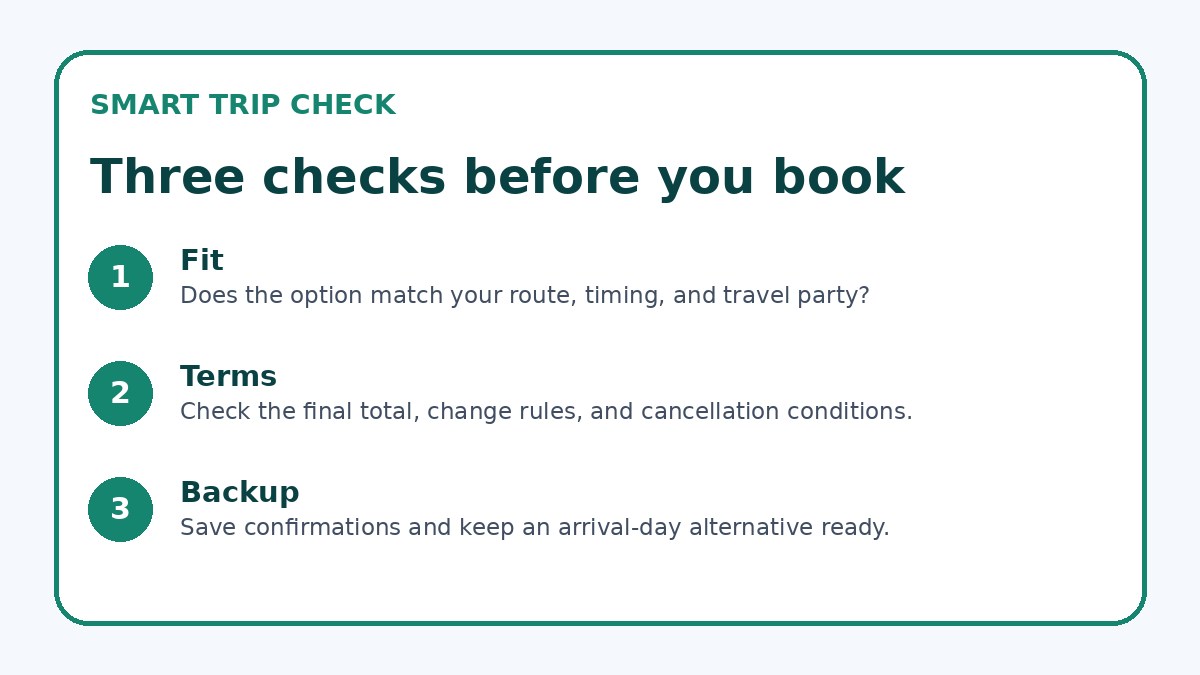
Timing flexibility: comparing fare rules and change options
Timing flexibility comes in several forms: fully refundable fares, flexible exchange windows, modest change fees, and same-day standby. Couples should match the likely degree of uncertainty to the most suitable policy — for example, a long flexible ticket if plans are fluid, or a fixed ticket if your schedule is firm. Always read the provider’s fare conditions on the booking page: look for exact change-penalty amounts, whether a fare can be reissued online, and any blackout windows. Don’t assume the word “flexible” means identical rules across modes; carriers and service types define flexibility differently.
Practical decision-making also factors how changes affect the second traveler. Can you change a single name or must both tickets be reissued? Are seat assignments transferable if one of you needs to shift plans? Decide whether to buy separate flexible fares or a joint ticket that allows a single amendment. If splitting tickets, plan who handles communications and receipts—this reduces confusion during stressful connection issues. Finally, consider backup transit options and their ticketing rules; knowing the alternative’s cancellation or exchange policy ahead of time makes switching smoother if disruptions occur.
Compare the practical alternatives
Use the final page to confirm what is actually offered on your dates and save a workable fallback.
Intercity travel checklist
- Confirm the exact change and cancellation terms shown on the carrier’s final booking page before paying.
- Map door-to-door travel times from your home to the origin terminal and from arrival terminal to your stay.
- Decide whether to buy two separate flexible tickets or a single joint ticket, and note the amendment process.
- Photograph tickets, IDs, and provider contact details and store them offline on both travelers’ phones.
- Plan a specific secondary route (coach, alternate train, or rideshare) and note how to buy it quickly if needed.
- Check luggage allowances for each leg and pack to minimize transfers—use one carry-on per person when possible.
Disruption backup: simple plans to recover together
Design a disruption backup that keeps both of you calm and moving. Start by choosing one flexible ticket option that covers the majority of scenarios you anticipate, and add a low-friction secondary option that’s easy to buy or board at short notice. For instance, if rail is your primary choice, identify a coach or alternate train route you could reasonably switch to if your initial service is delayed. Make sure both partners know who will manage rebooking and where to find the live policy details on the provider’s final booking page or app.
Include non-ticket elements in your backup plan: where to find secure luggage storage, how to get a local taxi or rideshare from each terminal, and which downtown hotels let you change plans on short notice. Exchange and cancellation contact details should be saved on both phones, and photocopies or screenshots of tickets and ID should be stored offline in case of spotty service. If you plan to consult a third-party comparison site like Trip.com for current availability, use it only as a comparison tool and always confirm flexible-fare details on the carrier’s actual booking page before changing or canceling.
Rail & Intercity Transport questions travelers ask
How do I compare flexible ticket rules between rail and coach for this route?
Start by opening each provider’s booking page and reading the fare rules section: look for exact change fees, whether exchanges can be done online or only at ticket offices, and any time windows for free rebooking. Note luggage allowances and seat-change policies, and whether refunds are issued as credit or back to the original payment method. Put these terms in a short comparison list and weigh them alongside your expected need to change plans; practical flexibility matters more than buzzwords, so prioritize the fare with the concrete policy that matches your likely scenarios.
If one partner needs to change plans, can we modify only one ticket?
That depends on how you booked. Many providers allow name-specific changes, letting one passenger modify their segment without touching the other’s fare, while some combined or multi-passenger fares require reissuing all tickets. Before booking, check whether the carrier permits single-ticket amendments and whether fees vary for individual changes. If the rules are unclear on the booking page, contact customer service and keep a screenshot of their confirmation. For maximum flexibility, consider separate flexible tickets with synchronized travel windows.
What’s the simplest disruption backup for couples traveling this corridor?
A straightforward backup is to pair your primary ticket with an identified alternate that’s quick to buy and board—commonly a coach or another train departing the same day. Save the ticketing app or website, the terminal’s pickup location, and a local rideshare option for reaching the alternative. Allocate at least 60–90 minutes to change plans to avoid rushed decisions and ensure you know whether the alternative requires paper tickets or a mobile pass. Always verify final fare-change processes on the provider’s booking page before relying on the backup.
Final decision note
For couples traveling between Los Angeles and San Francisco, ticket flexibility is a practical tool that protects your plans from small disruptions and schedule changes. Choose the mode that best matches your tolerance for transfers, luggage handling, and terminal access: a single long train ride reduces physical friction, coach options often allow quick last-minute swaps, mixed routes add scenic variety but more handoffs, and driving gives complete control. Whatever you choose, read the exact fare conditions on the provider’s booking page, save contact details, and plan a realistic backup so you can change course together without stress. Use a comparison site such as Trip.com to view options quickly, but always confirm flexibility details on the carrier’s official booking page before finalizing.
Continue planning
Check current options and final conditions
Use the provider page to confirm live availability, the final total, cancellation terms, and every condition that matters to your trip.
This evergreen planning guide was created with AI-assisted drafting and a structured quality review. It does not display live prices, schedules, availability, visa guidance, or provider rankings. Verify current details before booking. Some links are affiliate links; we may earn a commission at no additional cost to you.