If you’re traveling from Los Angeles to Honolulu with extra luggage, the practical question isn’t just which flight to pick—it’s how to match routing, baggage allowances, and airport time so your trip begins smoothly. Start by deciding whether you value fewer connections or lower fares; each choice changes how much checked luggage costs, how much time you need at LAX, and how risky a delay becomes. Gather exact dates, the total number and weight of bags, passenger ages and connections, and whether you’ll check special items (sports gear, oversized cases). With those details in hand you can compare direct and connecting schedules, confirm baggage allowances and fees on the carrier’s final booking page, and plan how early to arrive at LAX, how to tag and consolidate bags, and which fare rules you might need to upgrade to avoid surprises.

See live routes for your exact travel day
Compare direct and connecting choices with the same baggage and traveler details.
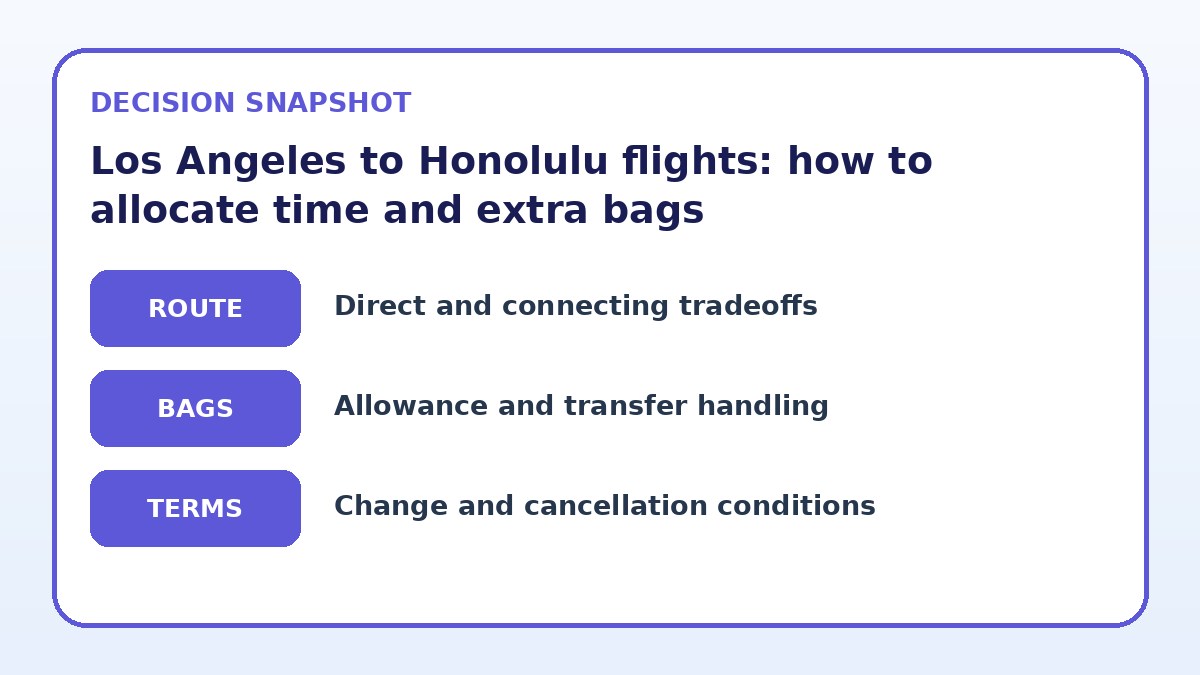
Routing: direct versus connecting choices
Los Angeles to Honolulu is a popular route with both nonstop and connecting options offered by different carriers and through different hubs. For travelers with extra luggage, the core tradeoff is simple: nonstops generally reduce handling steps and risk because checked baggage remains on one plane, while connecting itineraries can be cheaper but add handling events and a higher chance of delay or misrouting. When comparing options, look beyond the flight time and check how many checked bags the fare includes, which aircraft type is used, and whether the connection forces you to change terminals at LAX or at an intermediate airport.
Calculate the likelihood and cost of a delayed connection: if baggage is delayed on a multi-leg ticket, airlines typically attempt to route it on the next flight, but you may be without essential items for a day or more. If you carry fragile, high-value, or time-sensitive items, a nonstop flight or a single-carrier itinerary with through-checked bags is usually safer. Before you buy, note whether the booking shows bags checked through to the final destination and confirm the carrier’s policy for transferring checked baggage on connections—verify these details on the airline’s final booking page or the booking engine you use.
Baggage and connection risk: how to assess and mitigate
Start by creating a precise bag inventory: count checked suitcases, measure and weigh each, note any oversized or special items, and list carry-ons. Look up the exact checked-bag allowance and oversize/overweight fees for each fare class you’re considering. Don’t assume the same allowance across fares—even within the same carrier—so confirm whether your ticket includes one or more checked pieces, and whether fees apply by weight or dimension. If the booking tool lets you add exact bag counts during search, use that filter to see total trip cost with baggage included.
Mitigation strategies reduce the chance of trouble: opt for through-checked itineraries on one ticket, choose flights operated by the same carrier or valid interline partners, and allow cushion time at connections. Label bags inside and out with your contact details and a copy of your itinerary; place a change of clothes and essentials in carry-on so a delayed bag is less disruptive. For very heavy or valuable items, consider shipping them ahead or using specialized freight or sports-equipment services instead of standard checked baggage.
Compare flight-selection strategies
| Flight strategy | Best for | Risk to check |
|---|---|---|
| Nonstop with standard checked allowance | Travelers valuing simplicity and lowest connection risk | May have higher base fare but reduces missed-connection and reroute risk for extra luggage |
| Connecting with single-carrier through-check | Budget-conscious travelers who keep layovers reasonably long | Lower fares possible but adds handling steps and requires adequate connection time |
| Mix-and-match carrier fares to save money | Experienced travelers willing to recheck bags or collect and re-drop | Higher risk of baggage separation; you may need extra time and effort at transfer airports |
| Pay for higher fare or baggage-inclusive ticket | Those who prefer predictable baggage costs and simpler airport processing | Higher upfront cost but fewer surprises and possibly faster processing at check-in |
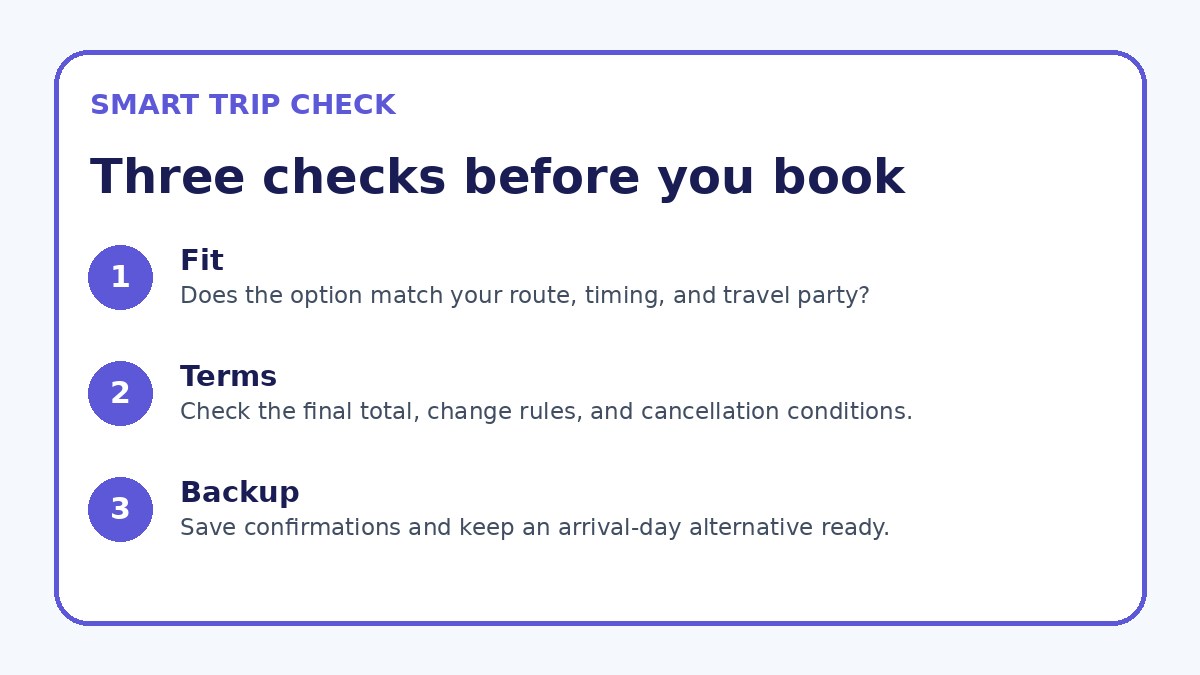
Recheck the complete itinerary
Confirm airports, connection handling, baggage, and change conditions before deciding.
Schedule fit: how much extra airport time to build in
At Los Angeles International Airport (LAX), extra luggage means extra time at every step—check-in, bag drop, security, and potentially oversize/baggage screening. For non-checked carriers and pre-tagged bags you can sometimes save time by using curbside or self-tagging options, but always confirm availability before departure. If you need special assistance, oversized bag handling, or last-minute baggage purchases at the airport, add additional buffer time. For nonstops, plan to arrive earlier than typical domestic guidance when you must pay or process multiple checked or oversized items.
For connecting itineraries, increase your minimum connection time compared to typical guidance: the extra time needed depends on whether connections require terminal changes, re-clearance through security, or collecting and re-checking bags. When building your itinerary, avoid connections with tight transfer windows if you have oversized or many bags; choose longer scheduled layovers or flights with the same carrier to minimize the time-sensitive risk. Before finalizing, enter your exact travel date and passenger details into the airline site or Trip.com to see carrier-specific recommended arrival times and baggage processing windows.
Flight details to verify
- Confirm exact travel dates, passenger names, and total checked bag count and weights before searching fares or contacting an airline.
- Compare full trip cost including checked-bag, oversize and overweight fees on the airline’s final booking page or Trip.com.
- Choose nonstop or single-carrier connections when possible to keep checked bags on one itinerary and reduce handling steps.
- Allocate extra arrival time at LAX: add at least 30–60 minutes to normal domestic guidance when dropping multiple or oversized bags.
- Pack essentials and one change of clothes in carry-on and add internal ID and itinerary copies inside each checked bag.
- If carrying sports or oversized gear, confirm special-item booking requirements and whether advance notice or separate payment is required.
Fare conditions: what to check on the booking page
When comparing fares, the headline ticket price is only part of the equation for travelers with extra luggage. Review the fare rules and baggage section on the carrier’s final booking page: confirm how many checked bags are included, weight and size limits, oversize and overweight charges, and whether fees are per segment or per itinerary. Also check whether the fare allows changes or cancellations with reasonable penalties in case you need to rebook to a later flight due to baggage handling or connection issues. If you buy through an OTA, verify the same baggage terms on the airline’s site before payment.
Also check any additional operational notes that affect baggage handling: whether the flight is codeshare and which carrier actually operates it, aircraft type for cargo capacity, and whether special items require advance notice or a separate reservation (for example surfboards or bicycles). For premium or flexible fares, baggage allowances may be more generous; weigh those extras against the higher fare. Always print or download the baggage policy details or take screenshots of the final booking page so you have the exact rules to reference at check-in and if any disputes arise.
Flight Guide questions travelers ask
How far in advance should I arrive at LAX if I have multiple checked bags for a Honolulu flight?
Arrival recommendations vary by airline and airport conditions; for multiple or oversized checked bags, add extra time beyond standard domestic guidance. A good rule is to arrive early enough to allow for check-in or curbside tagging, oversized-baggage handling, and security screening without rushing. Check the carrier’s advised arrival window on the final booking page and factor in traffic to LAX, parking or drop-off logistics, and any special handling counters you might need. If you must pay for extra bags at the counter, allow additional time to avoid cutting it close to boarding.
If I book a connecting itinerary, will my bags automatically be checked through to Honolulu?
Whether bags are checked through depends on whether the segments are on one ticket and the carriers’ interline agreements; it’s not automatic across separate bookings. When the itinerary is on a single ticket with one carrier or valid partners, carriers commonly check bags to the final destination. If you book separate tickets with different carriers, you may need to collect and re-check baggage at the transfer airport. Verify the baggage routing information shown at booking and confirm at check-in; if it’s unclear, ask the airline agent to confirm whether bags will be tagged through to Honolulu.
What is the best way to avoid oversized or overweight fees on a Los Angeles to Honolulu flight?
To avoid fees, first confirm each carrier’s specific size and weight limits on the final booking page and plan packing accordingly. Redistribute items to meet weight limits per bag, use lightweight luggage, and consider shipping bulky or heavy items via freight or postal services when practical. If bags slightly exceed limits, prepaying an extra baggage allowance online—when offered—can be cheaper than paying oversize fees at the counter. For items like surfboards or large equipment, check if advance reservations or special packaging rules apply to avoid costly surprises at check-in.
Final decision note
Traveling from Los Angeles to Honolulu with extra luggage requires planning choices: prioritize nonstop or single-carrier routes if minimizing baggage handling is crucial, or accept connecting routes if you need lower fares but are prepared to allocate more airport time. Always gather exact travel dates, passenger details, bag counts and weights before comparing fares so you can evaluate total trip cost and baggage conditions accurately. Verify baggage allowances, special-item rules, and connection handling on the airline’s final booking page and build extra cushion time at LAX for check-in and oversize processing. With deliberate packing, clear documentation, and the right flight strategy, you’ll reduce the chance of delays and make your Hawaii arrival smoother.
Continue planning
Check current options and final conditions
Use the provider page to confirm live availability, the final total, cancellation terms, and every condition that matters to your trip.
This evergreen planning guide was created with AI-assisted drafting and a structured quality review. It does not display live prices, schedules, availability, visa guidance, or provider rankings. Verify current details before booking. Some links are affiliate links; we may earn a commission at no additional cost to you.