For most first-time visitors to Los Angeles, the core question is practical: will a car improve your trip or add avoidable hassle? If your plan centers on stretching across the region—Santa Monica, Malibu, Pasadena, or a freeway-heavy road day—driving usually adds clear value. But if you’ll spend five days inside central neighborhoods like Downtown, Hollywood, West Hollywood and Venice, a car can become a liability: expensive parking, steep traffic, and time lost in congestion. This guide gives the direct answer up front: choose airport pickup when a multi-day driving itinerary outside the dense core is essential; choose city pickup when you need a car for a short day trip from a base with reliable parking. Read on for how to compare route value, understand insurance wording, pick the pickup and return setup with the least friction, and a clear non-driving fallback to keep your Los Angeles plans flexible.

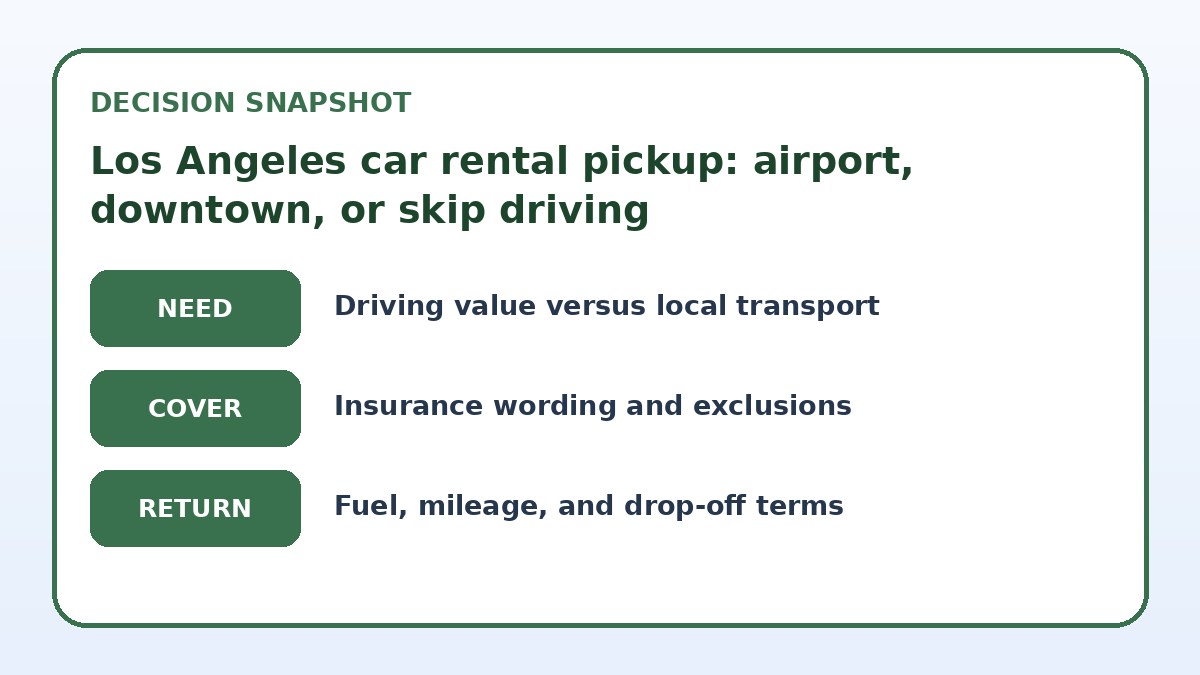
Route value: when driving truly improves your Los Angeles trip
Think of route value in terms of distance, schedule flexibility and destinations that are awkward to reach by transit. Driving clearly pays when your itinerary includes multiple sites spread across a long corridor—like a day that combines Malibu beaches with a late afternoon drive through Topanga and an evening in Santa Monica—or when you need to reach trailheads, wineries, or family suburbs outside rail and frequent bus service. On those days the car becomes a time-saving tool because it removes transfers and long waits.
Conversely, city-centered visits with compact neighborhood plans often lose route value. Traffic, limited parking near attractions, and paid garages can turn short hops into expensive and slow moves. Calculate expected daily driving hours: if most sightseeing days are under 30–45 minutes of driving total, the stress and cost of a rental may outweigh convenience. Use route value to decide whether pickup at arrival or a later city pickup better matches how much driving you’ll actually do.
Decide whether driving earns its place
| Mobility strategy | Best for | Cost or friction to check |
|---|---|---|
| Airport pickup (pick up on arrival at the airport) | Travelers with multi-day regional driving plans or arriving with heavy luggage who want to leave immediately. | Longer counters and possible airport fees, immediate exposure to highway traffic and parking costs at city destinations. |
| City pickup (rent from a downtown or neighborhood depot) | Visitors staying several days in one neighborhood who only need a car for a day trip or two. | Requires coordination with depot hours and local parking; may add a short rideshare or transit segment to access the depot. |
| Rideshare and taxis (no rental; use on-demand vehicles) | Short stays focused on central areas where parking is scarce and trips are single, point-to-point outings. | Costs can spike during peak demand and repeated rides add up; not ideal for multi-stop day trips or remote destinations. |
| Public transit plus occasional short-term rental or carshare | Guests who primarily use transit but want the option for one or two day trips without a multi-day rental. | Requires planning to sync transit schedules with short-term rentals; may be limited by service hours and availability. |
Check live rental choices only after the route test
Use the exact driver, dates, pickup point, and return plan to compare current conditions.
Insurance wording and coverage: the exact phrases to verify
Insurance documents are where small words make big differences. Focus on three phrases when you compare offers on the provider’s final booking page: whether a collision damage waiver (CDW) or loss damage waiver (LDW) is optional or included, the stated deductible amount, and explicit exclusions (for example, coverage for driving on dirt roads or unauthorized drivers). Also confirm the provider’s third-party liability limits and whether local mandatory insurance surcharges apply. If you plan to use a credit card for coverage, verify the card’s international rental terms and whether it requires the cardholder to be the primary renter.
Ask the rental company to clarify any ambiguous language before you finalize a booking. If the booking form includes optional 'insurance bundles' with vague promises, request precise deductible caps and what types of damage are excluded. Keep screenshots of coverage pages and the final rental agreement emailed to you. If you book through an aggregator like Trip.com, use their listing to identify options but always click through to the rental company’s final page to confirm exact wording and the cancellation policy.
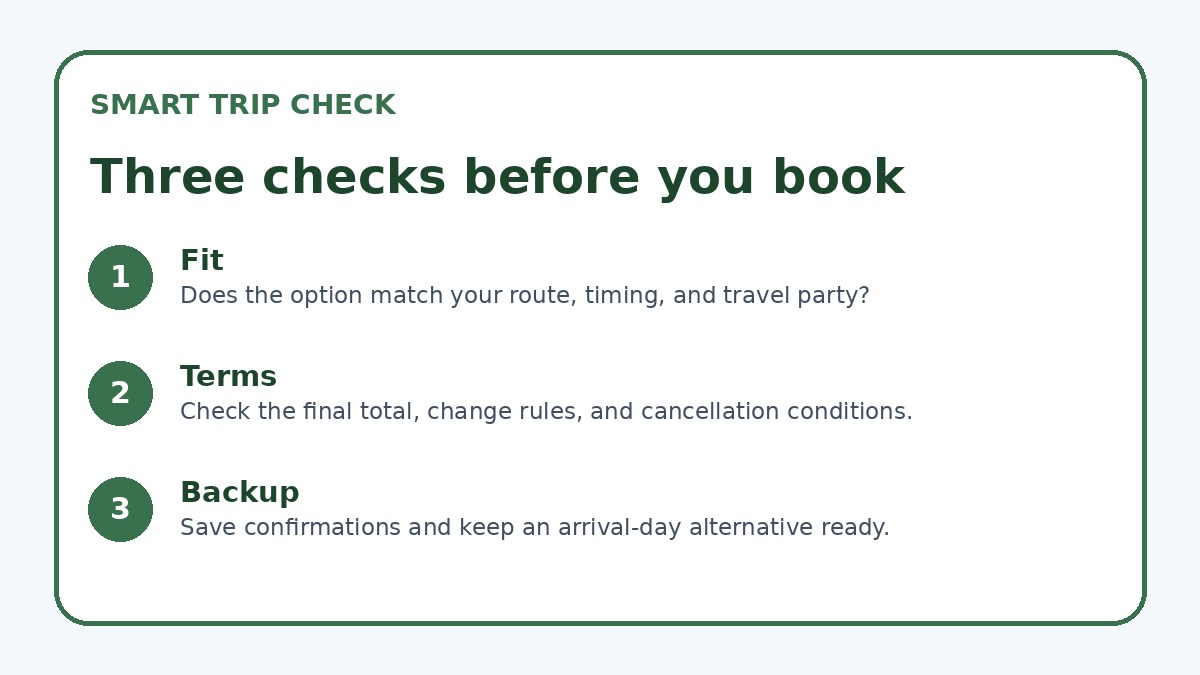
Compare the full rental conditions
Confirm insurance wording, exclusions, deposit, fuel, mileage, and return terms on the final page.
Pickup and return friction: airport logistics versus in-city convenience
Airport pickup often means longer initial waits but simpler logistics for return. At Los Angeles International Airport (or other regional airports), expect a shuttle or on-site terminal desk, luggage handling advantages, and the convenience of driving directly from arrival. However, airport pickups can include additional airport concession fees, longer queues at counters, and the need to navigate freeway exits immediately after arrival. If your arrival time is during peak traffic or late evening, factor in the first-mile stress of leaving the airport.
City pickup reduces initial friction if your lodging is nearby and offers parking; you can avoid airport lines and choose a vehicle that fits the neighborhood’s streets. Returns to a city location can be easier if you’re leaving from a hotel close to a depot or if you plan to fly out of a different airport. But city depots may have limited hours, stricter return windows, and can add the complexity of coordinating a one-way drop if you don’t return to the same neighborhood. Always confirm exact pickup and return addresses, depot hours, and any one-way fees on the booking page.
Car rental terms to verify
- Sketch your itinerary by day and mark each destination by drivability and parking ease to decide if a car is necessary.
- On the rental provider’s final booking page, verify CDW/LDW inclusion, deductible amounts, liability limits, and explicit exclusions.
- Confirm exact pickup and return addresses, depot hours, shuttle requirements, and any airport concession fees before booking.
- Compare one-way fees and whether returning at a different depot or airport is permitted and how it changes the total cost.
- Identify the nearest Metro station or major bus line and download relevant transit maps and a rideshare app as a non-driving fallback.
- Take screenshots or save PDFs of your rental contract and insurance confirmations; keep them accessible during pickup and return.
Non-driving fallback: practical alternatives when a car becomes a burden
A solid non-driving plan keeps your trip flexible. For most central LA neighborhoods, a mix of public transit (heavy rail lines and frequent buses), rideshares, and short-term car hires (hourly rentals and carsharing where available) handles short outings without long-term parking costs. Map the nearest Metro stations, major bus corridors, and common rideshare pickup points from your accommodation. Note times when service is frequent versus sparse—weekday midday and evenings differ from weekend schedules.
Also identify a short-term rental or carshare hub for an on-demand day trip: many services let you meet a car near a transit station for a single-day excursion without a multi-day rental. Keep rideshare apps installed, store a budget ceiling for expected surge pricing, and identify local taxi numbers as a backup. This fallback preserves mobility without committing to a full rental if unexpected delays, bad traffic, or parking constraints make driving unappealing.
Car Rental & Road Trip questions travelers ask
Should I use my personal auto insurance or buy the rental company’s coverage?
Check your personal auto policy wording and your credit card’s rental coverage terms on the rental company’s final booking page. Many personal policies provide liability and some collision coverage for rentals, but limits vary and some policies exclude rentals in certain states or vehicle types. Credit cards may offer secondary or primary coverage—confirm whether the card requires you to decline the rental company’s CDW/LDW and whether there are restrictions on vehicle class or duration. When in doubt, ask the rental agent to explain deductible amounts and exclusions before signing.
Is it cheaper to pick up a car in the city rather than the airport?
Cost differences depend on concession fees, local taxes, and one-way surcharges rather than a fixed rule. Airport locations sometimes add higher fees for terminal access or airport concession recovery, while city locations might charge less but add convenience or after-hours fees. Price also depends on inventory and demand on your travel dates. Use comparison tools or Trip.com to compare options, then click through to the provider’s booking page to confirm the exact fees and total cost for your specific pickup and return combination.
What parking rules and costs should I expect around popular LA neighborhoods?
Parking patterns vary widely: some neighborhoods have abundant street parking with time limits, others rely on paid lots or parking garages. Popular areas like Santa Monica and Venice have time-limited curb zones and metered parking, while downtown hotels and attractions often use private garages with daily rates. Verify parking at your accommodation before booking and ask whether the hotel offers guest parking or validation. For long stays, check if monthly or multi-day parking passes exist. Always verify exact rates and rules with your hotel or parking operator rather than assuming availability.
Final decision note
For first-time visitors, the right Los Angeles car rental pickup depends on how much of the region you truly plan to drive. Choose airport pickup if your itinerary includes several long drives, out-of-core destinations, or heavy luggage that makes immediate mobility valuable. Choose city pickup if you’ll base yourself in a neighborhood with parking and only need a car for one or two planned day trips. Always read insurance and fee wording on the rental company’s final booking page, confirm pickup and return logistics, and keep a non-driving fallback—transit, rideshare, or short-term carshare—ready. This approach keeps your trip flexible, reduces surprises, and ensures you only carry the costs and friction that your itinerary actually requires.
Continue planning
Check current options and final conditions
Use the provider page to confirm live availability, the final total, cancellation terms, and every condition that matters to your trip.
This evergreen planning guide was created with AI-assisted drafting and a structured quality review. It does not display live prices, schedules, availability, visa guidance, or provider rankings. Verify current details before booking. Some links are affiliate links; we may earn a commission at no additional cost to you.