
If your family can move dates by a few days, that flexibility quickly becomes your strongest tool when hunting Jeju travel deals. Start by widening your search window to include midweek and shoulder-season dates, then layer in preferences like school schedules, local events, and ferry or flight frequency. Practically, create a shortlist of acceptable arrival and departure dates, pick two or three lodging zones on the island you’d enjoy, and run parallel searches for flights and ferries across those windows. This gives you a clear sense of tradeoffs—earlier or later travel may shave time off your itinerary but save money, while switching islandside neighborhoods changes daily logistics more than cost. Below I explain how to compare options, what family priorities to weigh, and the exact checks to make on booking pages so you can decide without surprises.
See current options before you compare the details
Availability and final conditions change. Open Trip.com now or keep reading for the practical comparison.
Set clear family priorities before widening dates
Begin by listing what your family cannot compromise on: specific school or holiday dates, preferred sleep schedules for young children, stroller access, and any mobility needs. Note attractions that require timed entry, like museums or tours, and identify days they’re closed or unusually busy. With those constraints clear, decide how much extra transit you accept in exchange for savings—longer ferry rides, overnight stays, or early-morning flights. That decision determines how wide your date flexibility should be: families with infants may only shift by a day or two, while families with older kids might expand to an entire week of alternate dates to reduce costs.
Translate your priorities into a simple ranking: non-negotiables, nice-to-haves, and flexible elements. Use that ranking to filter date options quickly—if a midweek flight saves hours and you rank uninterrupted beach mornings above a shorter transit time, midweek becomes appealing. Consider the practical rhythm of a family holiday: minimize turnover days and maximize full activity days by choosing arrival times that let you settle in the same afternoon rather than arriving late at night. This approach keeps date flexibility pragmatic and focused on what matters to your household.
Compare travel modes and schedules with flexible windows
Jeju is reached by air and by ferry; each mode has different scheduling patterns and family considerations. When you run searches, compare direct and connecting flights, but also compare ferries from nearby ports if your family enjoys a scenic journey or needs to transport bulky gear. Use a multi-date search to reveal which days have more family seating availability or better schedules for nap and meal times. For flights, look at morning versus afternoon departures because consigning an infant to a later evening flight can upset sleep routines; for ferries, check departure and arrival times so you avoid long transfers at either port with tired kids.
Don’t assume the fastest option is best for the family. A slightly longer travel time that aligns with a child’s nap or avoids overnight travel may save stress and incidental costs like extra childcare or late-night taxi fares. When comparing routes, write down total door-to-door transit time and the number of transfers you’ll need. If a connection increases layover time or involves a separate terminal transfer, weigh that inconvenience against any fare savings. On each provider’s booking page, verify luggage allowances, seat selection policies, and the process for families traveling with car seats or strollers.
| Approach | Best for | Tradeoff to check |
|---|---|---|
| Shift by one weekday | Families with tight school constraints who can move just a little | Usually small savings and improved seat/room options, but limited choice compared with larger date changes |
| Move by 3–7 days (full-week window) | Families seeking better rates and wider lodging availability | May require juggling work or school plans and could misalign with specific events you want to attend |
| Change arrival time instead of dates | Families prioritizing daily rhythm and fewer exhausted travel days | Might not reduce cost much but improves comfort and arrival-day usability |
| Compare ferry versus flight across flexible dates | Families carrying bulky gear or preferring less airport hassle | Ferry can take longer and have fewer daily departures; check schedules and onboard facilities carefully |
Ready to check the option that fits your plan?
Use your exact dates and traveler details so the provider page can show the current total and conditions.
Use lodging flexibility to improve comfort and logistics
Lodging choices affect daily life more than small price differences. With flexible dates, you can time your stay to access preferred room types—family rooms, adjoining rooms, or apartments—since availability often opens or closes across a week. Search for properties in two or three areas (for example, beaches, Jeju City, and Seogwipo) because proximity to planned activities reduces taxi or bus time and costs. If you need kitchen facilities or laundry, factor those preferences into date choices: some family-friendly units are only available on certain check-in days due to turnover patterns.
When evaluating deals, compare total stay convenience: check-in and check-out times, whether early check-in is possible, and how far the property is from ferry or airport transfers. Flexible dates sometimes let you avoid a property’s peak check-in day, giving you first pick of room types and quieter floors. On the property’s booking page, confirm the exact sleeping arrangements, crib or rollaway availability, and any extra fees for additional guests. Those details are the ones that will change the family experience far more than a small nightly rate difference.
Before you book
- Create a three-date window for arrivals and departures and run parallel searches for flights, ferries, and hotels for each window.
- List non-negotiables (bed types, stroller access, meal needs) and verify them on the supplier’s booking page before booking.
- Compare total door-to-door travel time and number of transfers for each route option, not just headline duration.
- Capture screenshots of final prices and policies for each date option, then compare totals including all fees.
- Confirm seat selection and baggage rules for flights and ferries; contact the carrier if family seating is not clear.
- Check cancellation and change policies and choose at least one option with reasonable flexibility in case family plans shift.
Practical checks to do on booking pages before you commit
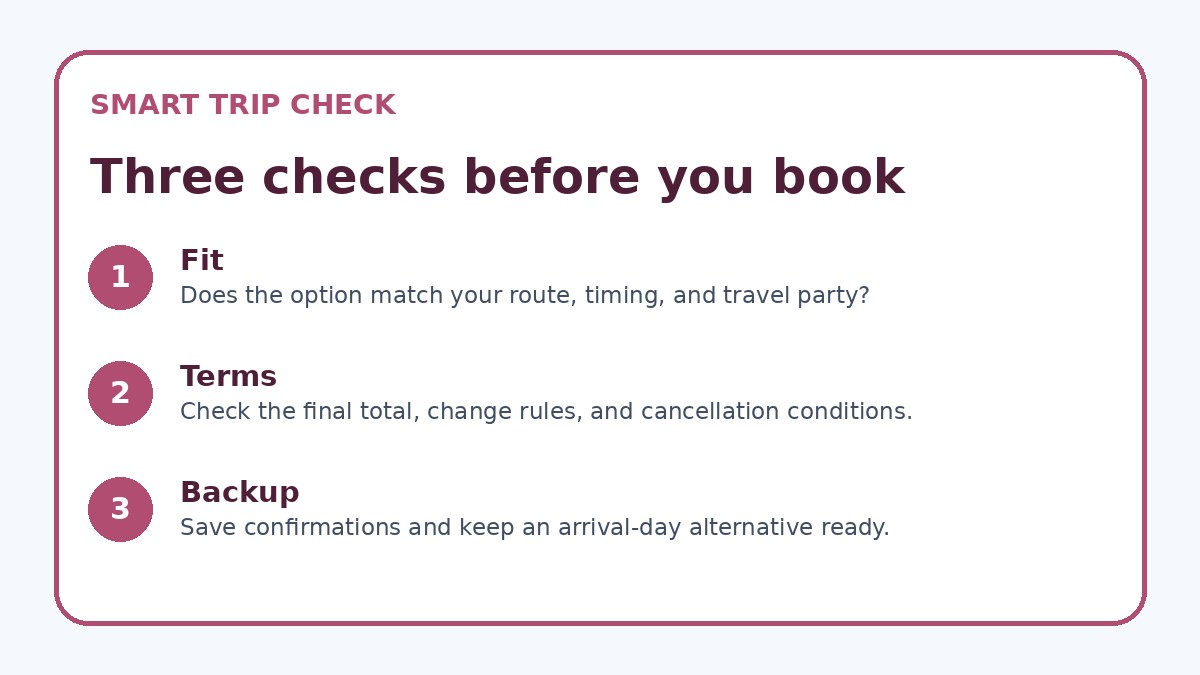
Always verify the final total price on the provider’s own booking page: that includes taxes, service fees, and any mandatory local charges. For transport bookings, confirm baggage rules, infant or child seat policies, and whether you can select seats together—these can change the suitability of a seemingly good fare. For accommodations, double-check room bedding layouts, whether a crib is complimentary or charged separately, and any deposit or cancellation rules that could affect a family if plans shift. If you used an aggregator, follow through to the operator or hotel page and read the policy language carefully.
If you’re comparing several dates, take screenshots or save links for each option so you can review differences side by side before booking. Note blackout dates, minimum-stay rules, and any required advance purchase or non-refundable terms. Trip.com can be a useful place to compare availability and conditions, but always verify the final terms and total price on the supplier’s page. Make a final checklist of what matters most to your children—sleeping arrangements, meal options, proximity to healthcare—and confirm those items directly with the supplier before paying.
Frequently asked questions
How much date flexibility do families typically need to find noticeably better Jeju travel deals?
Even shifting by a single weekday can expose better inventory for family rooms or contiguous seats, but larger windows of three to seven days often reveal more substantial options in both transport and lodging. The right window depends on your constraints: if you have infants or fixed school dates, a one- or two-day shift may be the realistic limit. If parents can afford remote work flexibility or children have open vacation weeks, expanding to a full week gives a much clearer picture of off-peak nights and midweek departures that suit family routines. Track several windows and compare practical comfort tradeoffs as well as price.
Should we prioritize cheaper travel or a more convenient schedule for young children?
Prioritize convenience when savings would cost you extra childcare, disrupted sleep, or long late-night transfers—those intangible costs add up quickly with young children. If a cheaper option means an overnight ferry transfer or a very early flight that forces an extra hotel night, factor those outcomes into the total. For older children, cost savings may be more valuable, so calibrate based on your family’s tolerance for disruption. Run both cost and time comparisons with your three-date windows and choose the option that best balances stress and budget for your household.
What exact things should I verify on a booking page before confirming a family-focused Jeju deal?
On any airline or ferry page check baggage allowances, infant/child fare rules, seat selection options, and whether family seating is guaranteed. For accommodations verify bed configuration, crib or rollaway availability, check-in/check-out times, and any extra guest charges. Also read cancellation and change policy details—note refundable versus non-refundable terms and whether credit or vouchers apply. If you used an aggregator, confirm the final total and policies on the supplier’s page. Finally, ask about transport between port, airport, and lodging if it’s not clearly described.
Final planning note
Using flexible dates is one of the simplest, most effective levers families have when planning a trip to Jeju. Start small—test shifting by a weekday—and expand to a longer window if your household schedule allows; pair that with lodging zone flexibility to reduce daily transit. Always verify the granular details that affect family comfort—seat assignments, bedding, baggage, and cancellation rules—on the provider’s booking page before paying. With a modest amount of upfront comparison across a few date windows you’ll find options that balance cost, convenience, and the calm holiday rhythm children need.
Continue planning
Check current options and final conditions
Use the provider page to confirm live availability, the final total, cancellation terms, and every condition that matters to your trip.
This evergreen planning guide was created with AI-assisted drafting and a structured quality review. It does not display live prices, schedules, availability, visa guidance, or provider rankings. Verify current details before booking. Some links are affiliate links; we may earn a commission at no additional cost to you.