
If you're traveling to Jeju with extra luggage, price alerts can save time—but only if you use them strategically rather than reactively. The practical approach: set alerts for multiple fare classes and nearby travel dates, track baggage allowance and change/cancellation policies for each alert, and combine alerts with a short decision checklist (baggage cost cap, acceptable connection windows, refund flexibility). When an alert reaches a target, pause and verify the final carrier or OTA baggage rules on the booking page before purchasing. That prevents impulse buys that look cheap until you add fees for overweight or oversized bags. This guide shows how to configure and use alerts, the decisions that should trigger booking, and simple tests to make sure the price actually works for travelers carrying extra luggage to Jeju.
See current options before you compare the details
Availability and final conditions change. Open Trip.com now or keep reading for the practical comparison.
How to set useful alerts for Jeju travel deals
Start by choosing tools that let you set multiple, specific alerts: different departure dates, fare types (basic economy vs standard), and routes (direct vs connecting). For travelers with extra luggage, an alert for the headline fare isn’t enough: also set alerts for the same flight if it’s sold with a checked-bag allowance or if the airline offers a bundled fare. Many search services and OTAs allow you to track a fare or a particular seat class—use that to watch the fare class you’d actually book once luggage costs are considered.
Create a parallel set of alerts for alternative arrival ports or slightly different travel windows—early morning vs evening flights, or a day earlier/later—because luggage fees and availability can vary across the same week. Keep alerts organized by naming them (for example, “Jeju—2 bags—direct”) so you can quickly scan which triggered alert matches your baggage needs. Finally, set a realistic target alert threshold that includes an estimated baggage charge; this prevents a low headline fare from tripping you into an impulsive purchase that becomes expensive once baggage is added.
Verifying baggage rules and true cost before you buy
When an alert notifies you of a promising fare, do not complete the purchase immediately. Instead, open the airline or OTA booking page and confirm three things: the fare class code or bundle, the included baggage allowance (weight and piece limits), and how much additional or overweight baggage costs. Airlines sometimes display per-bag fees in the final booking flow only, and OTAs may present different baggage rules—so you must verify on the provider’s final booking page. If you plan on oversized items (surfboards, ski equipment, large suitcases), check whether those count as checked baggage, require special handling, or need advance notice.
Also check refund and change policies and whether the fare can be upgraded to include baggage after purchase without a big penalty. For travelers with extra luggage, a slightly higher flexible fare that includes at least one checked bag can be cheaper overall than a lower non‑refundable fare plus add-on baggage and change fees. If mileage redemption or loyalty benefits matter, verify whether the fare earns points and whether elite status affords free checked bags—those factors can change the effective cost of the alert you received.
| Approach | Best for | Tradeoff to check |
|---|---|---|
| Wait for the headline fare alert and add bags later | Travelers willing to risk variable baggage costs to chase lowest base fares | Headline fare may be cheap but final cost can rise significantly after per-bag fees and seat selection |
| Track bundled fares that include one checked bag | Travelers with at least one checked bag who want predictable total cost | Higher upfront fare but fewer surprises; may still need extra bag fees for more luggage |
| Set alerts for multiple dates and nearby airports | Flexible travelers who can shift travel times to reduce baggage or connection risk | Requires more monitoring and comparison; might complicate logistics such as transfers or accommodation |
| Book only after calling the airline to confirm oversized/fragile item rules | Travelers carrying unusual or oversized equipment who need certainty | Takes extra time and effort; phone confirmations should still be verified on the official booking page |
Ready to check the option that fits your plan?
Use your exact dates and traveler details so the provider page can show the current total and conditions.
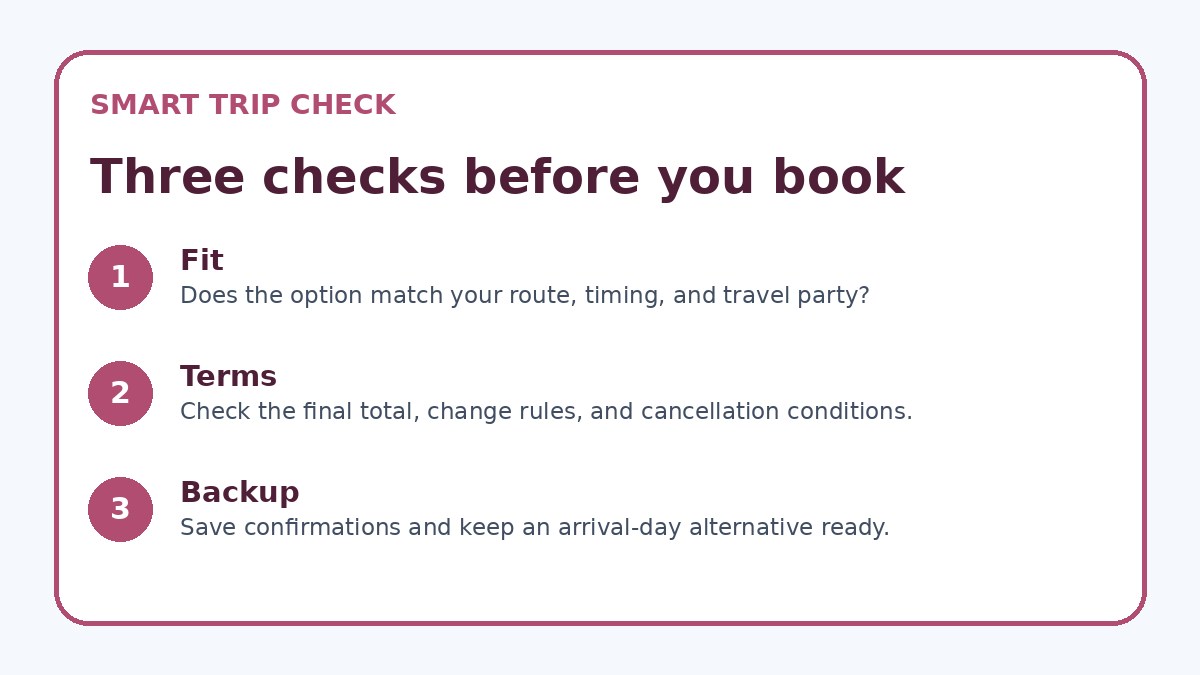
Avoiding impulse buys: decision criteria for passengers with extra bags
Create a short decision rule set you use every time an alert triggers. Examples: (1) If the fare plus two checked bags is within my budget cap, book; (2) If the fare requires adding more than one extra-fee bag and the total exceeds the cost of next-higher bundled fare, choose the bundled fare instead; (3) If the itinerary includes a tight connection that risks baggage misconnect, avoid booking unless there’s buffer time. Put these rules in a note on your phone so you can consult them under the impulse of a sudden good-looking alert.
Time-based pauses help. If an alert looks good but you’re unsure, give yourself a set cooling-off window—an hour for simple domestic trips, up to 24 hours for complex itineraries or group bookings. Use that pause to run quick comparisons: open the airline’s official site, check an OTA like Trip.com for current availability and baggage displays, and if needed call the airline to confirm oversized-baggage policies. The goal is to replace gut reactions with fast verification steps that directly address luggage-related costs and risks.
Before you book
- Name and save each price alert with baggage notes (e.g., “Jeju—2 checked—direct”) so alerts match your luggage needs.
- When alerted, open the airline’s final booking page and confirm fare code, included baggage allowance, and per-bag fees before checkout.
- Calculate total trip cost by adding airfare, checked-bag fees for the number of bags you’ll carry, and any needed oversized-item charges.
- Compare the alerted fare to the next bundled fare that includes baggage to see if the bundled option is cheaper overall.
- If carrying oversized equipment, call the airline to confirm handling requirements and note the representative’s name or reference number.
- Take screenshots of the booking page that shows baggage inclusion and fare rules; save confirmation emails and policy links for reference.
Practical booking strategies once you decide to buy
If you decide to purchase, prefer booking channels where baggage rules and costs are transparent and change policies are clear. An airline’s official site often shows exact baggage allowances for the fare you’re buying and is usually the simplest place to manage add-ons later. If you use an OTA, verify the final cart on the OTA’s booking page and then cross-check on the airline’s site—confirm the fare code and baggage terms there. Keep screenshots or saved confirmations that show included baggage in case a discrepancy arises later.
Consider buying bundled fares or adding baggage at the time of booking to lock in the lower online add-on price many carriers offer. For valuables or fragile oversized items, look at shipping alternatives or specialized carriers—sometimes shipping items ahead can be cheaper and less risky with very heavy or awkwardly sized luggage. Finally, save contact numbers and a copy of the airline’s baggage policy link in your travel folder; if baggage rules change between alert and departure, you’ll have the exact references needed to seek clarification or file a claim.
Frequently asked questions
Do price alerts show baggage fees or just the base fare?
Many price-alert tools track headline fares only and may not include baggage fees in their notifications. Some services allow you to set alerts for specific fare classes or bundles that include a checked bag; use that feature where available. Always click through an alert to the airline or OTA booking page and confirm the fare code and the baggage allowance listed there. If the alert came from an OTA, verify the identical fare and baggage terms on the airline’s official site before booking.
If I see a low fare to Jeju but need two checked bags, how should I compare options?
Don’t compare headline prices alone—add the known per-bag fees to calculate the all-in ticket cost. Next, find the bundled or higher fare that includes one or two checked bags and compare that total. Factor in change and cancellation flexibility, and whether a direct flight reduces the chance of baggage misconnect. For tight connections consider the risk of lost or delayed baggage; a slightly higher direct or bundled fare may save time and stress when carrying more luggage.
Can I trust OTA alert details, or should I always confirm with the airline?
OTAs are useful for scanning options but their baggage displays and fare rules can differ from the airline’s final booking page. Treat OTA alerts as a starting point: when an alert looks good, verify the fare code and baggage policy on the airline’s official site or the OTA’s final checkout page. If anything about oversized items or special handling is involved, call the airline to confirm. Trip.com can be used as one comparison point, but always confirm final baggage rules and booking conditions on the carrier’s page before paying.
Final planning note
Price alerts are powerful for hunting Jeju travel deals, but for travelers carrying extra luggage they must be used with discipline. Set multiple, clearly labeled alerts that reflect the fare classes and baggage options you would actually book. When an alert fires, pause long enough to verify the fare code, baggage allowance, and additional fees on the provider’s final booking page—this step prevents impulse buys that add hidden costs. Use simple decision rules and a short checklist so you can act quickly but deliberately. With a small amount of verification and a booking strategy that prioritizes total cost over headline price, you’ll find Jeju options that match both your schedule and your luggage needs.
Continue planning
Check current options and final conditions
Use the provider page to confirm live availability, the final total, cancellation terms, and every condition that matters to your trip.
This evergreen planning guide was created with AI-assisted drafting and a structured quality review. It does not display live prices, schedules, availability, visa guidance, or provider rankings. Verify current details before booking. Some links are affiliate links; we may earn a commission at no additional cost to you.