If you’re booking Sydney to Melbourne flights and expect to travel with extra luggage, the single most useful step is to build a tight pre-booking checklist that focuses on baggage rules, total trip cost, and door-to-door logistics. Start by comparing each fare’s included allowance and the carrier’s fees for checked and oversize bags. Factor in how many transfers are involved and whether a connecting carrier will impose different restrictions. Consider airport access, how you’ll move heavy bags to and from terminals, and whether a changed schedule could force rebooking or higher fees. Use the checklist below to turn nebulous worries into specific items to verify on airline booking pages and your final itinerary.
See current options before you compare the details
Availability and final conditions change. Open Trip.com now or keep reading for the practical comparison.
Establish what “extra luggage” means for your trip
Start by listing every item you expect to take beyond a typical carry-on: additional checked suitcases, overweight pieces, musical instruments, surfboards, or bulky equipment. For each item note approximate weight and dimensions. This inventory turns vague concerns into concrete questions you can ask the airline when comparing fares. Different carriers treat the same item differently—one may include a second checked bag while another charges, or one may accept a surfboard as checked luggage only if packaged in a soft bag. Clarity now prevents surprises at check-in.
Once you have that inventory, map each item to likely fee categories: included checked pieces, paid extra piece, overweight surcharge, oversize surcharge, or special-handling fee. Also consider whether items exceed carry-on limits and would force you to check them even on a short flight. That affects arrival times because checked baggage adds collection time and can complicate tight connections. With this grounded definition of ‘extra,’ you can use consistent criteria when comparing Sydney to Melbourne flights.
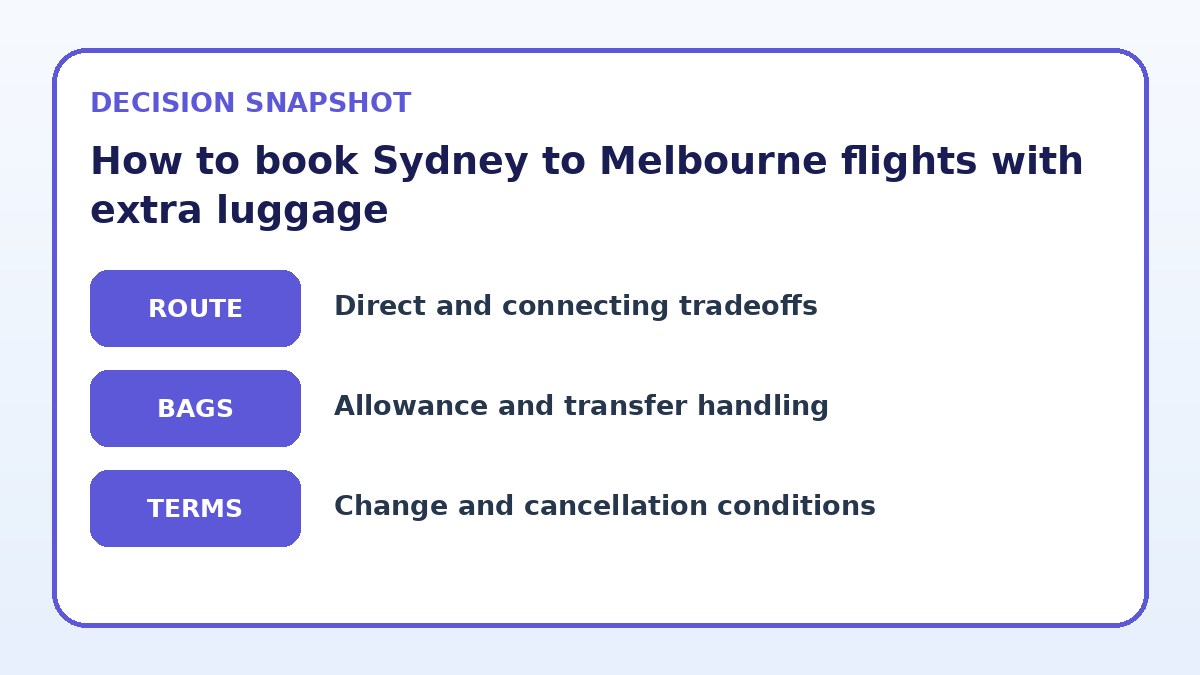
Compare fares by total baggage cost, not headline price
Airfare headlines often hide the real cost when baggage charges are extra. To compare effectively, add up the total expected baggage cost for each fare option: included allowance, the fee for the second piece, overweight fees for anticipated weights, and any special handling charges. Don’t forget fees for pre-paid vs. airport-paid baggage; many airlines charge less if you add baggage during online booking. Calculate the total and treat that as the effective fare to make an apples-to-apples comparison.
Also check whether the fare rules allow you to add baggage to a connecting carrier under the same booking. If you book a mixed-carrier itinerary, each segment’s carrier may enforce its own limits and surcharges. For itineraries with connections, verify on the booking confirmation which carrier’s baggage policy applies and whether online systems let you pre-pay the exact fees you’ll face at check-in. Where the booking page does not state this clearly, contact the airline or verify with the final ticketing carrier before purchasing.
| Approach | Best for | Tradeoff to check |
|---|---|---|
| Lowest headline fare plus pay-as-you-go baggage | Travelers prioritising upfront ticket cost over convenience | Can become expensive once multiple or overweight bags are added and adds uncertainty at check-in. |
| Higher fare with generous included baggage | Those with multiple checked pieces who want predictable costs | Higher upfront ticket cost may not make sense if you end up travelling lighter. |
| Buy baggage allowance online when booking | People who know their exact baggage needs and want lower pre-payment rates | Requires accurate planning; changing allowances later can incur extra fees. |
| Pay baggage fees at the airport | Flexible travellers unsure of final packing choices | Often the most expensive and creates delays at check-in if queues form. |
Ready to check the option that fits your plan?
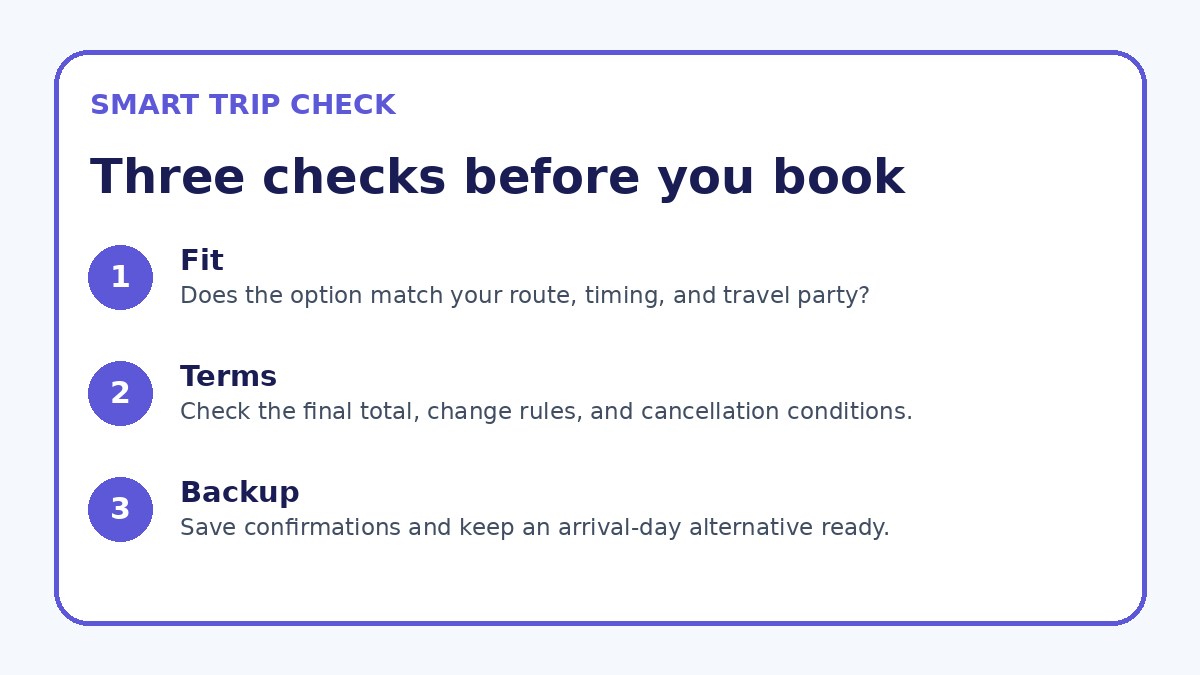
Use your exact dates and traveler details so the provider page can show the current total and conditions.
Plan for airport logistics and ground transport with heavy bags
Sydney and Melbourne airports have different terminal layouts and ground transport options that matter when you have extra bags. Think through how you will travel between your home and the departure terminal with heavy items—car, rideshare, taxi, or public transport—and whether those options can accommodate oversized luggage. Confirm pickup/dropoff points and whether a long walk, escalators, or stairs are involved. At arrival, consider where luggage reclaim is located relative to onward transport. These practical details can add time and cost if you haven’t pre-planned.
If your trip includes a connecting airport or a transfer between terminals, allow generous transfer margins to collect and re-check bags when needed. For connections in a single booking, verify whether checked bags are through-checked to your final destination; if not, you will need to retrieve and re-check them, which changes connection minimums. Where possible, choose flights that use the same airline alliance or single operator to simplify baggage handling, but verify that simplification on the booking page, because alliances and marketing arrangements can vary.
Before you book
- Inventory every item you’ll bring (weight and dimensions) and mark which qualify as carry-on, checked, oversize, or specialty equipment.
- On each airline’s booking page, verify the exact baggage allowance and all relevant surcharges for the selected fare class before confirming purchase.
- For itineraries with connections, confirm whether checked luggage is through-checked to Melbourne or must be reclaimed and rechecked.
- Calculate the total door-to-door time and transfer needs, allowing extra margin for baggage collection and possible overweight handling.
- Decide whether to add baggage online at booking (often cheaper) and confirm how to change or prepay baggage on the final ticketing page.
- Check what your travel insurance or credit card covers for delayed, lost, or damaged baggage and store claim procedures and contact numbers.
Decide on protections and services to reduce baggage risk
Assess whether to buy extra protections: checked-bag insurance, premium fare options with higher allowances, or add-ons such as priority baggage handling. If you have fragile or valuable equipment, consider packing options and dedicated cases designed for air travel, and compare whether the airline requires special acceptance procedures. Some protections reduce stress by prioritising your baggage on arrival, but they add cost. Balance the monetary cost against the time and emotional cost of delayed or damaged luggage on your plans in Melbourne.
Finally, verify what the airline’s booking page states about liability limits, delay compensation, and lost-bag processes. These rules can differ between domestic carriers even within Australia. Also check whether your travel insurance or a credit card gives supplemental baggage coverage, and what documentation you would need in the event of loss or damage. Knowing exactly what to expect and which numbers to call will speed resolution if an issue arises and is as important as any purchased add-on.
Frequently asked questions
Can I pre-pay for extra checked bags when booking Sydney to Melbourne flights?
Most airlines let you add and pre-pay for checked bags during the online booking process or in the manage-booking section; pre-paying is often cheaper than paying at the airport. However, policies and prices vary by carrier and fare class. Before you complete payment, check the airline’s final booking page to confirm the exact fee, the weight and size limits included with the purchase, and whether fees differ for changes later. If the itinerary uses multiple carriers, verify each carrier’s rules and whether a single pre-payment will cover all segments.
How should I factor oversized or sporting equipment into my booking?
Treat oversized or sporting equipment as special items: they frequently have separate size limits, packaging requirements, and handling fees. On the airline’s booking or baggage policy page find the acceptance guidelines—how items must be packaged, whether advance notice is required, and what surcharges apply. If the item is critical to your trip, consider calling the airline to get a written confirmation on acceptance and fees. Also plan for ground transport that accommodates the item and allow extra time at check-in for special handling.
Is it better to choose a single carrier or a mixed-carrier itinerary with extra luggage?
A single carrier or alliance partner usually simplifies baggage handling because checked luggage is more likely to be through-checked and subject to one consistent policy. Mixed-carrier itineraries can introduce differing allowances and fees for each segment, which complicates pre-booking calculations and increases the risk of extra charges. Before booking, review the booking confirmation to see which carrier is responsible for each segment and verify the baggage policy that will apply. When in doubt, contact the ticketing carrier to confirm handling for checked and oversized items.
Final planning note
Building a practical pre-booking checklist for Sydney to Melbourne flights turns a potentially stressful packing decision into a set of verifiable steps. Start by inventorying what you’ll carry and mapping each item to baggage categories. Compare fares on the basis of total baggage cost and confirm rules on the airline’s booking page—especially for mixed-carrier itineraries and special items. Plan ground logistics, allow extra time for transfers and baggage collection, and consider protections such as prepaid baggage or insurance if the value or fragility of your items warrants it. Verify every charge and policy on the carrier’s final booking or manage-booking page before you pay to avoid surprises at the airport.
Continue planning
Check current options and final conditions
Use the provider page to confirm live availability, the final total, cancellation terms, and every condition that matters to your trip.
This evergreen planning guide was created with AI-assisted drafting and a structured quality review. It does not display live prices, schedules, availability, visa guidance, or provider rankings. Verify current details before booking. Some links are affiliate links; we may earn a commission at no additional cost to you.