If you’re renting a car in Hong Kong for work, the quickest way to avoid an annoying final bill is to check the fuel and mileage rules before you hit ‘confirm’. Many corporate trips are short and tight on scheduling, so small differences in how companies handle fuel levels, refueling charges, and distance allowances can add up quickly. Start by identifying whether the rental uses a full-to-full, full-to-empty, or prepaid fuel option, and whether the quoted rate includes any daily mileage or imposes excess-kilometre fees. Also confirm whether distance is tracked per calendar day, per 24-hour rental block, or per contract period — that affects overage calculations for meetings that run late. This article focuses on the decision points business travelers need to compare and the exact provider details to verify on the booking page.
See current options before you compare the details
Availability and final conditions change. Open Trip.com now or keep reading for the practical comparison.
Understand common fuel policies and their tradeoffs
Rental companies in Hong Kong typically use one of three fuel models: full-to-full, prepaid (fuel purchase), or full-to-empty (return as charged). Full-to-full is straightforward: you pick up the car full and are expected to return it with the same level; the company checks fuel on return and only charges for what’s missing. Prepaid fuel lets you pay for a tank up front and return the car empty, which can be convenient if you prefer to skip a fuel stop but often costs more per litre than local petrol stations. Full-to-empty tends to be the least transparent because providers estimate consumption at return and may apply a higher refuelling rate plus administrative fees.
For business travelers weighing convenience against cost, the right choice depends on schedule and access to petrol stations during your trip. If you have uninterrupted ground time and a chance to refuel near your destination or before returning the car, full-to-full usually minimizes cost and surprise fees. If your itinerary is tight, with early departures or late returns where stations may be closed, prepaid fuel removes uncertainty but can be more expensive. Always compare the provider’s described per-litre refuelling rate, any flat administrative fuel charges, and whether fuel checks accept photographic evidence (useful if there’s a dispute).
Mileage allowances: how to compare limits and overage rules
Mileage rules vary by vehicle class and booking type. Some corporate or long-term rates include unlimited kilometres; many standard short-term rentals set a daily allowance (for example, a fixed number of kilometres per 24-hour rental) with per-kilometre charges for overage. The important detail is how the provider defines the allowance period: is it per calendar day, per 24-hour rental block, or per contract period? A meeting that runs late or a multi-day trip with evening work can trigger additional full-day charges instead of a small overage fee if the rental clock resets on strict 24-hour intervals.
When comparing offers, calculate plausible kilometres for your planned routes, including pickups, airport transfers, client sites, and any contingency driving. Multiply planned daily distance by the number of rental days and compare to the total allowed by the provider. If your estimate comes close to the included allowance, factor in a buffer for detours or extra errands and prefer a rental with a higher included limit or an explicitly low per-kilometre overage rate. If the booking page mentions tiers (e.g., first 100 km/day included, then charged by the km), note the exact thresholds and the rounding rules for partial kilometres.
| Approach | Best for | Tradeoff to check |
|---|---|---|
| Full-to-full fuel policy | Travelers with time for a quick refuel before drop-off | Requires making a fuel stop but typically avoids inflated refuelling fees |
| Prepaid fuel option | Tight schedules or late returns when stations may be closed | Convenient but often costs more than local pump prices and may not be refundable |
| Limited daily mileage with low base rate | Predictable short-distance corporate itineraries | Risk of excess-kilometre fees if meetings add unexpected driving |
| Higher-rate unlimited mileage | Multi-stop or uncertain-distance business trips | Higher upfront cost but avoids per-kilometre admin and overage charges |
Ready to check the option that fits your plan?
Use your exact dates and traveler details so the provider page can show the current total and conditions.
Billing details and what to verify on the final booking page
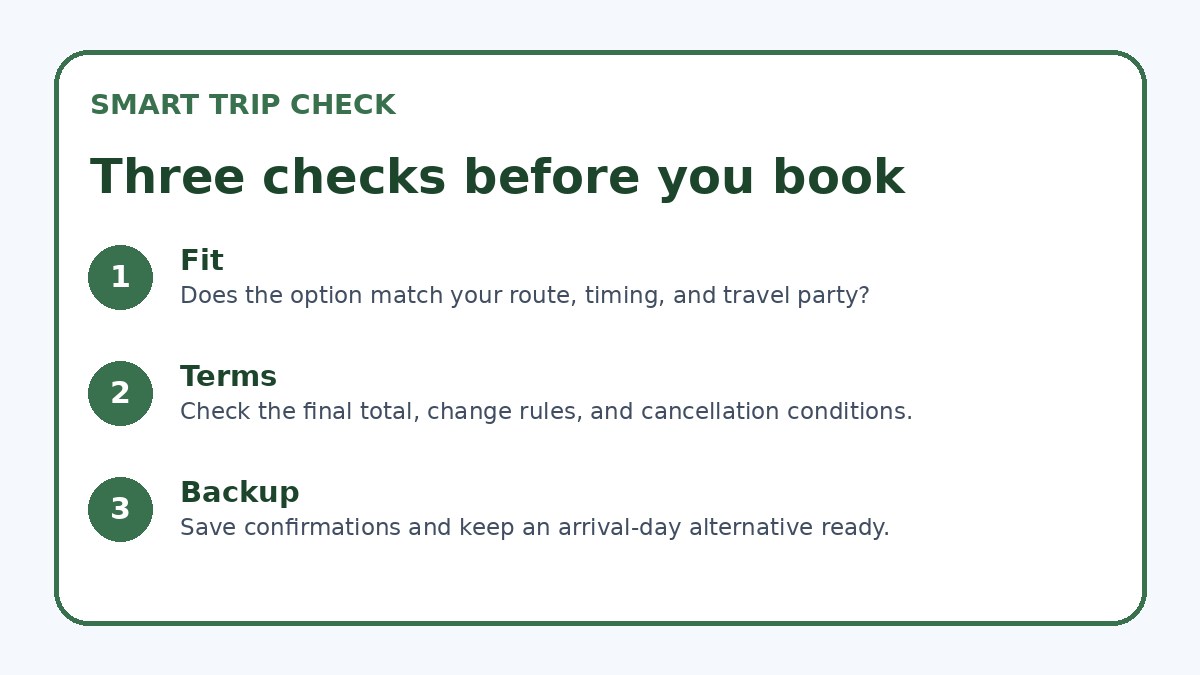
Because supplier policies can change, always verify three things on the provider’s final booking page before you confirm: (1) the stated fuel policy and any per-litre or flat service rates for refuelling, (2) the mileage allowance and precise overage charge, and (3) the billing rules for late returns, extra drivers, tolls, and fines. For each item, read the full terms rather than relying on short summary lines—some pages show a headline policy while the detailed terms list exclusions or administrative fees that matter. If you need corporate invoicing, confirm how charges are presented on the invoice and whether fuel or tolls appear as separate line items for accounting.
During pickup, inspect and photograph the fuel gauge and odometer with timestamps or the rental company’s check-in record; this documentation protects you from disputed return readings. If you plan to add an authorized driver or request after-hours drop-off, check whether these choices incur extra daily charges or different mileage calculations. When anything is ambiguous, call the provider’s reservation or corporate desk and ask for clarification in writing (email or booking notes) so there’s a record that can be attached to expense reports or used in disputes.
Before you book
- Confirm the exact fuel policy wording on the final booking page and note any per-litre or administrative refuelling rates.
- Calculate estimated total kilometres for your itinerary and compare to the included allowance and overage rate.
- Photograph the fuel gauge and odometer at pickup and have the agent sign or timestamp the condition report.
- Ask whether tolls, parking fines, and charges for congestion zones will be billed separately or included on the invoice.
- Check the provider’s policy for late returns, extra drivers, and after-hours drop-offs for any additional daily charges.
- Request written confirmation of any corporate or negotiated terms on the reservation if your company has preferred rates.
Decision criteria for busy business travelers
Prioritize clarity over a slightly lower headline rate: a low daily price is only a saving if the fuel and mileage rules don’t produce a larger outlay later. If your itinerary is predictable and allows refuelling at convenient times, choose full-to-full and keep fuel receipts for expense claims. If you value time and want to avoid stopping, a prepaid fuel option can be worthwhile—just remember to compare the provider’s prepaid rate with local station prices, and verify whether unused prepaid fuel is refundable or forfeited.
For multi-stop or multi-day work trips with uncertain distances, prefer rentals that include a generous mileage allowance or offer reasonable flat-rate unlimited options. Also weigh the administrative burden: if filing an expense for a small overage is acceptable to your company, you may optimize for the lowest base rate and accept modest per-kilometre charges. Finally, coordinate with your company’s travel or procurement team: they may have negotiated corporate terms that change fuel and mileage tradeoffs, or require specific documentation at pickup for seamless reconciliation.
Frequently asked questions
Should my company prefer prepaid fuel or full-to-full for short Hong Kong business trips?
For short trips where drivers can easily access petrol stations, full-to-full typically saves money because you only pay for the fuel used. Prepaid fuel suits itineraries with tight timelines, early-morning pickups, or late returns when filling stations might be inconvenient. Ask the provider whether prepaid fuel refunds unused fuel and compare the prepaid per-litre equivalent to local station prices. Your company’s travel policy may also favor one option for ease of expense reconciliation—verify that choice with procurement before booking.
How do I estimate whether a mileage limit will be sufficient for a multi-meeting day in Hong Kong?
List each planned trip leg: airport to hotel, hotel to client sites, and any transfers between meetings, then add a buffer for detours or traffic diversions. Use realistic city distances rather than straight-line estimates because urban routing and one-way streets can add kilometres. Multiply the daily total by the number of rental days and compare to the overall allowance. If your estimated total approaches the allowance, prefer a plan with higher included kilometres or confirm the per-kilometre overage fee so you can assess the likely extra cost.
What evidence should I collect at pickup to avoid disputes over fuel or mileage?
Take clear photographs of the dashboard showing the fuel gauge and odometer with a timestamp or the agent’s check-in receipt. Ask the agent to initial or sign the condition report and ensure any noted fuel level is written into the check-out paperwork. Keep all fuel receipts and toll tags used during the rental, and if possible, keep an in-car GPS or app log of major trip legs. This documentation supports expense claims and protects you from disputed charges when the vehicle is returned.
Final planning note
When renting a car in Hong Kong for business, the practical decision comes down to three linked questions: what fuel policy fits your schedule, how much mileage you will actually use, and how clearly the provider documents billing rules. Prioritize transparent policies and exact wording on the booking page over small headline savings. Prepare by estimating kilometres, checking prepaid versus full-to-full costs, photographing pickup readings, and confirming invoicing details for tolls and fines. Finally, coordinate with your company travel policy or procurement team so that reimbursement or corporate billing matches the chosen fuel and mileage approach—this reduces disputes and keeps your focus on the trip’s work objectives.
Continue planning
Check current options and final conditions
Use the provider page to confirm live availability, the final total, cancellation terms, and every condition that matters to your trip.
This evergreen planning guide was created with AI-assisted drafting and a structured quality review. It does not display live prices, schedules, availability, visa guidance, or provider rankings. Verify current details before booking. Some links are affiliate links; we may earn a commission at no additional cost to you.