If you’re planning to explore Tuscany from Florence, deciding whether to rent a car hinges less on romance and more on pickup and return logistics. Solo travelers often underestimate the time and paperwork around collecting and returning a rental in a compact historic city: limited downtown parking, low-emission zones (ZTL), and strict company check-in windows can turn a 30-minute handover into an hour-plus chore. The practical answer: rent a car if your itinerary needs flexible day trips outside Florence (hill towns, vineyards, Val d’Orcia) and you’re comfortable handling pickup/return friction and insurance choices. If most of your stay focuses on Florence’s centro storico, walking, bikes, taxis and regional trains are often faster and less stressful. Below you’ll find how to evaluate route value, read insurance wording, anticipate pickup/return friction, and a concrete non-driving fallback for solo travelers.
Route value: when Florence driving actually improves your trip
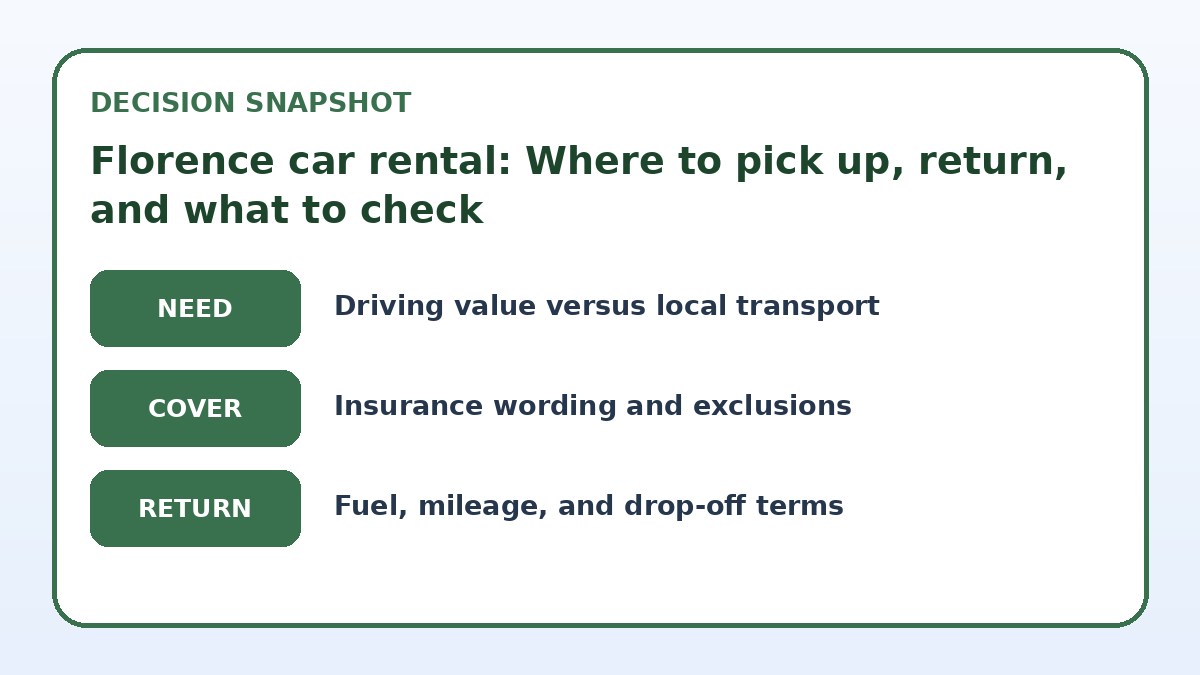
Ask whether a car unlocks places you can’t reach comfortably by public transport. If your solo trip includes overnight stays in rural towns, early-morning vineyard visits, or flexible photographic stops along secondary roads, driving in and out of Florence can save hours. For single-day itineraries to San Gimignano, Chianti hamlets or Lucca with varied stops, the door-to-door freedom can justify the pickup and return bother. Also factor time of year: shoulder seasons give quieter roads and easier parking, increasing the value of having a car.
Contrast that with a Florence-focused plan. If you’ll be based in the centro storico, most attractions are pedestrianized and better reached on foot or by short rides. Heavy traffic, restricted zones (ZTL areas where unauthorized cars are fined), and high central parking costs reduce convenience. For mixed itineraries, consider collecting the car on your last day in Florence or at a regional airport or train-adjacent rental office to avoid central-zone pickups and their parking headaches.
Decide whether driving earns its place
| Mobility strategy | Best for | Cost or friction to check |
|---|---|---|
| Rent a car from Florence city depot | Solo travelers needing short-term flexibility around the city and nearby towns. | Higher pickup friction, ZTL exposure, and city parking costs versus convenience. |
| Rent at Florence airport or nearby hub | Those who prefer a clear counter, longer hours, and straightforward returns for onward flights. | Possible airport surcharges and shuttle wait times; good for timed returns but adds travel to/from center. |
| Public transport and occasional taxis | Travelers staying in central Florence who prefer no paperwork and stress-free navigation. | Less flexibility for remote day trips; scheduling constraints and possible need for organized tours. |
| Hybrid: trains plus one-day car rental | Solo travelers who want car freedom only for a single or limited-day excursion. | Requires careful pickup/return timing and may incur day-rental surcharges, but minimizes driving days. |
Check live rental choices only after the route test
Use the exact driver, dates, pickup point, and return plan to compare current conditions.
Insurance wording: what to read on the booking page
Insurance language on rental pages is where hidden costs hide. Focus on these terms: collision damage waiver (CDW) and its excess or deductible, theft protection and whether it covers keys and accessories, and third-party liability limits. Look for explicit statements about roadside assistance — check if it covers towing, flat tires, and battery jump-starts, and whether 24/7 assistance is included or sold separately. When insurers quote a reduced excess with an extra daily charge, calculate whether the incremental daily fee multiplied by your rental days is cheaper than purchasing separate excess-cover insurance from a third-party provider.
Also verify driver age restrictions and license acceptance phrasing: some pages list an age range or extra fee for young drivers; others require an International Driving Permit (IDP) or original physical license. For solo travelers, declarations about additional drivers matter less unless you plan to share driving. Finally, note precise exclusion clauses: off-road use, driving on unpaved rural tracks, and driving in restricted municipal zones are common exclusions and can void cover after an accident. On the final booking page, confirm exact deductible amounts and which incidents are excluded.
Compare the full rental conditions
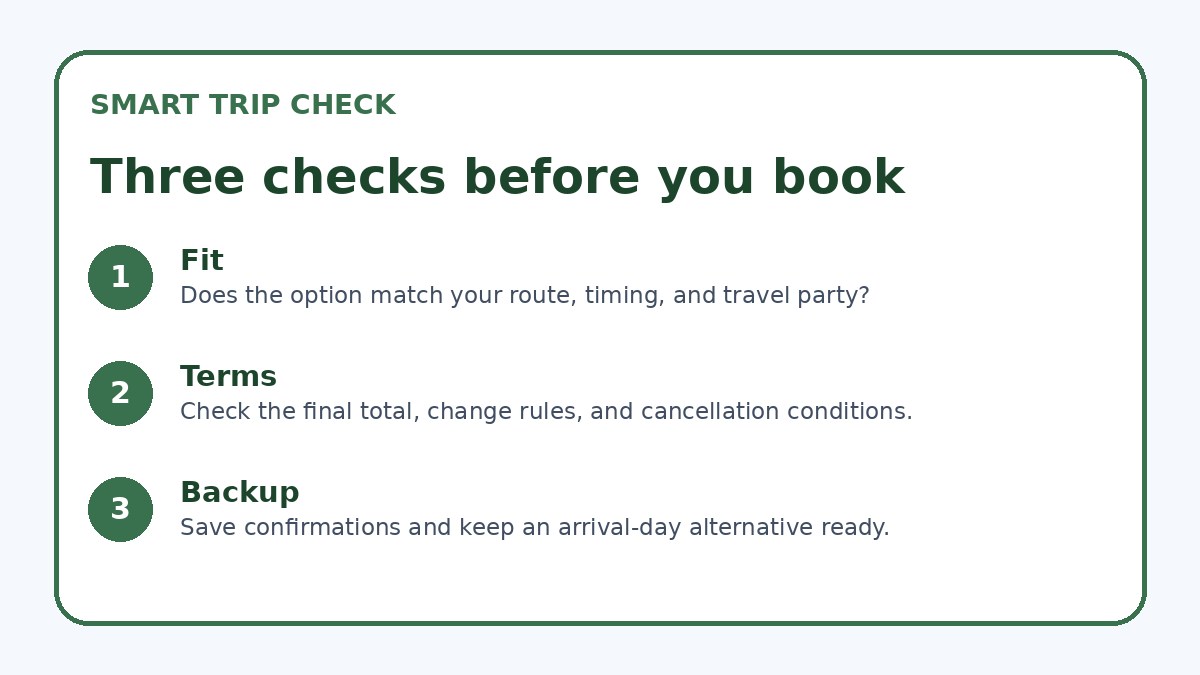
Confirm insurance wording, exclusions, deposit, fuel, mileage, and return terms on the final page.
Pickup and return friction: logistics to expect and reduce
Pickup friction varies by location. Airport counters typically offer longer opening hours and clearer signage, but can impose extra airport surcharges and shuttle waits to parking lots. City-center locations may require a short walk from a meeting point or using public transit to reach an off-site depot. Expect document checks: passport, driver’s license, proof of address in some cases, and the payment card used for the deposit. Allow a generous time buffer around pickup—staffing delays, queueing, and vehicle checks can add 30–60 minutes to your schedule, and solo travelers have no co-driver to queue separately.
For returns, note mileage-based late fees and the company’s grace period. Many rentals require returns during office hours to avoid after-hours drop-off fees or simplified key-drop procedures that may leave you liable for post-return damage claims. Inspect and photograph the car at pickup and again at return, focusing on pre-existing scratches, tires, and interior condition, and keep time-stamped evidence. If returning to an airport, factor in shuttle time and security lines before any onward train or flight. Always verify where the agent inspects the car and what the documented check-out process is on the booking page.
Car rental terms to verify
- Confirm the exact pickup location and required arrival documents on the final booking page, including IDP requirements and the authorized payment card.
- Photograph the vehicle thoroughly at pickup and at return (time-stamped if possible) including odometer and fuel level.
- Check the insurance deductible (excess) in euros and whether optional excess-waiver coverage is offered or excluded.
- Verify depot opening hours and after-hours return procedures to avoid unexpected late or key-drop fees.
- Compare fuel policies (full-to-full vs pre-purchase) and note how the provider documents fuel level at handover.
- Look up ZTL maps for Florence and confirm whether the rental company offers guidance or toll/zone coverage to avoid fines.
Non-driving fallback: practical alternatives for solo visitors
If you choose not to drive, Florence has strong non-driving options for solo travelers. Regional trains and frequent bus services connect Florence with Pisa, Lucca, Siena, and other towns; they’re straightforward, inexpensive, and remove parking stress. For last-mile travel or flexible day schedules, use local taxis or ride-hailing apps where available; for the countryside, book guided day trips or small-group tours that include hotel pickup. These alternatives often add minimal cost for a solo traveler and reduce administrative friction when you’re managing bookings alone.
Use a combination strategy: keep central days car-free to enjoy Florence by foot and collect a rental only for a specific multi-stop day trip, picking up at a suburban office or airport for a single overnight. That limits pickup/return exposure and still gives driving freedom when you need it. When comparing options on provider pages, look for one-way allowances if you plan to drop off elsewhere, and check depot opening hours to avoid unexpected after-hours charges.
Car Rental & Road Trip questions travelers ask
Do I need an International Driving Permit to rent a car in Florence?
Whether you need an International Driving Permit (IDP) depends on your country of license and the rental company’s rules. EU and EEA licenses are usually accepted without an IDP; non-EU licenses may require an IDP alongside your national license. On the provider’s final booking page or rental agreement, check the exact statement about accepted licenses, any translation requirements, and whether the company will refuse rental without an IDP. Carry both your original license and passport when collecting the car to speed the process.
How can I avoid entering Florence’s ZTL restricted areas when driving?
Avoiding ZTLs means knowing where and when restrictions apply. Most centro storico sectors are restricted to permit holders; cameras issue fines automatically. Ask the rental agent for a map or specific instructions, and confirm whether the company automatically registers tolls or ZTL infractions on your behalf and how those fines and administrative fees will be charged. If your route requires entering central areas for short periods (hotel drop-off, parking), get explicit written guidance from the provider on permitted arrival and departure points to minimize the risk of fines.
What should I do if I return the car after hours as a solo traveler?
If you must return after hours, first confirm the provider’s documented after-hours drop-off process on the booking page. Many companies allow a key-drop but will note that the vehicle will be inspected the next business day; this can leave you liable for later damage claims. Photograph the car’s condition and the return location, keep time-stamped records, and retain any drop-off receipt or confirmation email. If possible, choose a location with a staffed return during operating hours to have an agent sign off and remove ambiguity.
Final decision note
For solo travelers, the decision to rent in Florence is pragmatic: rent when flexible rural or multi-stop day trips are central to your plan, and avoid it when your stay is Florence-focused. Evaluate route value, read insurance excess and exclusion wording closely, and plan for pickup and return friction—especially depot location, hours, and after-hours procedures. If avoiding driving, combine trains, local taxis, and organized day trips for most of your stay or use a hybrid approach that limits rental days. Before you book, verify exact pickup address, opening hours, fuel policy, deductible amounts, and ZTL guidance on the provider’s final booking page; Trip.com can be used to compare current availability but always confirm terms with the supplier directly.
Continue planning
Check current options and final conditions
Use the provider page to confirm live availability, the final total, cancellation terms, and every condition that matters to your trip.
This evergreen planning guide was created with AI-assisted drafting and a structured quality review. It does not display live prices, schedules, availability, visa guidance, or provider rankings. Verify current details before booking. Some links are affiliate links; we may earn a commission at no additional cost to you.