If you’re traveling to Busan with extra luggage, the practical question is simple: does the packaged deal actually cover the baggage and transport costs you’ll face, or will separate bookings save time and money? Start by checking the flight or ferry baggage allowance, checked-bag fees, and whether transfers, trains, or taxis between arrival points and your accommodation will accept oversized bags or charge extra. Compare that against the package’s stated inclusions — transfers, checked luggage, seat types, and change/cancellation policies. Don’t assume a bundle bundles everything: many packages advertise ‘baggage included’ but only for one standard suitcase, or they shift excess handling charges to local providers. This guide walks through what to compare, how to value flexibility, and which contractual terms to read closely so you can judge whether a package deal or separate bookings fit your Busan trip with extra luggage.

Test package value fairly
| Booking approach | Best for | Tradeoff to check |
|---|---|---|
| All-in-one package (flight + hotel + transfers) | Travelers wanting single-vendor support and minimal coordination. | May hide baggage limits or transfer handling rules; less flexible for changes or oversized items. |
| Book flight and hotel together, transfers separate | Those who want cheaper packaged rates but control over ground handling. | Requires coordinating separate providers and verifying transfer baggage capacity. |
| Book every component separately | Travelers with special or excess luggage who need precise baggage policies. | You handle more bookings and potential timing risks between unprotected connections. |
| Hybrid: use a package for basic items, buy baggage/transfer add-ons | People seeking some convenience while tailoring baggage handling. | Add-ons can be expensive; review final checkout charges to confirm true savings. |
Check current package and separate options
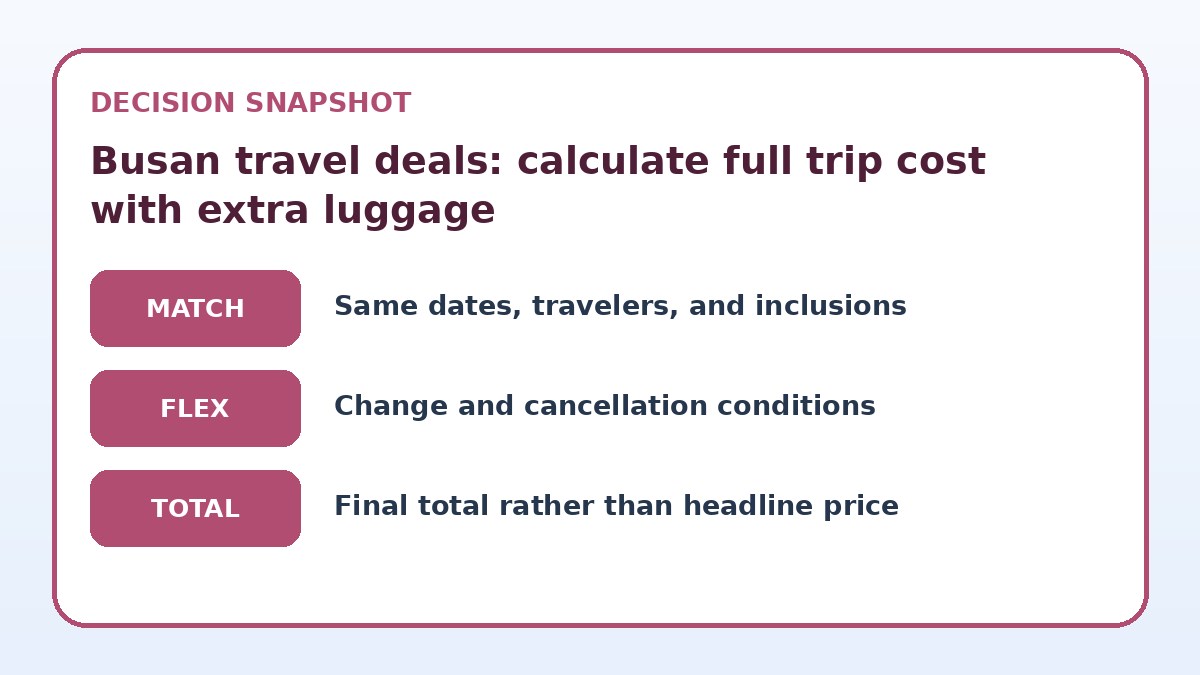
Use identical dates, travelers, room needs, baggage, and flexibility so the comparison stays meaningful.
What to check in package inclusions
Begin by reading the package inclusions line by line. Confirm whether the listed ‘baggage included’ applies to each traveler and whether it refers to carry-on, one checked bag, or another allowance. Many online package summaries combine flight, hotel, and a ‘transfer’ without specifying whether that transfer accepts large suitcases or charges a per-piece handling fee. If meals, seat assignments, or rail segments are part of the package, verify whether they include reserved seats or basic fare only — reserved seats may accommodate larger luggage better on trains.
Next, look at transfer types and meeting instructions: a package that includes an ‘airport transfer’ could be a shared shuttle with strict size limits rather than a private car. When accommodation is included, check whether the hotel or guesthouse charges for storing or handling oversized bags, or whether stair-only access complicates drop-offs. For each inclusion, write down the specific baggage allowances and any exceptions; this makes apples-to-apples comparisons possible when you later price separate bookings.
Flexibility versus upfront savings
Packages often advertise lower up-front costs by bundling fixed services, but that saving can evaporate when you need to change dates, add a bag, or upgrade seats. Review change and cancellation policies for the whole package and for each component. If the package imposes penalties for small changes while individual components allow free modifications or fee waivers, separate bookings may be more valuable despite a higher sticker price. Also consider the timing of changes: prepaid hotel nights may be nonrefundable while an airline ticket might offer a paid reissue with more predictable fees.
Think about operational flexibility too. With extra luggage, a direct flight with a checked-bag included could be worth paying more for, because avoiding domestic transfers reduces handling complexity and potential additional fees. Conversely, if you prefer the ease of a single vendor handling all connections and baggage movement, prioritize bundles that explicitly confirm oversized-luggage handling and liability. Balance your tolerance for possible fees and the risk of rebooking against the convenience a bundled itinerary promises.
Look past the headline total
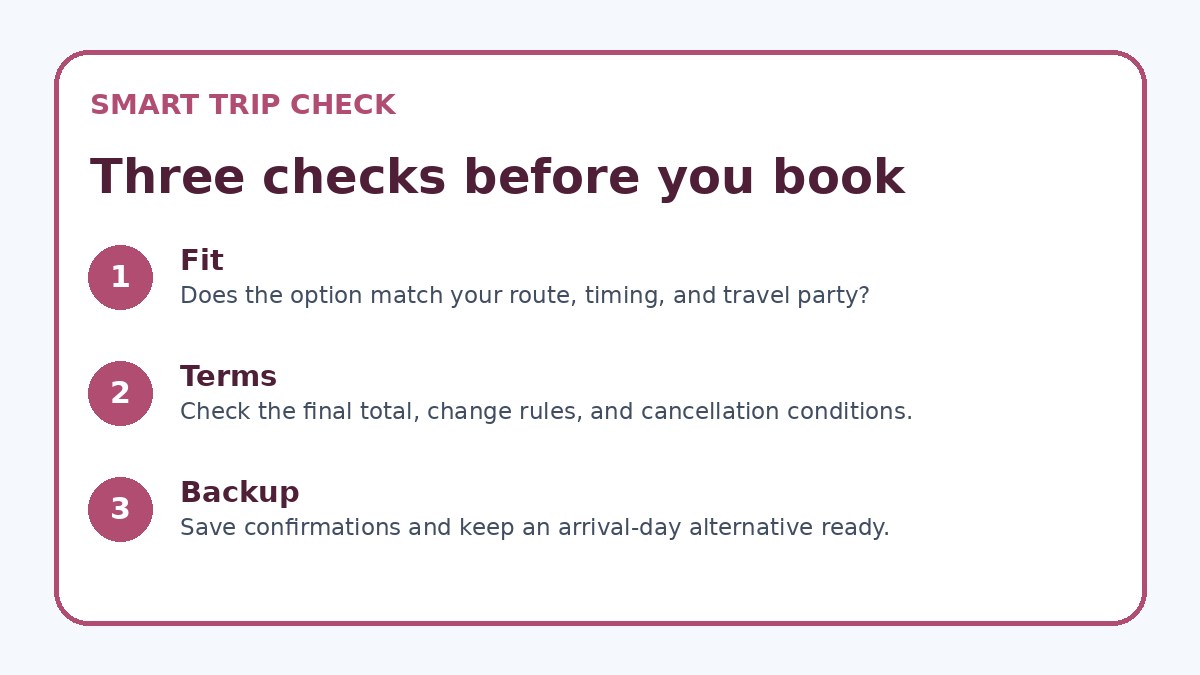
Compare inclusions and change conditions before deciding whether a package is genuinely useful for this trip.
Deal comparison checklist
- Match the exact dates, number of travelers, and number and size of luggage pieces when comparing package and separate booking totals.
- Open the flight provider’s final booking page and copy the baggage weight, size, piece limits, and per-extra-piece fees into your comparison notes.
- Confirm transfer type (private car, shared shuttle, or public transfer) and ask the operator whether oversized suitcases are accepted and whether extra fees apply.
- Check hotel arrival access and luggage handling policies, including stair-only rooms, porter fees, and short-term storage costs.
- Compare change and cancellation penalties for the full package versus each individual component to value flexibility before paying.
- If specialty items are included (sports or instruments), request written confirmation from the carrier or transfer provider that they accept and insure those items.
Traveler-specific value: who benefits from bundles
Identify your travel priorities: are you minimizing transfers, avoiding busy terminals, or keeping maximum flexibility? Travelers carrying sports equipment, musical instruments, or many suitcases often benefit from booking components that explicitly allow oversized or additional pieces rather than relying on a generic package. Families traveling with strollers and multiple checked items may value the simplicity of a fully managed transfer included in a package, provided the supplier documents that they accept the volume and weight you have.
Frequent flyers or travelers with status might prefer separate bookings to use loyalty benefits — checked-bag waivers, seat upgrades, or priority handling — that a bundled retail fare may not honor. If you have special baggage (surfboards, golf clubs), check whether the package lists specialty handling at each stage; if not, separate bookings allow you to select carriers with clear policies and known pricing. Match the bundle’s documented handling to your baggage profile to decide if the package offers real value for your specific needs.
Reading final terms and where to verify details
Before you commit, go to each supplier’s final booking page and read the baggage policy, transfer conditions, and the exact refund/change rules. Don’t rely on promotional summaries or third-party copy. Look for explicit language on weight limits, dimension caps, per-piece fees, and whether liability covers damage during transfers. If a deal mentions transfers or local carriers, note the name of that carrier so you can verify their baggage policy directly. For multi-leg itineraries, check whether the baggage allowance is consistent across all legs or whether a domestic segment imposes stricter limits.
Also confirm logistics that affect extra-luggage handling: whether meet-and-greet drivers can park curbside, whether train platforms require stairs that make large suitcases cumbersome, and whether luggage storage at your accommodation is free or paid. If the package is sold through an aggregator, use the aggregator’s booking link to access provider terms, and then confirm with the carrier or hotel. Trip.com can be used as one place to compare current availability and conditions, but always verify the provider’s own final terms before payment.
Travel Deals & Booking Strategy questions travelers ask
If a package says ‘baggage included,’ how do I know what that covers?
‘Baggage included’ is a summary phrase — it may refer to a standard checked bag, carry-on only, or a specific weight limit. Always open the carrier’s final booking page linked by the package and read the baggage policy the same way you would for a standalone ticket. Look for precise terms: piece limit, maximum weight per bag, and dimension caps. If the package mentions transfers, also verify whether the transfer provider accepts oversized or extra bags. If anything is unclear, ask the seller and request written confirmation before completing payment.
Can I rely on a package’s transfer to handle oversized luggage smoothly?
Not without confirmation. Transfers vary widely — a shared airport shuttle might restrict luggage to standard suitcases, while a private car can typically handle more. Packages sometimes subcontract transfers to third parties with different rules; the package description often omits those operational details. Check the transfer type and the named operator on the booking page, then contact them or read their terms to verify size and quantity allowances, any handling fees, and where the driver will meet you with luggage assistance.
When is booking separately clearly better for luggage concerns?
Booking separately tends to be better when you have nonstandard baggage — surfboards, multiple heavy suitcases, or fragile instruments — because you can choose carriers and services that explicitly cover those items. It’s also preferable if you can leverage airline or hotel loyalty benefits that waive baggage fees. Choose separate bookings when transfer baggage rules are uncertain or when package change penalties are high. Weigh the administrative work and connection risks against predictable baggage policies and potential long-term savings.
Final decision note
When planning Busan travel with extra luggage, the best decision comes from comparing identical scenarios: same dates, traveler count, and baggage profile. Don’t be swayed by a lower headline fare without checking baggage allowances, transfer rules, and change/cancellation terms on provider pages. For many travelers with excess or specialty bags, separate bookings give clearer baggage policies and the ability to use loyalty benefits, while well-documented packages can be the right choice for those prioritizing single-vendor convenience. Before you click pay, copy the baggage specifics from each supplier’s final booking screen into a simple spreadsheet — that small step prevents surprises and shows the true cost of getting your luggage to Busan.
Continue planning
Check current options and final conditions
Use the provider page to confirm live availability, the final total, cancellation terms, and every condition that matters to your trip.
This evergreen planning guide was created with AI-assisted drafting and a structured quality review. It does not display live prices, schedules, availability, visa guidance, or provider rankings. Verify current details before booking. Some links are affiliate links; we may earn a commission at no additional cost to you.