
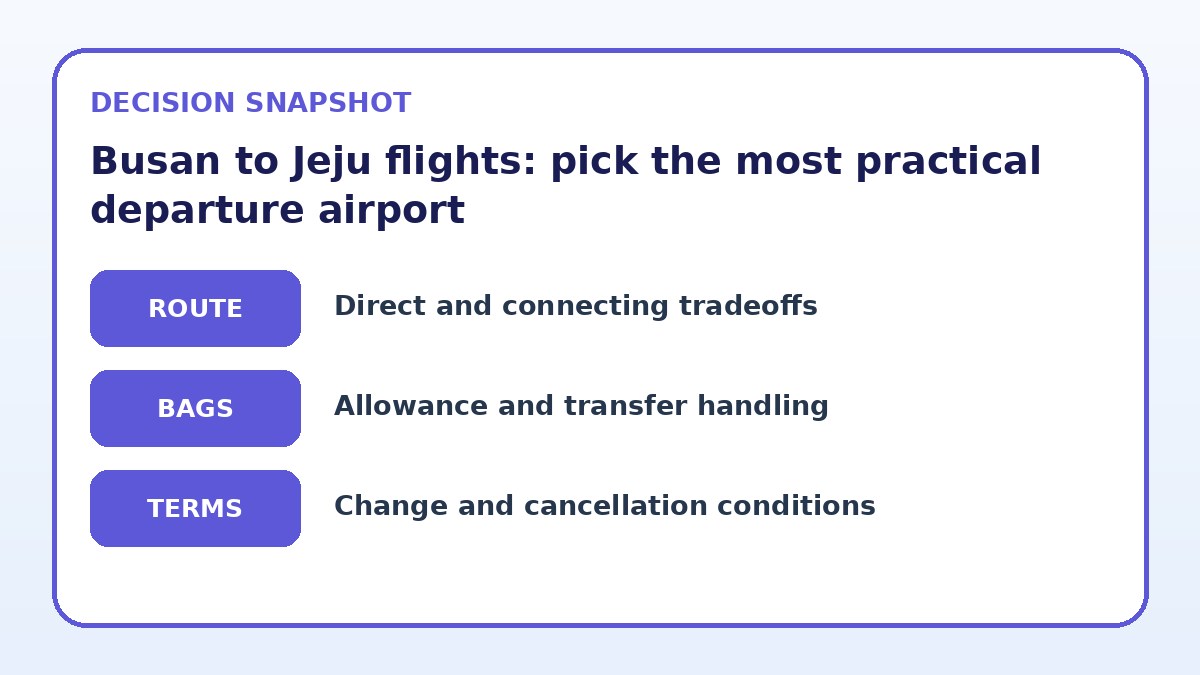
If you’re traveling from Busan to Jeju with more bags than usual, the practical choice of departure airport can save time, stress, and unexpected fees. Most travelers think only of flight schedules and price, but for luggage-heavy trips you should prioritize checked-baggage allowances, ground transfer convenience, and how straightforward it is to drop off oversized or extra suitcases. In Busan there are different airport choices and ways to reach them — and each option changes how early you should arrive, how much you might spend on transfers, and what baggage services are available. This guide gives a clear recommendation up front, then walks through the tradeoffs and the simple checks you should run on airline pages and booking platforms before you complete a purchase.
See current options before you compare the details
Availability and final conditions change. Open Trip.com now or keep reading for the practical comparison.
Practical recommendation up front
For most travelers with extra luggage looking to fly Busan to Jeju, depart from Gimhae (Busan) International Airport when possible. Gimhae is the primary commercial airport serving Busan and offers the most direct flight options to Jeju, which minimizes the number of takeoffs and landings you and your bags must endure. Fewer flight segments typically mean fewer opportunities for baggage misrouting and less need to re-check bags during connections. If you can book a direct service from Gimhae that meets your timing and baggage needs, that tends to be the most practical solution for luggage-heavy travel.
That said, Gimhae might not always be the only sensible choice. If your schedule, carrier loyalty program, or fare structure points to a different departure point or to a connecting itinerary with stronger baggage terms, it’s worth comparing those options. Some carriers or fare classes on connecting itineraries include higher baggage allowances or permit cumbersome items at lower extra cost. The decision should balance how many transfers are involved, how you’ll get to the airport with heavy bags, and which booking channels let you confirm baggage allowances before checkout.
How baggage rules and fares interact
Airline baggage allowances and how carriers charge for excess or oversized items are the biggest influences on cost for travelers with extra luggage. Low-cost carriers often show lower base fares but add fees per checked bag, per kilogram, or per oversized item. Full-service airlines may include one or two checked bags in the ticket price on certain fare classes. Always compare the total cost: base fare plus baggage charges. Look for a fare that includes the checked weight you need; even if the base fare is marginally higher, including a checked allowance can be cheaper than buying add-ons at booking or at the gate.
When comparing options, pay attention to the way a ticket is sold. If the trip is a single itinerary on one carrier, checked baggage is usually protected across segments; if you build separate tickets or change carriers en route, you may need to collect and re-check baggage at intermediate airports. That’s inconvenient and raises the risk of missed connections. Before booking, confirm whether the flight is direct or requires a connection, and if connection is involved check the handling rules for baggage transfers on the airline’s final booking page or the itinerary summary.
| Approach | Best for | Tradeoff to check |
|---|---|---|
| Depart from Gimhae (Busan) International Airport | Travelers wanting the fewest connections and simplest baggage handling | May have higher base fares or fewer fare classes with generous included baggage |
| Choose an alternate nearby airport or connecting itinerary | Travelers who find a fare class with a larger included baggage allowance | More transfers can mean more handling, higher transfer costs, and increased delay risk |
| Book a single-carrier through ticket even if slightly pricier | Those prioritizing baggage protection across segments and one-check-in convenience | Less flexibility to mix lower-cost carriers that might offer cheaper base fares |
| Split tickets to save on base fare but manage bags separately | Experienced travelers confident in tight schedules and baggage re-checking | Higher risk of missed connections and potential extra fees to re-check luggage |
Ready to check the option that fits your plan?
Use your exact dates and traveler details so the provider page can show the current total and conditions.
Ground logistics: getting to the airport with heavy bags
How you reach the departure airport matters as much as the flight itself when luggage is heavy. Take into account train or subway access, availability of elevators/escalators, taxi and airport shuttle options, and parking with luggage assistance. If you rely on public transit for cost or convenience, choose an airport with straightforward transfers and step-free access from platforms to check-in. If you’re taking a taxi or private transfer, check typical curbside rules and whether drop-off is close to the terminal entrance. The less handling between your door and the check-in counter, the easier the journey will be with several or bulky bags.
If you expect to use a rental car or park at the airport, factor in short-term parking locations that have luggage trolleys and brief walking distance to the terminal. For oversized items like surfboards or musical instruments, verify whether the airport and airline can accommodate early check-in or freight handling. Also consider the return leg: arriving at Gimhae for a late flight can be easier if you know how you’ll travel home with heavy bags. Plan to arrive earlier than normal when you have more or larger items to check in.
Before you book
- Verify the exact checked-baggage allowance (pieces and weight) on the airline’s final booking page before purchasing.
- Confirm whether your itinerary is direct or connecting and whether baggage is checked through on multi-segment tickets.
- Measure and weigh your luggage at home to compare against airline size and weight limits, including carry-on policy.
- Check ground transport options from your accommodation to each departure airport and estimate costs with heavy bags.
- Contact the airline for special items (sporting equipment, oversized cases) to confirm acceptance and any documentation needed.
- Allow extra airport arrival time (typically 45–90 minutes more) when you have multiple or oversized bags to check.
How to compare and verify before booking
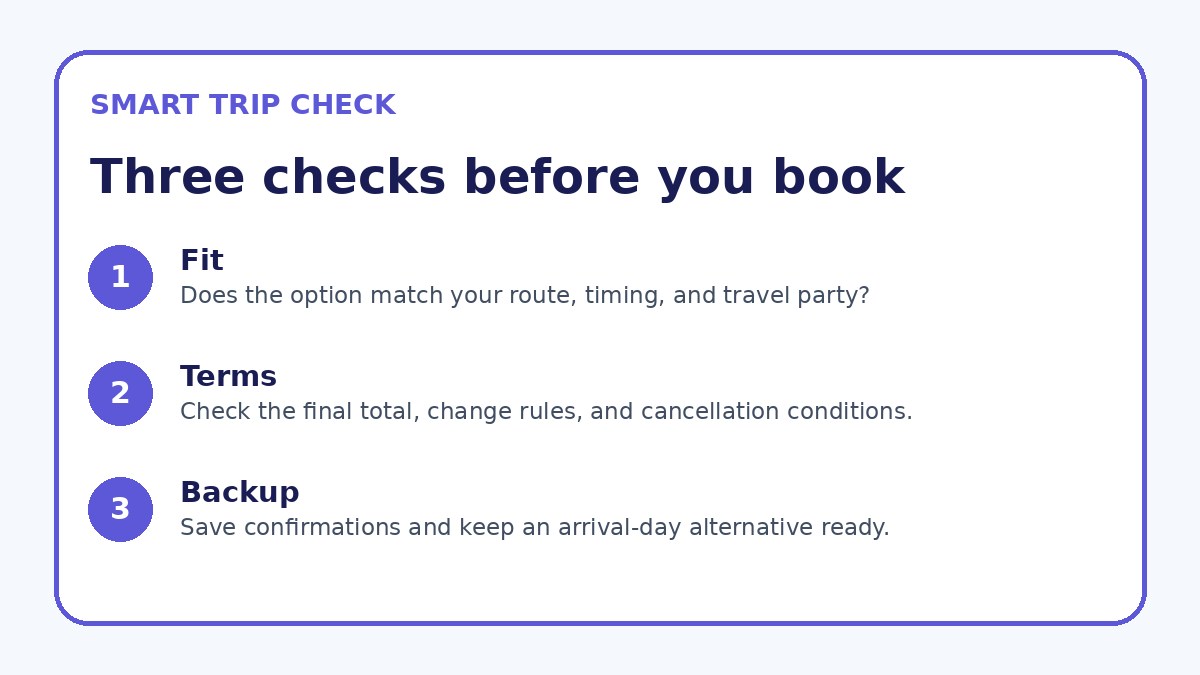
Before you commit to a ticket, follow a short checklist of comparisons. On the airline’s final booking page verify checked-baggage allowances, excess fee tables, size and weight limits, and handling rules for oversized items. If you see ambiguous wording or it’s unclear whether your specific item qualifies, contact the airline’s baggage customer service for confirmation. If you’re comparing itineraries on different carriers or connecting itineraries, compare the total door-to-door time and how many times your bags will be handled. Trip.com can be used as a comparison tool to review available options, but always verify baggage rules and fees on the actual carrier’s booking pages before finalizing your purchase.
Also compare ground transfer options and approximate travel time to each potential departure airport from your lodging in Busan. Map the route and consider whether multiple transfers are needed; extra transfers increase handling and walking. If an alternate airport requires a long commute or several changes on public transit, any savings on the ticket might be eaten by added taxi fares or the physical cost of moving luggage. Use the carrier’s baggage policy pages and airport ground-transport guides to finalize which departure airport matches your luggage profile and overall trip priorities.
Frequently asked questions
Is it cheaper to fly from a different airport if I have extra luggage for Busan to Jeju?
Cheaper base fares from an alternate airport can be offset by lower included baggage allowances or added transfer costs. Compare total trip cost: base fare plus baggage fees, transport to the airport, and potential time costs. If an alternate airport’s fare class includes larger allowed checked baggage, it can be cheaper overall; but if you need to add multiple checked bags to a low-cost carrier’s ticket, fees can escalate quickly. Always verify baggage pricing on the carrier’s booking page and factor in ground-transfer expenses.
How early should I arrive at the airport in Busan when traveling with oversized or extra baggage?
With extra or oversized baggage you should build in more time than usual. Allow extra minutes for queueing at dedicated oversized-check counters, for assistance with heavy or bulky items, and for any paperwork or inspections required. Aim to arrive earlier than standard guidance to avoid stress—this gives you leeway if check-in counters open late or if there are unexpected lines. Check the airline’s recommended arrival times for flights with oversized luggage and add additional buffer based on your distance from the airport.
Can I take sporting equipment or musical instruments on Busan to Jeju flights?
Many airlines accept sporting equipment and musical instruments, but policies differ on whether they count as a checked bag, require a special booking, or incur extra fees. Before booking, check the carrier’s specific rules for size, weight, packaging requirements, and whether advance notice or a special cargo process is required. If the item is unusually long or heavy, confirm whether the airport has a freight desk or special handling services. Always verify acceptance and fees on the airline’s official baggage policy page before you travel.
Final planning note
Choosing the most practical departure airport for Busan to Jeju flights when you have extra luggage comes down to minimizing handling, confirming baggage allowances, and matching ground logistics to your needs. In general, departing from Gimhae (Busan) International Airport is the simplest option when direct services are available because it reduces transfers and the number of times your bags must be handled. However, specific fare classes or single-carrier through-tickets from alternate airports can sometimes offer better baggage terms. Always verify baggage allowances, excess-fee schedules, and oversized-item rules on the airline’s final booking page and factor in the time and cost to get to your chosen departure airport before you book.
Continue planning
Check current options and final conditions
Use the provider page to confirm live availability, the final total, cancellation terms, and every condition that matters to your trip.
This evergreen planning guide was created with AI-assisted drafting and a structured quality review. It does not display live prices, schedules, availability, visa guidance, or provider rankings. Verify current details before booking. Some links are affiliate links; we may earn a commission at no additional cost to you.