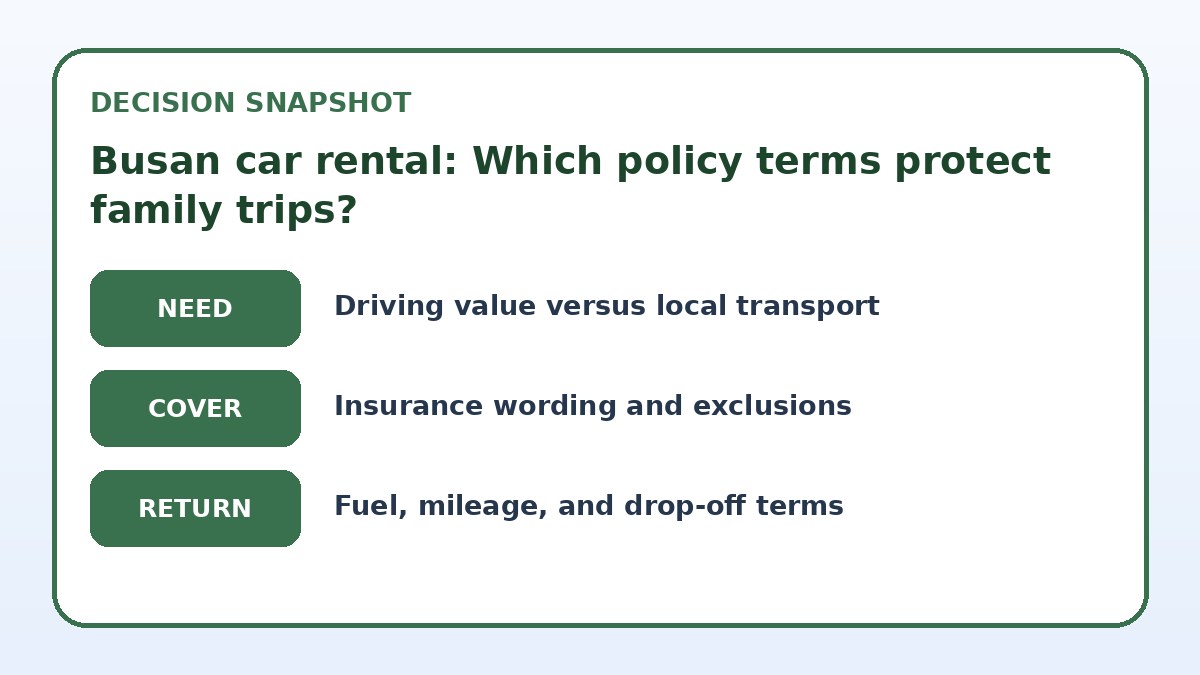
If you’re booking a car for a family trip in Busan, the single most useful move is to read the rental insurance wording line by line before you finalize the booking. That means knowing which words signal real protection (third-party liability, collision damage waiver, personal accident coverage) and which signal limits or exclusions (named drivers only, geography restrictions, deductibles). Families should focus on passenger and child-seat rules, damage limits, glass and tire coverage, and how claims affect deposits. This guide gives a quick decision path up front — which policy points to prioritize — then explains tradeoffs, common clauses to watch for, and exact questions to ask the rental counter or your insurer. When details can change, verify the final policy wording on the provider’s booking page or the insurer’s contract before accepting the car.
Key insurance terms families must know
Start by identifying three core types of cover in the policy language. Third-party liability covers damage and injury you cause to other people and their property — check the coverage limit and whether it meets Korean minimums stated by the provider. Collision Damage Waiver (CDW) or Loss Damage Waiver (LDW) reduces or removes your financial responsibility for damage to the rental vehicle but often comes with an excess (deductible) and exclusions. Personal Accident Insurance (PAI) provides medical payments for occupants but may be redundant if your travel or health insurance already covers medical treatment abroad.
Read the precise words for exclusions and conditions because family scenarios expose gaps: named drivers only means one person on the contract is covered, so an alternate driver — even a parent — could be uninsured. Geographic limits might exclude tunnels, island routes, or certain highways; if you plan day trips outside Busan, check this explicitly. Also note whether glass, tires, undercarriage, and roof damage are treated as ‘wear and tear’ (often excluded) or as claimable damage. These definitions dictate real risk during a busy family holiday.
How deductibles and hold amounts affect family budgets
A deductible (also called excess or hold) is the amount you pay out of pocket for an incident before the rental insurer pays. Policies with low daily rates sometimes pair them with high deductibles to shift risk to renters. For families, a high deductible can mean paying substantial sums right away for a fender-bender or parking lot scrape. Wording to watch for includes whether the deductible is per claim or per incident, whether it’s capped for multiple claims, and how long the rental company holds that amount on your card as a security deposit.
Also check whether there’s an option to reduce or buy out the deductible through a supplemental waiver, either from the rental company or a third-party insurer. The contract should state the exact reduction, any excluded damage types (for example tyres, windows, or interior), and whether waivers apply to all drivers on the contract. When comparing options, calculate the worst-case out-of-pocket cost for a plausible incident during your trip and compare that with the extra daily cost of reducing the deductible.
| Approach | Best for | Tradeoff to check |
|---|---|---|
| Base policy with standard CDW and high deductible | Families on a tight daily rental budget who accept a higher potential out-of-pocket cost. | Lower daily rate but risk of large immediate payment after damage and unclear coverage for glass/tyres. |
| Base policy plus rental company excess reduction | Families wanting simpler claims handling and lower immediate liability at the counter. | Higher daily cost reduces deductible but may still exclude certain parts like tyres or interior damage. |
| Third-party insurance bought before travel covering excess | Families comparing total trip cost who prefer buying cover once and covering multiple rentals. | Saves on daily rental costs but can require submitting a claim to the rental company first and a refund later. |
| Full-coverage package including PAI and added glass/tyre coverage | Families who prioritize peace of mind and minimal claims hassle during the trip. | Highest upfront cost but fewest gaps; check exclusions and whether child-seat damage is covered. |
Passenger safety, child seats, and medical wording
Insurance for families must be matched with safe seating practices. Confirm whether the rental company’s child seats are insured against damage and whether their use affects cover—some policies exclude claims if non-approved seats are installed. The wording should say who is responsible for securing child seats, whether installation damage to the vehicle is covered, and if there are limits on infant or booster seat availability. If the policy is vague, bring your own seat: that removes a point of ambiguity about damage and compliance with local child-safety laws.
Medical and injury wording also matters: Personal Accident Insurance may cover medical costs for occupants after a crash, but the limits, waiting periods and whether ambulance or repatriation are included vary. If your family already has travel medical insurance, compare wording for hospital and evacuation coverage rather than assuming the rental provider’s PAI will fully protect you. Remember to verify operation-specific facts — for example, whether a certain medical condition is excluded — on the insurer’s own policy page before relying on it.
Before you book
- Read the exact deductible/excess phrasing and calculate the maximum likely out-of-pocket cost for a plausible incident.
- Confirm named drivers and add any additional family drivers to the contract in writing before driving.
- Verify glass, tyre, undercarriage, and roof coverage; get explicit confirmation if these are included or excluded.
- Ask whether child seats are insured and whether installed seats can cause damage claims on the vehicle.
- Photograph the car’s condition from multiple angles and record existing damage on the rental agreement.
- Save and print the insurer’s full policy wording or request a PDF to review what’s covered and excluded before you drive.
Practical checks at booking and at the counter
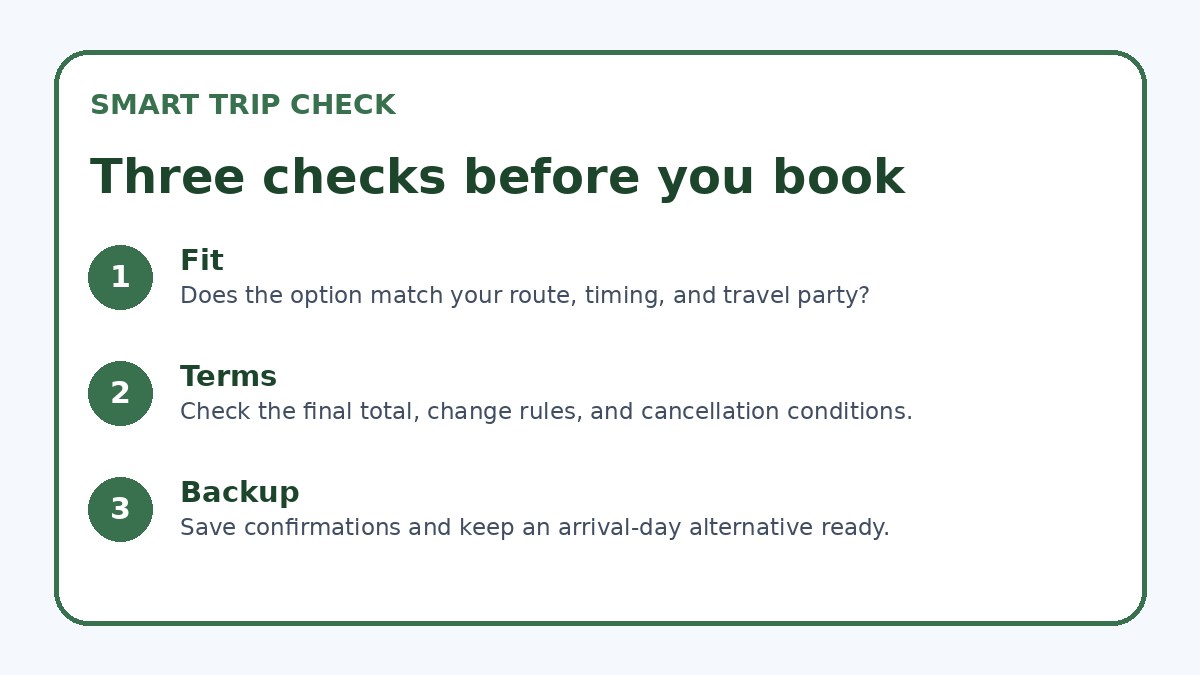
Before you book, scan the terms for these exact phrases: named drivers; deductible/excess amount and per-claim wording; exclusions for glass/tyres/undercarriage; continental/geographic limits; and child-seat responsibility. If any phrase is unclear, request a screenshot or PDF of the final policy wording from the provider, or compare with a third-party policy that lists explicit coverages. Trip.com can be used as one place to compare availability and provider terms, but always treat the rental company’s final contract as authoritative.
At the rental counter, ask to see the contract clause about damage reporting procedures and how long the security hold will remain. Photograph the car thoroughly, note existing damage, and confirm that any verbal promises (for example, about included GPS or child seats) are written into the rental agreement in English and Korean if possible. Finally, confirm the process for making a claim from abroad and get clear contact details for support — this avoids surprises if you need to file while visiting other parts of Korea.
Frequently asked questions
Can my travel insurance cover the rental car deductible in Busan?
Many travel insurance policies include coverage for rental car deductibles, but wording varies. Look for explicit ‘rental vehicle excess’ or ‘collision damage cover’ in your travel policy. Confirm whether the policy requires you to pay the rental company first and claim a refund later, or whether it allows direct settlement. Also check exclusions for drivers’ ages, licence requirements, alcohol or illegal activity, and whether damage to tyres or windscreen is included. Always verify the travel insurer’s conditions on their official policy page before relying on that coverage.
Is it necessary to accept every extra offered at the rental counter in Busan?
No; extras should be evaluated against the written policy. Some waivers genuinely reduce your liability; others duplicate cover you already have. Ask for the exact clause and price for each add-on and compare it to your existing insurance or third-party options. If an extra is unclear or only described verbally, request it be added in writing to the rental agreement. For families, prioritize child-seat charges and deductible reductions; decline extras that offer limited incremental protection.
How do I document and report damage during a family rental in Busan?
If damage occurs, stop driving if the car isn’t safe, then contact the rental company and the police if required. Take timestamped photos of the scene and damage, note witness details, and keep receipts for towing or repairs. Follow the rental company’s specified reporting procedure in the contract; some require a police report for certain incidents. Submit a claim promptly with all documentation and keep copies. Verify on the booking page how to contact after-hours support and whether the provider has English-speaking assistance.
Final planning note
For families renting a car in Busan, the smartest step is procedural: read the insurance wording closely, ask for specific clause references, and calculate your true worst-case cost. Focus on third-party liability, deductible size, child-seat rules, and exclusions for glass or tyres. Choose between paying more up front to reduce your deductible or keeping costs down and securing separate excess insurance — both are valid, but the difference shows up in a stressful claim. Always get policy pages or PDFs before accepting a vehicle, photograph the car, and confirm all drivers are listed. That small time investment prevents the biggest headaches on a family holiday.
Continue planning
Check current options and final conditions
Use the provider page to confirm live availability, the final total, cancellation terms, and every condition that matters to your trip.
This evergreen planning guide was created with AI-assisted drafting and a structured quality review. It does not display live prices, schedules, availability, visa guidance, or provider rankings. Verify current details before booking. Some links are affiliate links; we may earn a commission at no additional cost to you.