If you need a car in Busan for a tight business schedule, focus first on where you’ll collect and drop off the vehicle, what documentation the rental firm requires, and how the provider handles late returns. Practical priorities: choose a pickup location that fits your arrival (airport, train station, or downtown office), confirm the proof-of-identity and license documents the agent will accept, and understand the firm’s policy for mileage, fuel, and after-hours returns. These three checks will prevent most delays and extra charges. After the quick checklist I’ll explain tradeoffs—off-airport convenience versus higher fees, unlimited mileage versus per-kilometer limits, and whether you should pay for an extended return window—so you can decide what matters most given your meeting schedule and expected mileage.
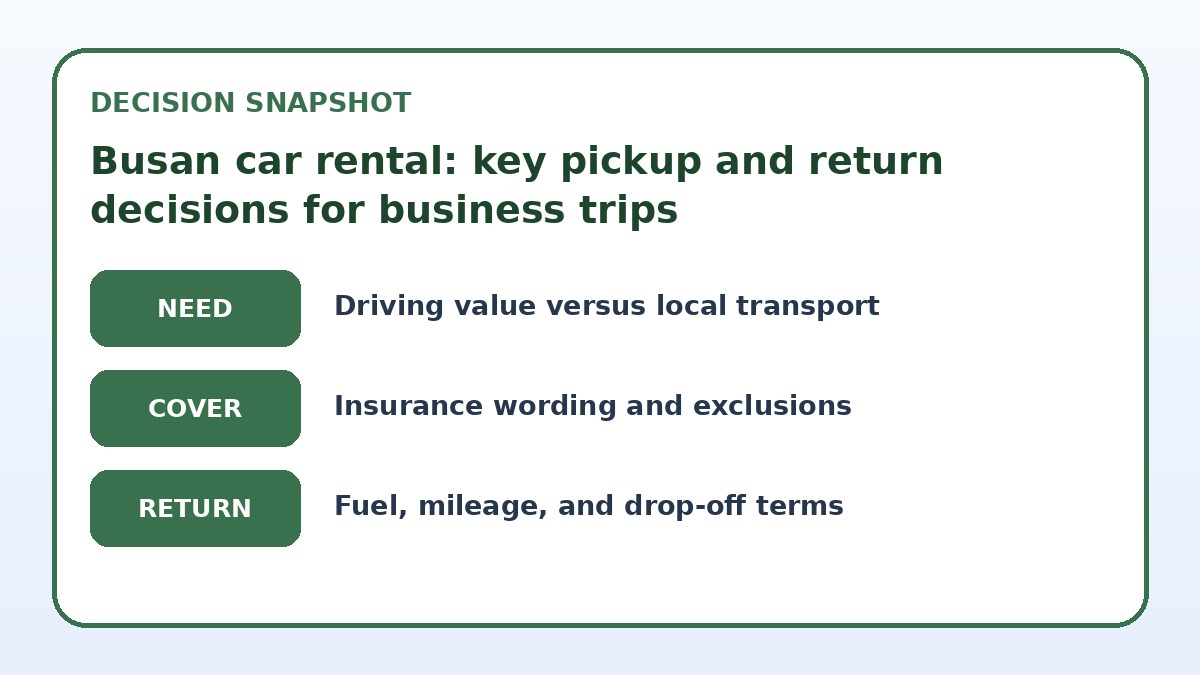
See current options before you compare the details
Availability and final conditions change. Open Trip.com now or keep reading for the practical comparison.
Choosing pickup location: airport, station, or city office
Your pickup location determines how quickly you can get to a meeting and what paperwork you’ll need to present. Airport counters are convenient if you land and want to be on the road immediately, but counters can be in terminals, satellite buildings, or off-site with shuttle transfers. Train-station desks and downtown branches may be closer to business hotels or conference venues. Before booking, map the counter or service desk on your arrival route and note whether the provider requires a reservation confirmation, flight number, or a fixed pickup window. On the booking page check whether transfers from the terminal are provided and the expected walk or shuttle time to the vehicle.
Accepting convenience often means accepting tradeoffs. Airport and station pickups can have surcharges or stricter cancellation windows, while city offices may offer more flexible drop-off times or easier vehicle swaps if plans change. If your meeting schedule is tight, prioritize a pickup point with the simplest route from your arrival gate or station platform—even if it costs more—because time saved can outweigh the extra fee. If you expect itinerary changes, choose a branch with multiple nearby locations to reduce the risk of missing the pickup window.
Document and driver requirements to avoid surprises
Korean rental firms typically require a valid driver’s license, passport or national ID, and a credit card in the driver’s name. Depending on your home country, some agencies will also ask for an International Driving Permit (IDP) or an official translation of your license—check the booking page for the provider’s exact list. Business travelers should carry both physical and digital copies of all documents and ensure the credit card has sufficient available credit for the security hold. If additional drivers are needed, add them at booking; some companies limit who can be listed or charge extra for non-spousal business colleagues.
Verify age restrictions and premiums on the final booking page, since younger or older drivers can face limitations or extra insurance requirements. Also check if the rental requires proof of a return travel ticket or business documentation for some corporate rates. Ask your company travel desk whether a corporate account or prearranged authorization letter is needed to avoid delays at the counter. When in doubt, photograph each counter’s displayed policy or request the agent’s name and confirmation number on collection for any later disputes.
| Approach | Best for | Tradeoff to check |
|---|---|---|
| Airport pickup with quick-return option | Tight arrival-to-meeting schedules needing immediate mobility | Typically more convenient but may include service surcharges or stricter cancellation terms |
| City-center pickup with flexible return times | Meetings inside downtown Busan and uncertain end times | Requires extra transfer time from airport or station but can offer longer return windows |
| Prepaid fuel and mileage package | Predictable daily driving and avoiding refueling stops | Saves time but you must compare effective per-kilometer cost against actual usage |
| Minimal upfront insurance, rely on corporate/credit coverage | Business travelers with comprehensive corporate policies or credit-card protection | Lower immediate cost but higher potential financial exposure for policy gaps or exclusions |
Ready to check the option that fits your plan?
Use your exact dates and traveler details so the provider page can show the current total and conditions.
Fuel, mileage and insurance: what the contract really means
Fuel and mileage clauses determine both cost and convenience. Common choices are return-full (you refuel to the same level), pre-purchased fuel, or pay-for-what-you-use billing. For business trips with multiple short journeys, return-full is often simplest because you control refueling; for long one-way drives, a pre-paid option can save time but requires checking the effective per-kilometer cost on the rental page. Mileage limits sometimes apply to lower-class vehicles or special corporate rates—confirm whether your corporate booking includes unlimited kilometers and how excess miles are billed.
Insurance coverage names and levels are confusing—Collision Damage Waiver (CDW), theft protection, third-party liability, and supplementary liability insurance are commonly offered or required. Corporate policies or personal credit-card benefits may already provide coverage; verify exclusions like driving in restricted zones or using unpaid toll lanes. Check the provider’s deductibles, which determine your financial exposure in a claim, and whether the booking page allows you to add or decline waivers. Keep copies of insurance confirmations and photographed vehicle condition notes at pickup to avoid disputes on return.
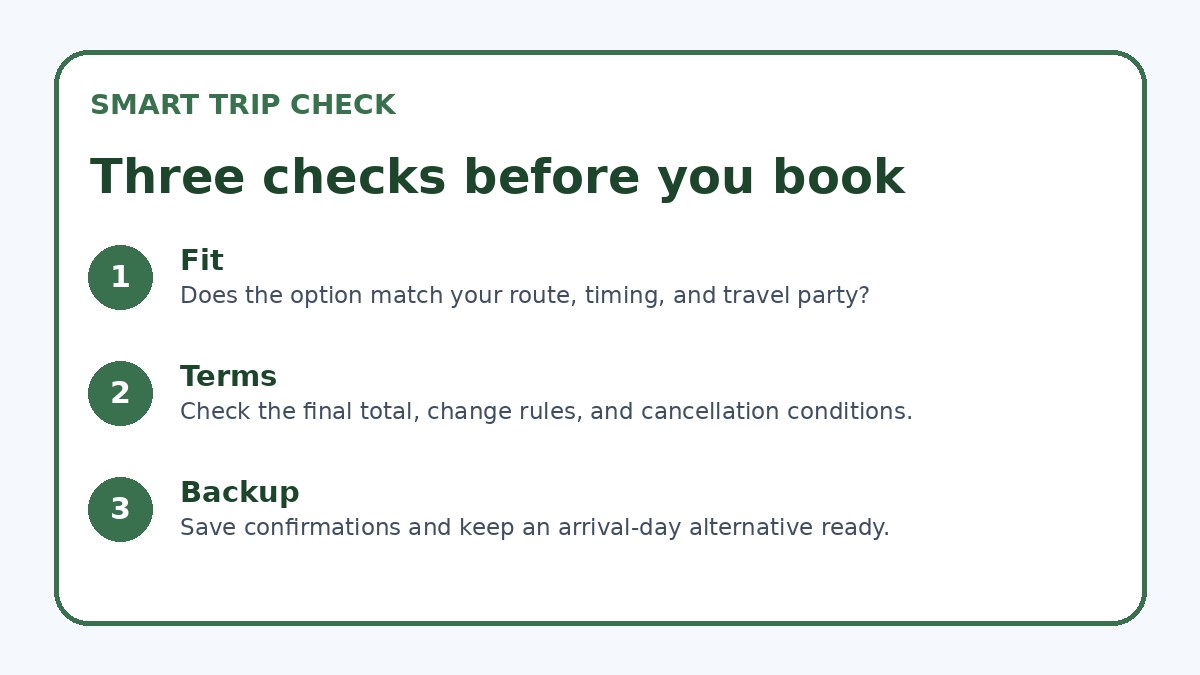
Before you book
- Confirm pickup location details (terminal, counter number, shuttle requirements) on the provider’s booking page before you travel.
- Prepare original driver’s license, passport/ID, any required International Driving Permit, and the credit card used for the reservation.
- Photograph the vehicle (all sides, interior, odometer) at pickup and keep time-stamped images for any later disputes.
- Verify fuel policy and choose return-full or prepaid fuel based on your likely mileage and meeting times.
- Check the rental agreement’s late-return and after-hours procedures and get confirmation for any authorized extensions.
- Save the booking confirmation, insurance details, and the branch contact number in your phone and forward them to your travel coordinator.
Return procedures and handling potential delays
Returning the car smoothly depends on knowing the company’s late-return policy and inspection process. Some firms offer a short grace period—often explicitly stated on the booking page—while others charge hourly or daily rates for late drop-offs. If you anticipate being delayed by meetings, ask whether you can extend the return time online or by phone and whether extensions are confirmed instantly. For after-hours returns, confirm where to park, whether a sealed drop-box or locked gate is used for keys, and how the company documents the vehicle’s condition without an attendant.
Document the vehicle’s mileage and condition at handover and again at drop-off; take time-stamped photos when you return the car and obtain a receipt or confirmation number. If the agent notes damage after return, request written documentation and photos; if you return outside staffed hours, keep images and any automated confirmation emails. On the final booking page validate where the return branch records discrepancies and the timeframe in which the company can issue post-return charges so you can escalate quickly through your corporate travel manager if necessary.
Frequently asked questions
Can I pick up a rental car at Busan Gimhae Airport and return it at a downtown branch?
One-way rentals between Gimhae Airport and downtown Busan branches are commonly offered but are subject to availability and potential one-way fees. Check the provider’s final booking page for allowed drop-off locations, any location-specific surcharges, and whether a reservation must explicitly state a different return branch. If you need flexibility between terminals or branches, book a rate that supports one-way drop-offs or contact the rental provider’s customer service to confirm the logistics and any documentation you should bring to avoid extra charges.
What happens if my meeting runs late and I return the car after the agreed time?
Late returns are handled differently by each company: some apply an hourly fee, others charge for an additional day after a short grace period. The safest approach is to check the rental agreement for the grace window and extension process before you pick up the vehicle. Call the rental office as soon as you know you’ll be late; many providers allow same-day extensions without a full new charge if handled proactively. Keep records of any extension confirmations and the agent’s name in case your corporation needs to dispute a late-return fee.
How do I know whether my corporate insurance or credit card covers damage on a Busan rental?
Coverage depends on the exact terms of your corporate policy and the issuing credit card’s benefits. Before declining optional rental waivers, request written confirmation from your company travel office or insurance administrator that the policy covers collision, theft, and third-party liability in Korea, and note any exclusions such as inexperienced drivers or specific vehicle classes. For credit-card coverage, check the card issuer’s international rental-car policy, required enrollment steps, and whether you must use that card to pay for the rental to be covered. Always carry proof of coverage when collecting the car and confirm with the rental agent which damages are excluded.
Final planning note
For business travel in Busan, the most important planning step is to align pickup and return terms with your meeting schedule and risk tolerance. Prioritize a pickup location that minimizes transfer time from your arrival point, verify all document requirements, and decide whether convenience options—prepaid fuel, added insurance, or flexible return windows—are worth the extra cost for your itinerary. Always confirm final terms on the provider’s booking page, document the vehicle condition at handover and return, and keep contact details handy for quick extensions. With those checks done, you’ll reduce surprises and keep your trip focused on meetings, not logistics.
Continue planning
Check current options and final conditions
Use the provider page to confirm live availability, the final total, cancellation terms, and every condition that matters to your trip.
This evergreen planning guide was created with AI-assisted drafting and a structured quality review. It does not display live prices, schedules, availability, visa guidance, or provider rankings. Verify current details before booking. Some links are affiliate links; we may earn a commission at no additional cost to you.