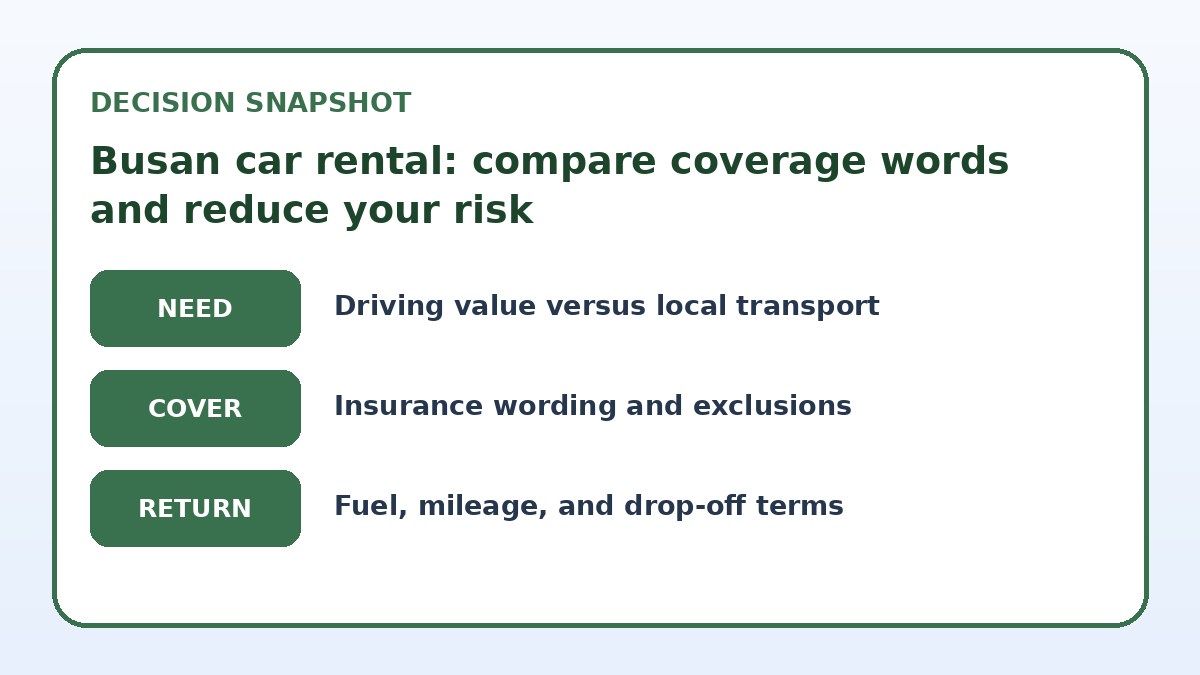
If you plan to rent a car alone in Busan, the simplest practical step is to confirm exactly which losses you would pay for after a claim: check the excess amount, what 'collision' or 'comprehensive' actually excludes, whether third-party liability is included, and whether roadside assistance and theft cover apply to solo drivers. Insurance pages use similar terms but mean different things—excess (your out-of-pocket), CDW/LDW (limits on damage), and SCDW or 'super' waivers (reduce or eliminate excess) are common. Read the provider’s final booking page and the rental agreement appendix for exclusions like driving on unpaved roads, alcohol limits, or unauthorized drivers. This article helps you parse the wording, weigh tradeoffs, and prepare the documentation and questions to resolve before you pick up keys in Busan.
See current options before you compare the details
Availability and final conditions change. Open Trip.com now or keep reading for the practical comparison.
Key insurance terms and what they mean for solo drivers
Insurance summaries use short labels that hide important details. 'CDW' or 'Collision Damage Waiver' often reduces your liability for damage to the rental car but does not always remove responsibility entirely—there may still be an excess or exclusions for specific parts (windshield, tires, underside). 'LDW' or 'Loss Damage Waiver' is similar but can be worded differently. 'Third-party liability' covers damage or injury you cause to others; its limits and exclusions matter more if you plan to drive on busy roads or outside urban Busan. Reading the fine print, especially words like 'subject to' and 'unless,' reveals where you still have personal financial exposure.
For solo travelers, 'Personal Accident Insurance' and 'Personal Effects Coverage' can seem attractive but often duplicate your existing travel or health insurance. Roadside assistance should be checked separately: does it include towing, jump starts, and unlocking for lost keys? Some waivers state they do not cover negligence—if you leave the keys in the ignition and the car is stolen, a waiver that excludes negligence won't help. Be comfortable asking the rental agent to show the exact clause in the rental contract that corresponds to any verbal claim about coverage.
How to compare options without being misled by marketing labels
Marketing labels such as 'full coverage' or 'zero excess' are convenient, but always match them to the legal language. Look for the numeric limits: if a policy says 'zero excess' check whether that applies to all damage categories or only to collision while excluding glass, tires, or undercarriage. Confirm the maximum liability the provider accepts for third-party claims; a high-sounding phrase without a stated limit is not useful. If a credit card company offers coverage, compare the card's documentation with the rental agreement: most card benefits require you to decline the rental agency’s collision waivers and follow specified claim steps.
Make side-by-side comparisons on the same criteria: excess amount, covered damage categories, third-party limits, theft cover, roadside assistance, and exclusions. Create a short checklist when booking to score each option. Remember conditions matter: an add-on that lowers excess from a large amount to a moderate one might be a better fit than one that claims 'comprehensive' but excludes theft or single-vehicle incidents. Ask the rental provider to point you to the clause that defines the excess and the process to dispute or reduce it after an incident.
| Approach | Best for | Tradeoff to check |
|---|---|---|
| Decline agency waivers relying on credit card coverage | Travelers with documented, strong card collision coverage and willingness to manage excess | You must follow the card issuer’s claim steps exactly and may pay the excess upfront until reimbursed |
| Purchase the agency’s SCDW/no-excess waiver | Solo travelers who want minimal out-of-pocket risk and simpler on-site handling | Higher immediate cost and possible exclusions that still require careful contract review |
| Buy basic liability plus roadside assistance add-on | Drivers focused on third-party protection and being able to call for help quickly | May leave you with significant excess for damage to the rental car itself |
| Rely on standalone third-party insurance from a local insurer | Drivers seeking higher liability limits than the base rental provides | Adds paperwork and requires confirming acceptance by the rental company before pickup |
Ready to check the option that fits your plan?
Use your exact dates and traveler details so the provider page can show the current total and conditions.
Practical pickup and claims steps relevant to solo travelers
At pickup, document everything. Walk around the car with the agent, take timestamped photos or video of all sides, interior, and obvious wear, and request that any pre-existing damage be noted in the rental agreement or photographed by the agent. Ask the agent which phone number to call for roadside assistance and whether the service is included or billed separately. Make sure the rental contract lists you as the authorized driver; some policies void coverage if someone else drives, which matters if you expect to switch drivers during the trip.
If you must file a claim, follow the provider’s steps exactly: notify local police if required, keep copies of the rental agreement and receipt, and obtain an incident report or case number. Verify what receipts and repair invoices the company needs and how long you have to submit them. Keep records of all calls and email replies. If you used a credit card for coverage, contact the card issuer early to learn required documentation and deadlines, and ask the rental company for written confirmation of damages and costs to avoid disputes.
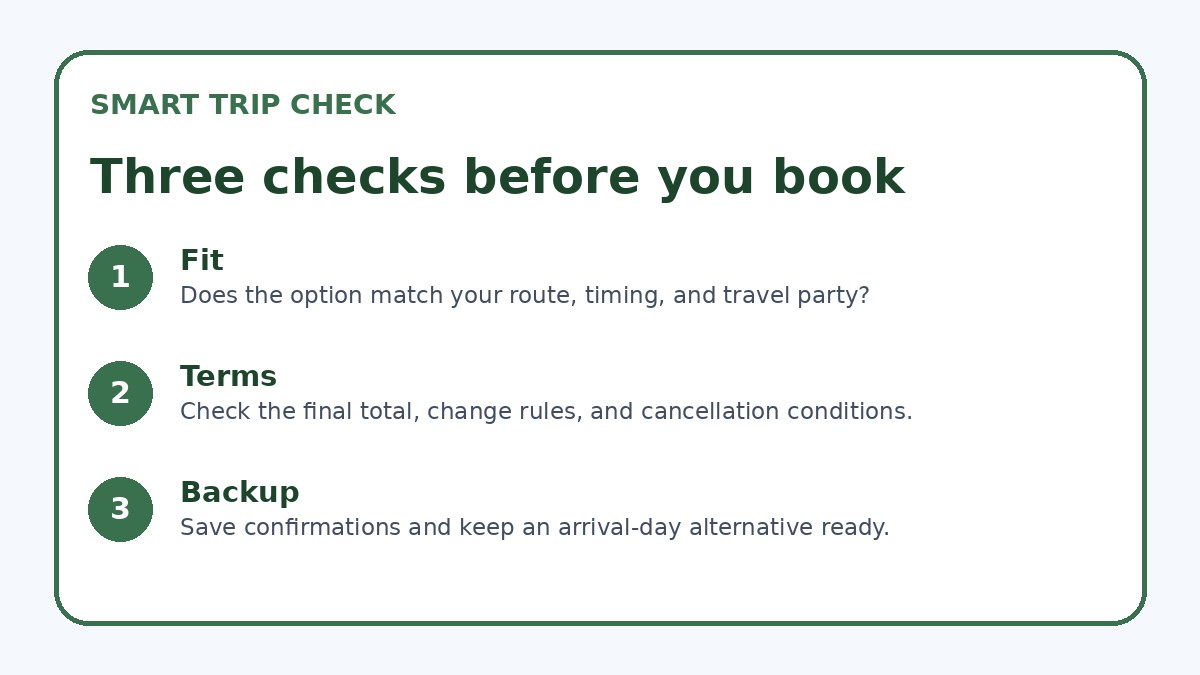
Before you book
- Read the rental provider’s final booking page and download the full rental agreement PDF before pickup.
- Take timestamped photos and video of the vehicle’s exterior and interior with the rental agent present.
- Confirm the exact excess amount in writing and ask which categories (glass, tires, undercarriage) are excluded.
- Check whether roadside assistance and towing are included and save the emergency contact number.
- Verify whether your credit card or travel insurance covers collision/theft and print the issuer’s claim steps.
- Ask the agent to note any pre-existing damage on the contract and to initial or photograph the notation.
Decision criteria and tradeoffs solo travelers should weigh
Deciding what coverage to buy is a balance between peace of mind and cost avoidance. If your existing travel insurance or credit card provides strong collision and theft coverage and you are comfortable managing a moderate excess, you might decline some agency waivers. Conversely, if you prefer certainty or worry about language barriers handling a claim while traveling alone in Busan, a lower-excess option or a waiver that removes your liability may be worth the extra cost. Factor in the driving context: unfamiliar narrow streets, night driving, or heavy traffic increase the value of lower-excess coverage.
Also weigh convenience and post-trip paperwork. A no-excess waiver can streamline claims and reduce stress, but it may come with exclusions that still leave you exposed. If a waiver covers everything except negligence, accept that you must be diligent about keys, alcohol rules, and permitted roads. Always confirm on the provider’s final booking page the exact clause wording, any age-related limits, and whether the coverage is refundable if you cancel or return the car early.
Frequently asked questions
Can my credit card’s rental insurance fully replace the rental company’s waivers?
Many credit cards offer collision or loss damage coverage, but the benefit levels and claim requirements vary. Before relying on that coverage, get the card issuer’s benefit guide and confirm it covers rentals in Korea, the types of damage included, and whether it requires you to decline the agency’s own waivers. Check documentation for required claim timing, police reports, and whether the card will reimburse you for the excess or requires you to pursue reimbursement after paying the rental company. If anything is unclear, ask the issuer in writing and save their reply.
What should I do if the rental agent’s verbal promises conflict with the written contract?
Always trust the written contract. If an agent makes a verbal promise, request that they write the exact wording into the rental agreement or initial a printed amendment. Photograph the signed pages and the agent’s name and ID badge if possible. If a dispute arises later, your strongest evidence is the signed contract and contemporaneous photos. If the company refuses to place the promise in writing, consider raising the issue to a manager or choosing a different provider—verbal assurances are difficult to enforce after the fact.
How do exclusions typically affect single-driver coverage in Busan?
Exclusions commonly found in rental agreements can void coverage for single incidents: driving under the influence, unauthorized drivers, off-road use, or using the vehicle for unauthorized activities. For solo travelers, the most relevant are unauthorized driver clauses—if you lend the car even briefly, coverage can be void—and negligence exclusions, such as leaving keys in the vehicle. Carefully read the exclusions list on the booking page and rental contract and ask the agent to point out any phrases that could apply differently to a lone driver.
Final planning note
Renting a car in Busan as a solo traveler doesn’t have to be stressful if you stop treating headline labels as facts and read the contract language. Focus on the excess amount, specific exclusions, and third-party liability limits, and compare that to any credit card or travel insurance coverage you already have. Document the car at pickup, obtain written confirmation for any verbal statements, and keep copies of all relevant policies and numbers. When in doubt, request the clause references on the final booking page and decide based on what you are prepared to handle financially and administratively should a claim occur.
Continue planning
Check current options and final conditions
Use the provider page to confirm live availability, the final total, cancellation terms, and every condition that matters to your trip.
This evergreen planning guide was created with AI-assisted drafting and a structured quality review. It does not display live prices, schedules, availability, visa guidance, or provider rankings. Verify current details before booking. Some links are affiliate links; we may earn a commission at no additional cost to you.