
If you’re planning to rent a car in Busan and you’ll travel with bulky or extra luggage, the first practical step is to confirm the rental company’s fuel policy, daily or mileage caps, and the vehicle’s cargo capacity before you finalize the booking. Fuel rules determine whether you return the car full, prepay for fuel, or pay for refill fees; each option changes your cost and convenience, especially if you plan to make multiple stops or cross regional borders. Mileage allowances matter because extra weight raises fuel consumption and could push you past daily or unlimited-mileage rules that affect charges. Also check vehicle dimensions and roof-rack or trunk space limits so your luggage actually fits without damaging the interior or obstructing visibility. These checks take ten minutes and will save both time and surprise charges at drop-off.
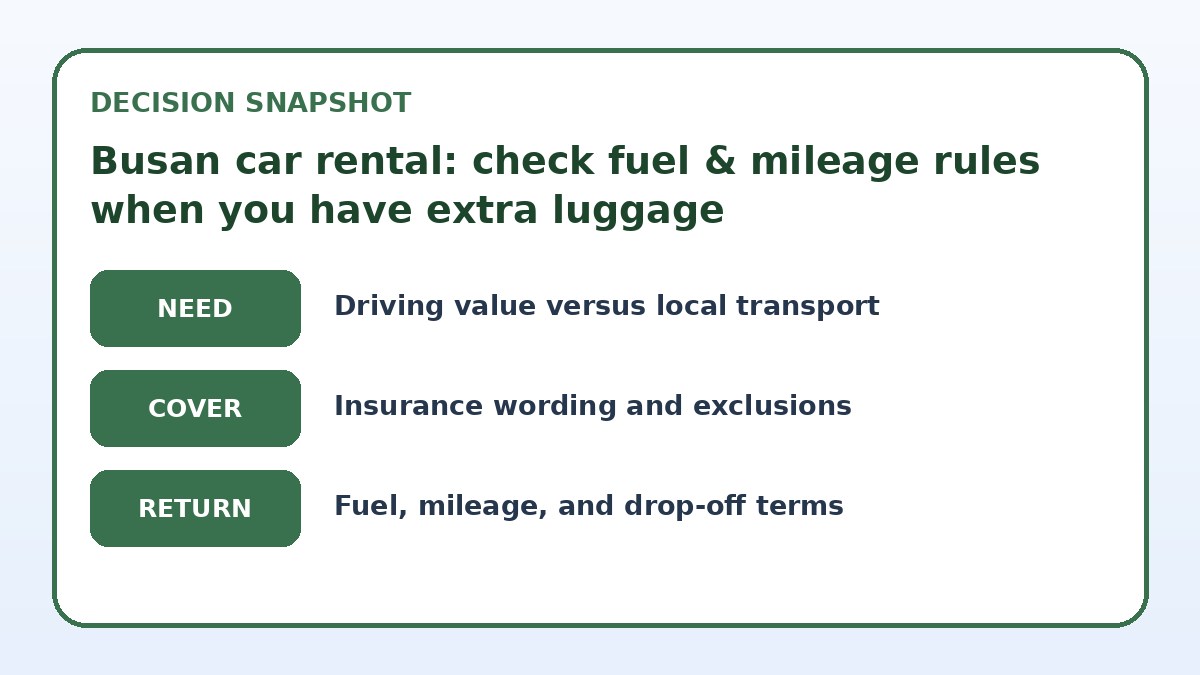
See current options before you compare the details
Availability and final conditions change. Open Trip.com now or keep reading for the practical comparison.
How fuel policies affect trips with extra luggage
Fuel policy is the single most immediate cost and inconvenience factor when you’re carrying extra luggage. Full-to-full means you pick up the car with a full tank and must return it full; this avoids paying an uncertain refill fee but requires you to budget time before drop-off to find a station near the rental office. Prepaid fuel options let you skip a refill but may charge you for a full tank even if you use only part of it. Pay-on-return or third-party refueling fees are typically the most expensive option because staff time and administrative surcharges increase the final bill.
With extra luggage, your car will likely use more fuel than an empty vehicle, especially if you load heavy suitcases or a rooftop carrier. That increased consumption interacts with fuel policy: if you prepaid, wasted fuel is harder to reconcile. If you return full, plan for the fuel stop before drop-off and factor in traffic in Busan’s busy districts. For hourly or short rentals during airport pickups, ensure fueling stations are open and reachable; the rental provider’s final booking page should list exact fuel terms and any third-party refueling charges you must verify.
Mileage limits, weight and when extra kilometers matter
Rental contracts often set a daily kilometer limit or offer unlimited mileage at a higher rate. When you carry heavier loads, the car’s fuel economy worsens and you may plan more local trips to ferry luggage, which adds distance. If your itinerary includes day trips outside Busan or long drives along the coast, calculate the likely kilometers and compare that with the contract cap. Exceeding the allowance usually means per-kilometer penalties that can add up faster than the incremental cost of an unlimited plan.
Deciding whether to buy an unlimited mileage option depends on route predictability and weight. For flexible sightseeing with frequent stops, unlimited is less stressful; for a fixed, short urban itinerary, a capped plan may be cheaper. Also note that some providers differentiate between urban and cross-border mileage; if you intend to take the car across provincial boundaries, confirm whether special permissions or different rates apply. Always check the rental’s definition of a rental day and how partial days are counted to avoid unexpected kilometers being charged.
| Approach | Best for | Tradeoff to check |
|---|---|---|
| Choose a compact car with full-to-full fuel policy | Short urban trips with minimal extra luggage | Lower rental rate but limited cargo space and need to refill before return |
| Select a larger vehicle with unlimited mileage | Multi-day road trips or plans with long daily drives and bulky bags | Higher daily cost but simpler distance planning and less worry about penalties |
| Prepay fuel and add a roof box or trailer | Convenience for tight itineraries with heavy luggage | Potentially wasted fuel cost and added fuel consumption from rooftop drag |
| Rent compact car plus intermittent taxi or cargo transfer | City-focused stays where parking and tight streets matter | Extra coordination and last-mile costs but avoids higher rental or oversized vehicle fees |
Ready to check the option that fits your plan?
Use your exact dates and traveler details so the provider page can show the current total and conditions.

Vehicle choice and cargo solutions for oversized baggage
Picking the right vehicle is as important as picking the policy. Compact cars save fuel but often lack trunk space for multiple large suitcases or sports equipment. A small SUV, wagon or minivan provides more interior volume and roof-rail options but may attract higher base rental and different mileage rates. Pay attention to passenger-seat configurations and whether rear seats fold flat; some listings include exact trunk liters, but images and published dimensions are the most reliable indicators when available.
Rooftop carriers and trailers solve space limits, but they change how fuel consumption is calculated and may be restricted by rental terms or local traffic rules. Confirm whether the rental company offers factory-fitted roof boxes or whether you must supply your own; also ask about installation fees, permitted speed limits with a loaded rack, and whether accidents while using external carriers affect insurance. The rental provider’s final booking page should list allowed accessories, their costs, and the requirements for returning the vehicle with them attached or removed.
Before you book
- Confirm the exact fuel policy (full-to-full, prepay, or pay-on-return) on the booking page and note any third-party refueling fees.
- Calculate expected kilometers for your full itinerary and compare with daily mileage caps or unlimited mileage options.
- Measure or list your luggage dimensions and verify trunk volume and rear-seat folding specifications in the vehicle description.
- Ask whether roof racks, boxes or trailers are available, how they are charged, and whether installation is included in the rental agreement.
- Photograph the vehicle interior, trunk and roof points with staff during pickup and request those photos be attached to your rental record.
- Read insurance exclusions concerning overloaded cargo and document the deductible or excess amounts shown on the final booking page.
Insurance, damage inspections and documenting luggage impact
Insurance coverages and the pre-rental inspection determine how damage to interior upholstery or roof mounts is treated. Heavy or abrasive luggage can scuff cargo liners, scratch entry points, or create pressure points on folded seats. Before driving off, walk around the vehicle with staff and photograph the trunk, rear seats and roof area at pickup and again at drop-off. Those timestamps protect you if the rental company later alleges interior damage caused by your bags.
Also ask how insurance handles damage caused by mounted gear or overloaded cargo. Some policies exclude damage resulting from improper loading, while others require additional waivers for trailers or roof boxes. If the insurer requires a signed load limit notice or an explicit inspection of mounting points, get those details in writing or as notes on the rental agreement. On the provider’s final booking page, verify the excess/deductible amounts, what is excluded for cargo-related damage, and the process for filing a claim.
Frequently asked questions
Will heavy luggage make me exceed mileage or fuel limits more quickly?
Yes — increased weight raises fuel consumption, which changes how far you can drive on a tank and can indirectly affect your mileage planning. Heavier loads mean lower kilometers per liter, so if your rental has a daily kilometer cap, you may cover fewer kilometers for the same fuel cost. To manage this, estimate added consumption (for example, expect small SUVs or vans to be less affected than compact cars) and choose either an unlimited mileage option or a larger tank size vehicle. Confirm exact mileage rules and any penalties on the rental’s final booking page.
Should I prepay for fuel if I’m carrying bulky baggage?
Prepaying is convenient if you want to avoid stopping for fuel near drop-off, but it can mean you pay for fuel you don’t use — particularly likely if extra luggage increases consumption and you return the car partly full. If stations near the rental office are easy to reach, full-to-full typically saves money because you only pay for what you used. Check the rental agreement for prepayment refund rules and compare estimated fuel usage for your loaded vehicle before choosing a prepaid option.
Are rooftop carriers and trailers allowed in Busan rentals, and what should I check?
Many providers allow rooftop carriers or tow options, but policies vary and some restrict their use on certain roads or bridges. Verify if the carrier is company-supplied or a customer-supplied accessory, whether installation is done by staff, and whether using a roof box changes insurance coverage or incurs extra charges. Also ask about speed limits with a load, how weather affects use, and how to return the vehicle with mounted equipment. The final booking page should list allowed accessories and any related insurance stipulations.
Final planning note
For travelers with extra luggage in Busan, the best outcome comes from confirming three things before you book: the fuel policy, the mileage terms, and the practical cargo capacity or accessory options of the vehicle. Those checks determine convenience, risk and likely total cost more than base rental rates. Where possible, favor clear written terms on the provider’s final booking page — including fuel rules, mileage caps, accessory availability and insurance exclusions — and document the vehicle condition at pickup. If you’re still unsure, consider renting a larger vehicle with flexible mileage or pairing a compact rental with occasional local transfers to balance space, fuel use and ease of driving in Busan’s urban areas.
Continue planning
Check current options and final conditions
Use the provider page to confirm live availability, the final total, cancellation terms, and every condition that matters to your trip.
This evergreen planning guide was created with AI-assisted drafting and a structured quality review. It does not display live prices, schedules, availability, visa guidance, or provider rankings. Verify current details before booking. Some links are affiliate links; we may earn a commission at no additional cost to you.