If you're leaving Busan and need a clear plan for your Busan airport transfer, start by matching your accommodation location, flight time, and luggage to a realistic transport option. The simplest first step is to decide whether you prefer scheduled public transport, a door-to-door taxi or private car, or a hotel shuttle that drops you straight at the terminal. Each choice trades cost for convenience and risk: public modes require more time buffering but are reliable and usually cheaper; taxis reduce transfers but can be affected by traffic. This guide explains how to compare options, what to verify before booking, and how to time your departure so you reach the airport calmly, with a checklist and FAQs to finish your preparation.
See current options before you compare the details
Availability and final conditions change. Open Trip.com now or keep reading for the practical comparison.
Make your practical choice first
Start by asking three concrete questions: where exactly is your accommodation in Busan, how much luggage do you have, and what time does your flight depart? Your answers narrow the field quickly. If your hotel sits near a metro line or transfer hub, public transit can be straightforward. If you’re carrying bulky luggage or travelling in a group, a single taxi or private transfer may be simpler. For early-morning or late-night departures, check which modes run at those hours and whether the hotel offers an alternate pickup.
Think about risk tolerance next. Public transport requires buffers for walking between lines and potential waiting; if you prefer to minimize variables, choosing a door-to-door option reduces the number of things that must go right on the day. Whatever you lean toward, write down the exact pickup time you’ll need and add a safety margin. Use local mapping apps to confirm the route and estimated duration, then plan your departure time from the property accordingly.
Public transport: predictability vs. planning
Public transport in Busan can be cost-effective and largely predictable in operation, but it usually involves transfers—metro to light rail or a bus link—and navigating stations with luggage. If you choose this path, map the full journey end-to-end ahead of time: which stations, which line changes, and where you will walk with bags. Pay attention to station names, exits, and any required ticketing or card top-ups. For shorter transfers, a single card or ticket often covers multiple legs, but confirm that at stations or on the provider’s site.
Buffer time is crucial when relying on trains or airport buses. Account for walking between platforms, buying tickets, and possible short delays. If a luggage locker or elevator is required, factor in the extra minutes to use them. Before departure day, check the operator’s final booking or schedule page for updated service times and advisories; services can change seasonally or for maintenance. Trip.com is one place to compare current availability, but confirm details directly with the transport operator or your hotel.
| Approach | Best for | Tradeoff to check |
|---|---|---|
| Public transport (metro + rail/bus) | Budget-minded travellers comfortable with transfers and walking with luggage | Requires careful route planning and extra time buffers for transfers and station navigation |
| Airport shuttle or hotel pick-up | Guests who want lower hassle without arranging separate taxis | May run on a fixed schedule and require aligning your departure time to the shuttle timetable |
| Taxi or metered car | Small groups or travellers with lots of luggage who prefer a direct route | Subject to traffic conditions; final fare can vary with congestion and route |
| Prebooked private transfer | Those wanting a guaranteed vehicle and pickup time with confirmed luggage handling | Higher cost than public options and requires verifying pickup details on the booking page |
Ready to check the option that fits your plan?
Use your exact dates and traveler details so the provider page can show the current total and conditions.
Taxis and private transfers: door-to-door tradeoffs
A taxi or private car gives you direct pickup and drops you at the airport curb, which is especially useful with heavy bags, tight connections, or early flights. When considering this option, confirm the vehicle’s luggage capacity and whether a child seat is required if you travel with young children. For private transfers booked in advance, check the provider’s cancellation policy, exact pickup point, and whether they monitor flight times in case of delays. Always get the driver’s contact or the operator’s booking reference and confirm a visible meeting point at your accommodation.
Remember traffic variability: door-to-door travel reduces walking and transfers but can be subject to congestion, roadworks, or accidents. Add a time cushion and plan the pickup earlier for peak traffic windows. If you opt for a metered taxi versus a prebooked fixed-rate transfer, know the advantages: meters reflect real-time conditions while fixed-rate services provide price predictability but may require early payment. Verify the final booking page for terms, pickup details, and any extra charges for tolls or waiting time.
Before you book
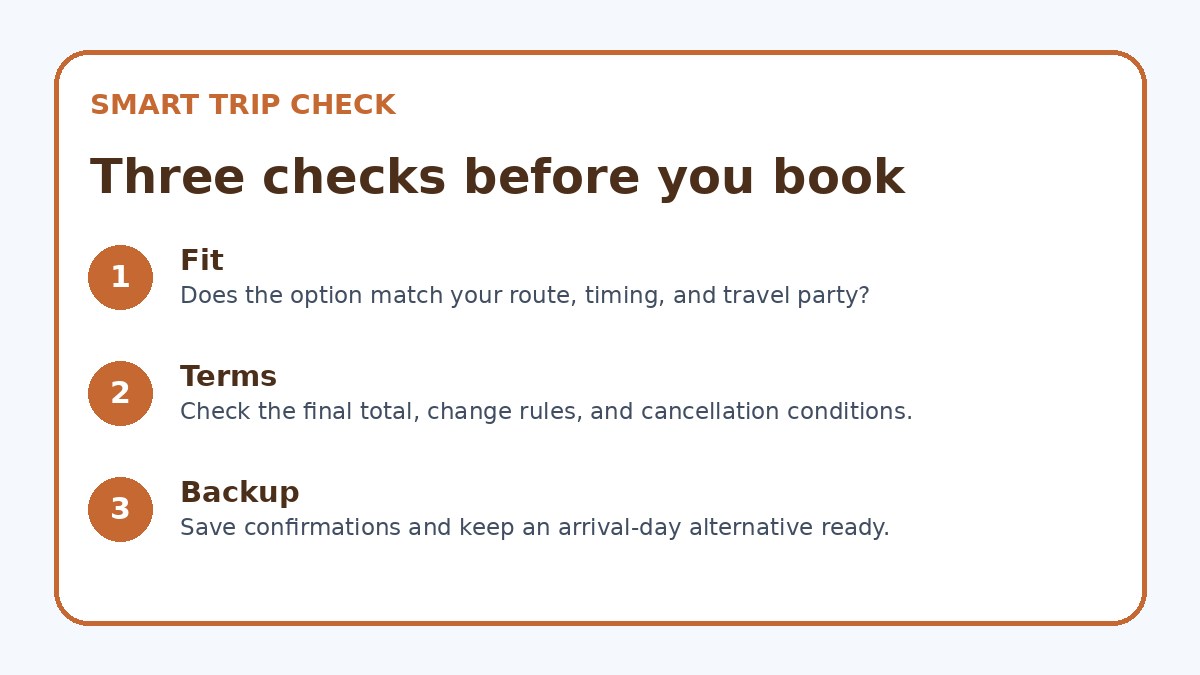
- Confirm your accommodation address and the preferred pickup point or closest station entrance in writing.
- Calculate the door-to-door transfer time and add at least 30–60 minutes buffer for traffic or connections.
- Check luggage capacity and any special requirements (oversized items, child seats) with the chosen transport provider.
- Review the operator’s final booking page for exact pickup times, meeting points, baggage rules, and cancellation terms.
- Save the transport provider’s phone number and your booking reference, and keep them accessible on your phone.
- Pack a small carry-on with travel documents, chargers, and essentials so you can leave quickly if plans change.
Timing, luggage, and last-minute checks
Decide your airport arrival target based on your airline’s recommendations, your comfort with security lines, and whether you need to check bags. Once you have that target time at the terminal, subtract transfer duration plus a buffer to find your required departure from the hotel. For example, if you aim to be at the airport two hours before departure, reverse-calculate using conservative transfer estimates to avoid stress. Keep a mobile charger and paper copies of reservation confirmations and contact numbers in case your phone loses power or service.
The night before departure, re-check all confirmations and the live status on the operator’s final booking page—this includes shuttle times, taxi pickup contact, and public transport advisories. Pack carry-on essentials so you can step out quickly, and place documents and passports in a visible, accessible spot. If language is a concern, save translated directions or the airport name in Korean to show drivers or station staff. Finally, leave earlier rather than later if you’re uncertain about an unfamiliar route.
Frequently asked questions
How much buffer time should I leave for a Busan airport transfer?
Buffer needs depend on your chosen mode and time of day. For public transport, allow extra time for walking between stations and potential waits; add at least 30–60 minutes beyond scheduled travel time. For taxis or private cars, allow additional time for peak-hour traffic or road incidents—again, build in at least 30 minutes extra if you have a fixed flight check-in deadline. If your flight requires extra check-in time (international flights, checked baggage), increase the overall buffer accordingly. Always confirm specific service times on the operator’s booking page before departure.
Is it safer to book a private transfer than to take public transport?
Safety depends more on preparation than the transport mode. Private transfers reduce exposure to crowded transfers and simplify door-to-door logistics, which some travellers prefer. Public transport in Busan generally runs on regular schedules and is well-used by locals and tourists, but it requires navigating stations and possibly carrying luggage on stairs or platforms. Verify the credentials and reviews of private transfer providers, and check the operator’s final booking page for identity and contact details. For late-night departures, private transfers may offer added convenience when fewer public options operate.
What should I verify on a provider’s final booking page before departure?
Check the exact pickup time and location, the driver or operator contact number, baggage allowances, and cancellation or amendment policies. Look for details about meeting points (hotel lobby, curbside, specific station exit), any extra fees for waiting time or tolls, and how the provider handles flight delays. For shared shuttles, verify how many stops are planned and whether that affects your schedule. If you used a third-party platform to book, confirm the operator’s own page or contact details in case you need to reach them directly on the day.
Final planning note
Planning your Busan airport transfer becomes straightforward once you identify what matters most: minimizing cost, avoiding transfers, or guaranteeing a direct pickup. Map your full route, confirm pickup points and luggage rules, and add a healthy time buffer to account for transfers or traffic. Use local maps and the operator’s final booking page to verify schedules and meet-up instructions the night before your flight. With a clear plan and contingency time, you’ll leave Busan without last-minute stress and reach the terminal with confidence.
Continue planning
Check current options and final conditions
Use the provider page to confirm live availability, the final total, cancellation terms, and every condition that matters to your trip.
This evergreen planning guide was created with AI-assisted drafting and a structured quality review. It does not display live prices, schedules, availability, visa guidance, or provider rankings. Verify current details before booking. Some links are affiliate links; we may earn a commission at no additional cost to you.