If you’re traveling from Bangkok to Chiang Mai with extra luggage, the practical answer is to plan transfers around a single, luggage-friendly route: pick the right departure/arrival points, pre-book a vehicle that fits your bags, and schedule extra time for handling and security checks. Start by deciding whether you prefer train travel (more luggage-friendly carriages) or air travel (faster but needs airport transfers), then map the exact terminals and stations you’ll use in each city. Allow padding for Bangkok traffic or station crowds, and avoid last-minute connections that force you to haul bags across long concourses. This article focuses on the station and terminal transfer choices that most affect travelers with bulky or multiple pieces of luggage, explains the tradeoffs, and gives practical checklists so you can compare options and book with confidence.
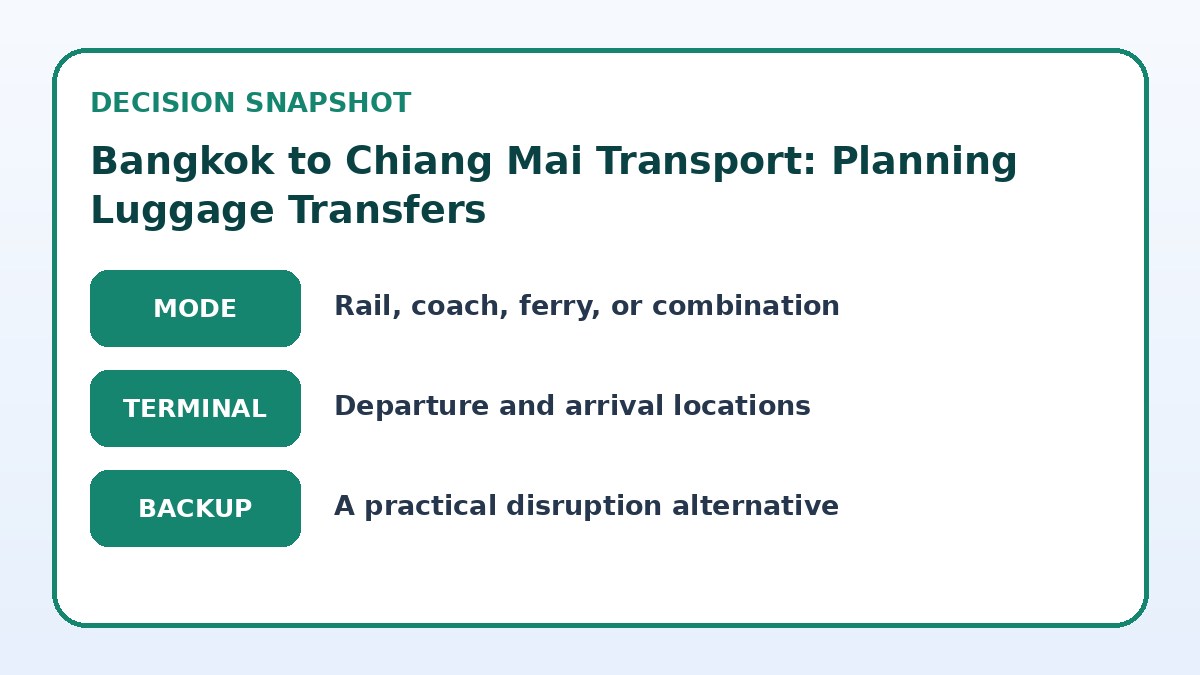
See current options before you compare the details
Availability and final conditions change. Open Trip.com now or keep reading for the practical comparison.
Choosing between train and plane for bulky luggage
When deciding route mode, think in terms of bag handling rather than travel time alone. Trains between Bangkok and Chiang Mai give you more freedom to bring oversized or multiple bags into the carriage, and platforms are usually accessible by elevators or ramps at major stations—yet some overnight trains have limited storage space near berths. Flying is faster but adds compulsory steps: check-in, security, and potentially inter-terminal transfers. For heavy or fragile items, trains reduce the number of times baggage has to be lifted on and off vehicles.
Compare the inconvenience cost: a longer trip that avoids multiple transfers can be worth the extra hours if it saves repeated lifting and re-packing. Also consider how you’ll get to and from stations or airports in both cities—Bangkok traffic can turn a short distance into a slow transfer. Make your decision by listing all pickup and drop-off points, the equipment needed to move bags (trolleys, ramps), and whether you can pre-book a vehicle with more space to handle everything in a single move.
Picking the best departure and arrival points
Bangkok has several major rail and air hubs; Chiang Mai also has its main stations and an airport. For train travel, choose the station in Bangkok that offers direct long-distance trains to Chiang Mai and confirm which platform access options (lifts, staff assistance) are available. In Chiang Mai, check how close the train station or airport is to your final accommodation and whether the last-mile transfer services have vehicles large enough for your luggage. Avoid routes requiring shuttles between different terminals unless those shuttles are guaranteed to accommodate oversized bags.
If you opt to fly, verify whether departure or arrival is at a domestic terminal that’s easier to reach with luggage. In both cities, look for transfer providers who advertise high-roof vans or SUVs, and check whether they’ll meet you curbside or require a walk from a parking area. Where possible, arrange meet-and-greet service so a driver handles bags at pickup, and always confirm the pickup point and expected stops to prevent unexpected carrying or long walks.
| Approach | Best for | Tradeoff to check |
|---|---|---|
| Direct train station-to-station transfer | Travelers with heavy or oversized bags who want minimal intervening handling | Slower overall travel time compared with flying; platform access may require stairs at smaller stations |
| Flight with pre-booked private airport transfer | Those prioritizing speed and door-to-door convenience despite extra handling steps | More steps (check-in, security) and potential extra fees; requires careful timing to avoid missed transfers |
| Metered taxi or ride-hailing between terminals | Flexible travelers who want on-demand pickup without advance commitment | Vehicle size varies; you may need to wait or request a larger vehicle, risking inconsistent capacity |
| Pre-booked large-van or minibus transfer | Groups or single travelers with multiple big bags needing guaranteed space and assistance | Higher cost and possible fixed pickup schedules; less flexible if plans change last minute |
Ready to check the option that fits your plan?
Use your exact dates and traveler details so the provider page can show the current total and conditions.

Booking transfers: types, costs, and verification steps
There are three common transfer types: public transport, metered taxis/ride-hailing, and pre-booked private transfers or vans. Public transport is cheapest but often the least convenient for bulky bags; stair-only stations or crowded buses can be impractical. Metered taxis and ride-hailing apps offer door-to-door service but confirm vehicle size before entering a ride. Private transfers or minivans can be arranged in advance specifically for large loads and usually include assistance with luggage; ask the provider whether they supply trolleys or will help load and unload.
When booking, verify capacity and pickup details on the provider’s final booking page. Look for explicit statements about maximum number of suitcases, vehicle type, and any extra charges for oversized items. If using an online marketplace to compare options (Trip.com can be useful for checking availability), always click through to the operator’s terms and the booking confirmation to ensure vehicles are suitable and meet-and-greet arrangements are recorded. Save contact numbers and the driver/vehicle ID for the day of travel.
Before you book
- List every piece of baggage and measure dimensions to confirm vehicle or storage acceptance before booking transfers.
- Contact the transfer operator to confirm vehicle type, luggage capacity, pickup point, and any extra fees for oversized items.
- Book a transfer option that minimizes changeovers—prefer single door-to-door or station-to-station movement where possible.
- Save offline maps, station/terminal names, and the driver’s contact details in case of delays or rerouting.
- Plan at least 45–90 minutes buffer for urban transfers and longer if traveling in peak traffic or with fragile items.
- Label luggage clearly and take photos of everything before departure to speed up recovery if bags are misrouted.
Practical packing and day-of-travel strategies
Distribute weight so no single bag is too heavy for one person to lift—carry essentials and valuables in a smaller daypack for easy access. Use durable, clearly labeled luggage and secure fragile items inside clothing or padding. If you have items that can’t be lifted by one person, arrange for a transfer with two helpers or a vehicle with a tail lift. Keep a packing list and photos of your bags in case of mishandling, and ensure you have copies of booking confirmations and directions to stations or terminals saved offline.
On travel day, allow at least 45–90 minutes extra for station or airport navigation when carrying lots of baggage; more time if you expect heavy traffic or long ticket queues. Arrive early and ask staff for baggage assistance where available. When transferring between modes, avoid routes requiring multiple short stops—each stop multiplies the number of times you need to load and unload. If you expect to store luggage temporarily at a station, check storage availability and security procedures before you go.
Frequently asked questions
Can I bring oversized luggage on the train from Bangkok to Chiang Mai?
Trains are generally more tolerant of larger or multiple bags than airlines, but storage space near berths varies. Verify with the train operator what counts as oversized and whether you need to store items in designated areas. If your bags are unusually large or heavy, ask about porters, staff assistance, or reserved luggage space when you book. On the day, arrive early to find suitable storage and to avoid last-minute shuffling between carriages.
How should I time my transfer if I fly and then need to get to central Chiang Mai with heavy bags?
When flying, allow additional buffer for gate-to-baggage claim time and any inter-terminal movement in Bangkok. Once you land, prioritize a pre-booked vehicle that explicitly lists capacity for your luggage so you avoid last-minute vehicle changes. Check the transfer operator’s pickup procedures — curbside meeting points or meet-and-greet services reduce walking. If using ride-hailing, request a larger vehicle in advance and communicate any special loading needs to the driver.
Are there secure luggage storage options when switching stations or terminals?
Many major stations and airports offer paid luggage storage or left-luggage services, but availability and size limits differ by location. Before relying on storage, confirm operating hours, maximum item dimensions, insurance or liability policies, and whether advance reservation is required. If storage isn’t suitable for large items, arrange a transferable lockable container or a transfer service that accepts temporary holding. Always retain receipts and take photos of stored items for identification.
Final planning note
For travelers with extra luggage, the decision between train and air travel on the Bangkok–Chiang Mai route comes down to how many times you want to handle your bags. Trains tend to reduce repeated lifting and are friendlier to oversized items, while flying saves time but adds mandatory steps and potential inter-terminal movement. The best practical strategy is to choose a departure/arrival point that minimizes transfers, pre-book an appropriately sized vehicle or porter service, and build in time buffers for traffic, queues, and loading. Verify vehicle size, pickup details, and luggage policies on the operator’s final booking page before you pay, and keep contact details and confirmations accessible throughout the journey.
Continue planning
Check current options and final conditions
Use the provider page to confirm live availability, the final total, cancellation terms, and every condition that matters to your trip.
This evergreen planning guide was created with AI-assisted drafting and a structured quality review. It does not display live prices, schedules, availability, visa guidance, or provider rankings. Verify current details before booking. Some links are affiliate links; we may earn a commission at no additional cost to you.