If you’re traveling from Seoul to Tokyo with kids, the practical question is simple: pick the flight type that matches your family’s priorities. For most families with small children or tight schedules, a direct flight minimizes stress and complexity. Families prioritizing lower fares, more flexible schedules, or sightseeing en route may find a single connection useful, but that comes with added transit time, baggage handling and planning for airport transfers. In this guide I’ll walk you through the tradeoffs — time vs cost, rest vs logistics, and how to judge connection layouts — and give a straightforward checklist to use at booking. Read the quick comparison, then use the decision criteria to match the option to your child’s age, mobility and tolerance for airport time.
See current options before you compare the details
Availability and final conditions change. Open Trip.com now or keep reading for the practical comparison.
How direct and connecting flights differ for family travel
Direct flights are typically one takeoff and one landing between airports; that simplicity means less time spent in airports and fewer opportunities for confusion. For families this reduces the number of times you need to manage boarding, security checks, stroller gate-checking, or carrying children between gates. The clearer timeline also helps keep young children on a predictable routine and makes pre-boarding and seat selection more straightforward when you book together.
Connecting flights split the journey into segments, which can offer more departure times, potentially lower fares, or the chance to visit a second city briefly. But every connection introduces handoffs: you may need to change terminals, navigate unfamiliar airports, collect and recheck luggage, or clear immigration and security again. Each additional step increases the chance of missed connections or delays that ripple through a family’s schedule.
When a direct flight is usually the better option
Choose direct service when minimizing stress, transit time, and logistical complexity are top priorities—especially with infants, toddlers, or elderly family members. A single flight reduces the number of times you’ll carry or gate-check a stroller, coordinate transfers with child-friendly amenities, or manage cranky kids in crowded terminals. If your family values predictability, having fewer moving parts on travel day makes for a calmer experience and a faster door-to-door journey.
Direct flights also simplify emergency planning: if a delay happens, you deal with one airline and one airport’s infrastructure instead of multiple providers. That can make rebooking, requesting assistance, or arranging special meals and seating easier. When seat continuity, luggage peace of mind and minimal airport transfers are your priority, direct options typically win even if they sometimes cost a bit more.
| Approach | Best for | Tradeoff to check |
|---|---|---|
| Prioritize time and simplicity (direct) | Families with infants, toddlers, or tight schedules | May be fewer flight times and sometimes higher fare or less flexibility |
| Prioritize cost and flexibility (connecting) | Families with older children or flexible plans | More steps, longer total travel time, and extra baggage/transfer logistics |
| Build a long, planned stopover (connecting) | Families wanting a mini-break or extra sightseeing en route | Requires careful visa/entry checks and adds overall trip complexity |
| Mix carriers for savings (connecting) | Budget-conscious families willing to manage transfers | Higher risk for missed connections and manual baggage reclaims; verify transfer policies |
Ready to check the option that fits your plan?
Use your exact dates and traveler details so the provider page can show the current total and conditions.
When a connecting flight makes sense for families
A connecting itinerary can be a smart choice when you need greater schedule flexibility, want to lower the fare, or plan a stopover that benefits the trip. If you can build a connection with a comfortable layover—long enough to refresh and move between gates without rushing—a break can be an opportunity to change diapers, stretch legs, and avoid cramped cabin time. Older children who enjoy a brief airport walk or plane spotting may find the rhythm of a connection tolerable or even fun.
Connecting flights can also expand seat availability for family groups and open earlier or later departure windows that fit your vacation plans better. The trade-off is extra planning: confirm whether baggage transfers automatically, whether you must clear immigration at the connecting airport, and whether the connection requires moving between terminals. Those operational details determine whether a connection will be a helpful pause or an added headache.
Before you book
- Confirm whether baggage transfers automatically between legs and note fees or weight limits for each segment.
- Check minimum connection times and whether you must change terminals or clear immigration at the connecting airport.
- Reserve seats together early and request bulkhead or bassinet seats if traveling with an infant.
- Pack a dedicated carry-on with snacks, medications, spare clothes, wet wipes, and small toys easily reachable during transit.
- Verify family-friendly services (priority boarding, restrooms with changing tables, airport lounges) on airline and airport pages before booking.
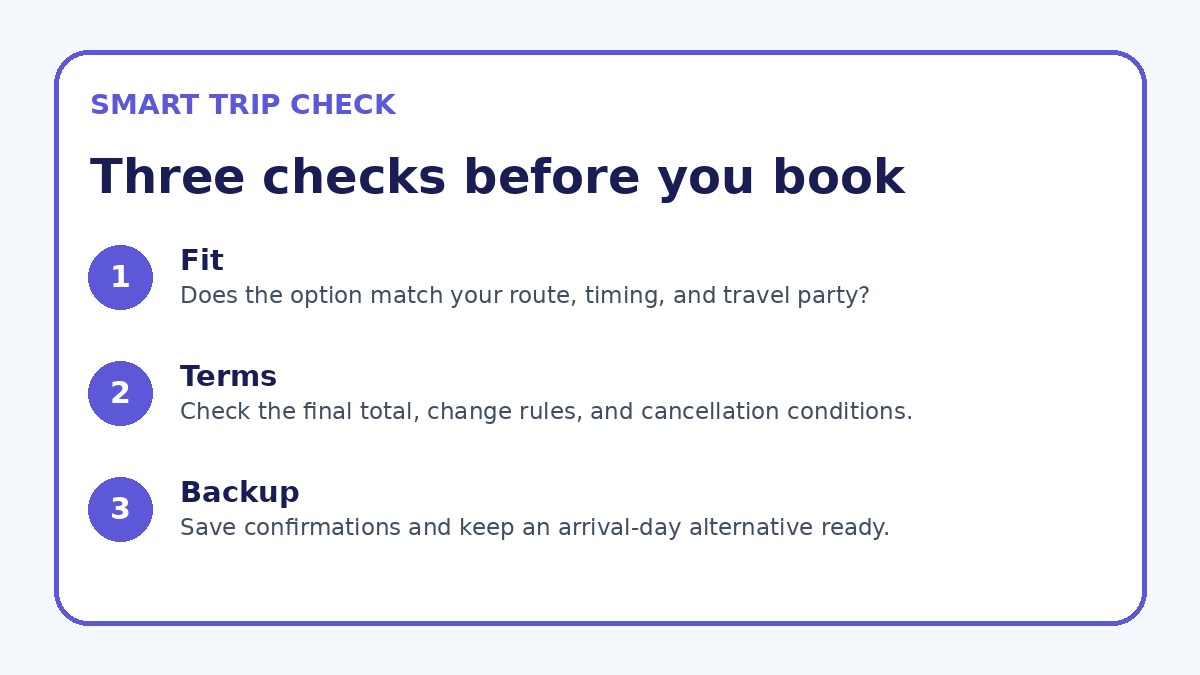
- Have a simple backup plan: know rebooking policies, alternate flights that day, and how to contact the airline quickly from the airport.
How to compare and verify options before booking
Make side-by-side comparisons that go beyond price and total travel time. Check the itinerary for the number and location of connections, minimum connection times, and whether the same carrier or alliance operates both legs—same-carrier itineraries are usually simpler for transferring luggage and handling disruptions. Look for family-friendly amenities listed by the airline or airport such as priority boarding for families, onboard bassinets, lounge access, diaper-changing facilities, and proximity of gates at the connecting airport.
Always verify key operational facts on the airline’s final booking page before you pay: baggage allowance for each segment, whether your luggage transfers automatically at the connection, whether you’ll need to clear immigration or customs mid-route, and the carrier’s policy on reserving adjacent seats for families. Use live comparison sites like Trip.com for availability, but confirm carry-on rules, infant fares, and seating directly with the carrier to avoid surprises.
Frequently asked questions
How much longer do connecting Seoul to Tokyo flights typically take compared with direct flights?
Connecting itineraries add both airborne time and layover time, so total travel duration depends on the connection length. Even a single connection can add one to several hours beyond flight time when you include time on the ground, terminal transfers, and any required immigration or baggage steps. When comparing options, look at door-to-door estimates rather than just scheduled flight times, and factor in extra buffer time for tight connections with children to avoid rushed transfers.
What should parents check about baggage and strollers when comparing airlines?
Confirm whether checked and carry-on allowances apply per ticketed segment and whether the connecting airline honors the same rules. Ask whether strollers can be gate-checked and whether they transfer automatically or must be reclaimed and rechecked during the layover. Check the airline’s policy for infant baggage allowances and whether items like car seats require advance notice or special handling on each carrier’s booking page before completing your purchase.
Are there connection patterns or airports to avoid for families traveling between Seoul and Tokyo?
Avoid itineraries that require unusually short layovers, long terminal transfers, or immigration stops that force you to exit and re-enter the secure area unless you’re comfortable with the procedure. If a connection requires moving between non-adjacent terminals or using shuttle buses, that increases complexity with kids and luggage. Before booking, review airport maps and terminal transfer procedures and confirm whether your itinerary keeps you airside or requires arrivals/immigration during the connection.
Final planning note
Choosing between direct and connecting Seoul to Tokyo flights for families comes down to priorities: reduce stress and save time with direct service, or gain schedule and cost flexibility with well-planned connections. Direct flights minimize the number of moving pieces—ideal with small children or tight schedules—while connections can be workable if you build realistic layovers, verify baggage transfer, and choose same-carrier or alliance itineraries to lower the risk of disruption. Use the checklist to confirm operational details on the airline’s final booking page, compare live options on sites like Trip.com if you want a broad view, and pick the plan that aligns with your family’s tolerance for airport time versus potential savings and schedule choice.
Continue planning
Check current options and final conditions
Use the provider page to confirm live availability, the final total, cancellation terms, and every condition that matters to your trip.
This evergreen planning guide was created with AI-assisted drafting and a structured quality review. It does not display live prices, schedules, availability, visa guidance, or provider rankings. Verify current details before booking. Some links are affiliate links; we may earn a commission at no additional cost to you.