Practical answer first: if you’re traveling light with one easy-to-wheeled bag and want the lowest hassle-cost balance, use Taipei’s public airport links (MRT, airport buses, and local trains). If you have multiple large suitcases, oversized items, or door-to-door pickup with minimal carrying, a private transfer or taxi will save time and physical strain. Which to choose comes down to how many bags and how much effort you're willing to spend, whether you need direct drop-off at a specific hotel entrance, and how comfortable you are managing luggage on stairs, crowds, and platform transfers. Below I explain the tradeoffs, how to compare options, what to check when you book, and a practical checklist so you can make a confident choice for arriving at or departing from Taipei.
See current options before you compare the details
Availability and final conditions change. Open Trip.com now or keep reading for the practical comparison.
How Taipei public options work with luggage
Taipei’s public options include the airport MRT, intercity and local buses, and commuter trains. These services are designed for regular passengers rather than oversized cargo, so you’ll typically carry or wheel luggage on and off trains and buses and move through paid areas, concourses, and platform stairs or elevators. Elevators and ramps exist at major stations and terminals, but you may still need to navigate crowded trains, transfer corridors, or gaps between platforms. If your bags are stackable and within standard rolling-suitcase sizes, public transport is usually manageable; plan a bit more time for transfers and choose off-peak travel if you want fewer crowds.
Think about the door-to-door aspect: public transport may require additional walking, transfers, or a short taxi from the station to certain hotels. Also check whether your hotel has a convenient station nearby or if it’s uphill or on a narrow street that makes carrying suitcases cumbersome. For group travelers with several medium suitcases, splitting luggage across people reduces strain. If mobility limitations or complicated hotel access exist, that changes the balance toward a private vehicle that can stop at the building entrance and handle loading and unloading for you.
What private transfers and taxis offer for heavy luggage
Private transfers, pre-booked cars, and metered taxis remove much of the physical work: the driver or service helps load and unload at curbside, and you go straight to your hotel without platform changes or bus stops. For oversized items such as sports gear, strollers, or multiple large suitcases, a vehicle with appropriate trunk space or an SUV/van is usually necessary. When booking a private vehicle, confirm on the provider’s final booking page the maximum luggage allowance, vehicle model or class, number of suitcases that fit, how additional baggage is charged, and whether there are any restrictions on items like bikes or musical instruments.
Tradeoffs include cost (private rides are typically more expensive than a public trip) and susceptibility to road traffic. Early morning or late-night arrivals can especially benefit from pre-arranged private transfers when public services are limited. Also verify pickup logistics: some services require meeting at a fixed desk or meeting point inside the terminal, while others will meet at curbside — the provider’s final booking page will show the exact instructions you must follow to avoid delays.
| Approach | Best for | Tradeoff to check |
|---|---|---|
| Public transport (MRT, train, bus) | Travelers with one or two standard-sized suitcases and flexible time | Lower cost but requires carrying luggage through stations and possible transfers |
| Pre-booked private transfer or van | Groups or travelers with multiple large/oversized bags needing door-to-door service | Higher cost; subject to road traffic and depends on correct vehicle sizing |
| Metered taxi or ride-hailing | Single family or small group needing direct ride and flexible pickup times | Easier than public transport but trunk space varies and fares can rise in traffic |
| Mixed approach (public + short taxi) | Travelers who want to save on long legs but avoid carrying luggage far at endpoints | Saves money versus private door-to-door but adds a taxi transfer and coordination |
Ready to check the option that fits your plan?
Use your exact dates and traveler details so the provider page can show the current total and conditions.
Decision criteria: luggage, mobility, timing, and budget
Start by listing what you’re carrying: count suitcases, note any oversized pieces, and flag fragile or valuable items that you’d rather keep near you. Next, consider mobility — do you have older travelers, children, or anyone who can’t manage stairs or long walks? Timing matters too: late-night arrivals or very tight connections increase the value of a private ride. Budget matters but weigh the hidden costs of public options: extra taxi segments, time spent transferring, or physical strain. Often the right choice is a mix: public transport for lighter loads at daytime, private transfers for heavy, awkward, or time-pressured arrivals.
Also factor in where you’re going in Taipei. If your hotel is steps from a major MRT station, public transport becomes more attractive. If it’s in a hilly alley or a neighborhood with narrow lanes, check whether a driver can stop nearby. For departures, confirm where you must arrive at the airport and how much lead time you want: a longer buffer can make public transport viable, while a short buffer pushes toward a private option to avoid missing check-in or baggage drop.
Before you book
- Count and photograph all pieces of luggage and note any oversized items before booking transport.
- Measure the widest and longest pieces or check the airline’s oversized policy if you have nonstandard gear.
- Check elevator and ramp availability for your arrival station and map the walking route to your hotel.
- When booking a private transfer, confirm vehicle model/class and the maximum number of suitcases on the provider’s final page.
- Confirm terminal pickup details: exact meeting point, driver contact method, and any grace period for delays.
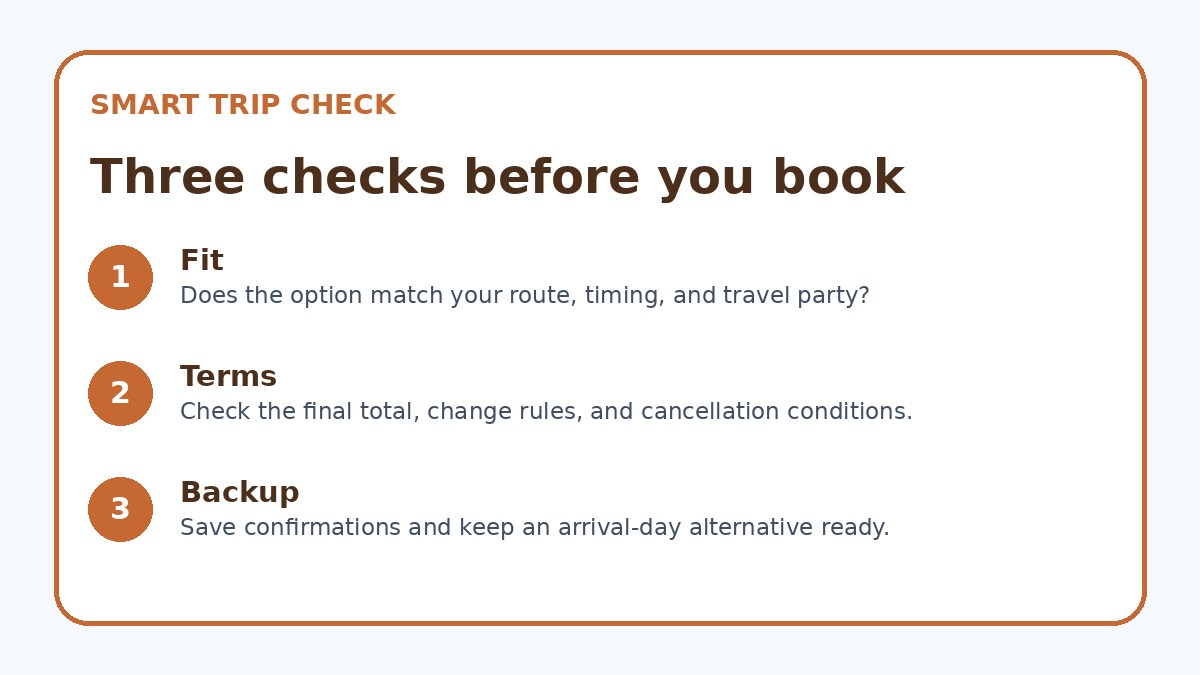
- Allow extra time for unexpected delays and have a backup plan (nearby taxi stand or station) if your primary option falls through.
How to compare and book the right transfer
When comparing options, make a short table for yourself: list total luggage count, number of people, mobility needs, desired pickup time, and whether you need curbside assistance. For private bookings, compare included kilometers, pickup instructions, vehicle size, and cancellation terms on the provider’s final booking page before you commit. For public options, check station locations relative to your hotel, number of transfers, and whether elevators or ramps are available at each station. Use a mapping app to measure walking routes and stairs between station exits and your accommodation to avoid surprises.
Trip.com can be a place to compare current availability and transfer types, but always verify important details like vehicle size and exact pickup procedures on the transfer operator’s own page or confirmation email. On the booking page confirm where the driver will meet you at the terminal, how long they wait, how additional waiting time is charged, and whether the vehicle will accommodate extra or oversized baggage. If in doubt, contact customer service or the provider directly to confirm specifics prior to travel.
Frequently asked questions
Can I take very large or oddly shaped baggage on Taipei’s public transport?
Public transport can handle typical rolling suitcases but becomes difficult with very large or unusually shaped items. Elevators and ramps exist at major stations, but you may face narrow corridors, platform gaps, or crowded carriages. For items such as surfboards, large musical instruments, or multiple oversized boxes, a private vehicle or taxi is usually more practical. If you must use public transit, plan for extra time, travel during off-peak hours, and verify station accessibility along your route.
How do I know what size vehicle to book for my luggage?
When booking a private transfer, check the operator’s stated vehicle class and luggage capacity on the final booking page. Operators typically list vehicle type (sedan, SUV, minivan) and sometimes the number of suitcases accommodated; if that detail isn’t clear, contact the operator to confirm trunk space for your specific number and sizes of bags. If you travel with bulky items, choose a larger vehicle or reserve an extra seat so the driver has space, and reconfirm pickup instructions in advance.
Is it faster to take a private transfer than MRT between Taoyuan and central Taipei?
Private transfers can be faster door-to-door when you’re going directly to a hotel with minimal walking, especially late at night or with many bags. However, travel time by road depends on traffic conditions and can be longer during peak periods. The MRT follows a predictable schedule and avoids road congestion but requires walking to and from stations and possibly transfers. Compare the total door-to-door time, not just in-vehicle time, and choose based on your luggage, schedule, and tolerance for walking and transfers.
Final planning note
Choosing between public and private Taipei airport transfer comes down to a few simple factors: how much and how bulky your luggage is, whether anyone in your party has mobility needs, how direct you want the route to be, and how much time and money you’re willing to trade for convenience. If you travel light and have time, the MRT and airport buses are efficient and integrate easily with Taipei’s transit network. For heavy, fragile, or numerous bags, or for arrivals when you want minimal handling, book a private transfer or taxi and confirm vehicle size and pickup details on the provider’s final booking page. Use the checklist before you book so you won’t be surprised at the terminal, and plan a backup taxi or station route just in case your primary plan changes.
Continue planning
Check current options and final conditions
Use the provider page to confirm live availability, the final total, cancellation terms, and every condition that matters to your trip.
This evergreen planning guide was created with AI-assisted drafting and a structured quality review. It does not display live prices, schedules, availability, visa guidance, or provider rankings. Verify current details before booking. Some links are affiliate links; we may earn a commission at no additional cost to you.