
If you’re traveling from Amsterdam to Rome with extra luggage, start by prioritizing airports that make baggage handling simple: lower transfer time, generous check-in counters, and straightforward transport options matter more than tiny ticket savings. For most travelers carrying large suitcases, sports gear, or bulky items, Amsterdam’s Schiphol (AMS) is typically the most practical departure because it concentrates airline services, multiple baggage-drop lanes, and reliable public and taxi links. However, depending on where you live in the Netherlands and your tolerance for connections, regional airports like Rotterdam The Hague (RTM) or Eindhoven (EIN) can still make sense—especially if they offer direct flights that avoid an extra connection and reduce overall door-to-door hassle. Read on to compare how baggage allowances, transfer logistics, and indirect routes change the calculus so you can book an Amsterdam to Rome flight that fits your luggage needs.
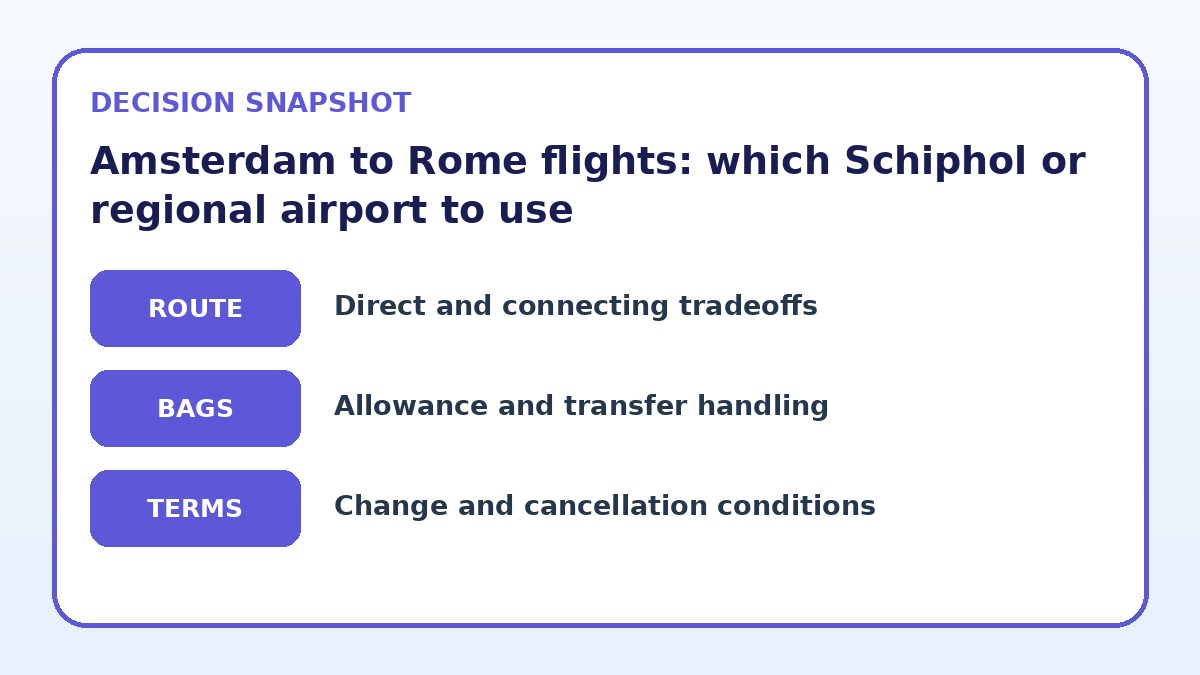
See current options before you compare the details
Availability and final conditions change. Open Trip.com now or keep reading for the practical comparison.
Why departure airport matters when you have extra luggage
Extra luggage changes travel priorities. When you’re juggling heavy suitcases, sports equipment, or multiple checked bags, the practical factors shift from ticket price alone to how easily you can check, move, and retrieve baggage. More airline counters and baggage-drop islands reduce queuing time; wide corridors and elevator access reduce strain; good ground-transport connections let you avoid long walks carrying bags. Choosing the right departure airport can cut total door-to-door time and the physical hassle of transfers, which is particularly relevant for older travelers, families, or anyone with oversized items.
Airports differ in how they accommodate luggage: some have centralized check-in halls with automated bag drops, while others operate smaller, single-terminal setups with fewer attendants. You should also consider contingency handling—lost-bag procedures, off-peak staffing, and space for oversized items. These operational differences affect the likelihood and impact of delays or mishandled bags. For Amsterdam to Rome travel, prioritize airports where the chain of movement—home to terminal, curbside, check-in, security, and boarding—has the fewest friction points.
Schiphol: the default practical choice for baggage-heavy travelers
Amsterdam Schiphol is the Netherlands’ main international hub and usually the practical pick for travelers with extra luggage because it consolidates airline services and facilities. Expect multiple check-in counters, several baggage-drop options, spacious arrivals and departures halls, and frequent public-transit connections that can carry luggage comfortably. Concentrated airline operations also help when you need to change flights or pursue rebooking—more staff and services are usually available to assist with oversized or special-item handling than at smaller airports.
That said, Schiphol’s scale brings tradeoffs. Terminals can be large and require longer walks between curbside, security, and gates—so plan for extra time to move with heavy bags. Peak-hour crowds can lengthen queues despite multiple counters. If you live much closer to a regional airport or have a short transfer time to a smaller airport offering a direct flight to Rome, Schiphol’s advantages may be outweighed by the convenience of a nearby departure. Always check the airline’s baggage policy and the airport’s terminal layout when planning.
| Approach | Best for | Tradeoff to check |
|---|---|---|
| Depart from Schiphol (AMS) | Travelers wanting comprehensive baggage services and many flight choices | Larger terminal means more walking and sometimes longer in-airport transfers |
| Depart from Rotterdam The Hague (RTM) | Those living nearby who prefer smaller terminals and potential direct flights | Fewer flights and airlines may mean higher baggage fees or limited schedules |
| Depart from Eindhoven (EIN) | Regional travelers seeking quick access and less crowded facilities | Limited frequencies can increase risk of delays or inconvenient connections |
| Choose a connecting itinerary via a secondary hub | Finding lower base fares or routing that reduces layover handling | Adds connection complexity and extra baggage handling steps you must verify |
Ready to check the option that fits your plan?
Use your exact dates and traveler details so the provider page can show the current total and conditions.

Regional airports: when proximity and direct routes beat hub convenience
Rotterdam The Hague and Eindhoven can be appealing when they offer direct flights to Rome or to a one-stop itinerary with short connection times. If you live near those airports and can reach the terminal quickly, you avoid the longer road or rail trip to Schiphol and simplify the start and end of your journey. Smaller terminals usually mean less walking between check-in, security, and the gate, and staff may be able to provide more personalized assistance for oversized items when flights are quieter.
On the other hand, regional airports often have fewer daily flights and limited airline choices, which can increase the chance of inconvenient schedules or connections that add complexity—especially if a missed connection means re-routing through a different hub. Baggage allowances and fees may also vary more by airline at regional carriers or low-cost operators; those fares frequently exclude checked pieces or charge higher per-item fees. Compare the full cost after adding the airline’s baggage fees and the time and difficulty of reaching the regional airport before deciding.
Before you book
- Verify the airline’s exact baggage allowance and fees on the airline’s final booking page before purchasing any ticket.
- Measure and weigh all luggage at home to ensure each item's dimensions and weight meet airline limits.
- Compare total door-to-door travel time from your home to the departure airport, including likely traffic or train connections.
- Factor in terminal layout and estimated walking distances; prioritize airports with elevators and short paths if you have heavy bags.
- Check how your itinerary handles transfers—whether luggage is checked through to Rome or must be rechecked at a connection.
- Buy travel protection or add flexible rebooking if your route depends on a single daily flight from a regional airport.
How to compare flights and pick the most practical option
Start by listing departure airports you can realistically reach (Schiphol, Rotterdam, Eindhoven, and potentially Lelystad depending on schedules). For each flight option, do three checks: total door-to-door time including transfers, the airline’s checked-baggage allowance and specific size/weight rules, and the airport terminal layout and ground-transport options. Add any baggage fees shown on the airline’s final booking page to the ticket price so you’re comparing apples to apples. If a direct flight is available from a regional airport, compare the time saved against any extra baggage fees the airline charges.
When evaluating connections, factor in minimum connection times and the practicalities of moving between gates with heavy bags. If a transfer requires changing terminals or re-checking luggage, that increases risk and effort. Also consider contingency: a missed connection at a small airport with limited flights can lead to longer delays than at a hub with many onward options. If you’re uncertain, contact the airline’s baggage desk and verify dimensions, fees, and any special-item handling before booking. Trip.com can be useful for seeing current availability, but always confirm baggage rules on the airline’s official booking page.
Frequently asked questions
Is Schiphol always the best airport to leave from if I have extra luggage?
Schiphol is often the most practical because it concentrates airline services, multiple baggage-drop options, and strong ground links, which reduce risk if issues arise. However, 'best' depends on your starting point and itinerary. If a regional airport offers a direct flight and is much closer to your home, the shorter transfer and smaller terminal could outweigh Schiphol’s advantages. Always compare the full door-to-door time, the airline’s baggage policies, and any extra fees before deciding.
How do I handle oversized or special items when booking Amsterdam to Rome flights?
Treat oversized or unusual items (sports equipment, instruments, large boxes) as special baggage: check the airline’s specific size and weight rules on its booking page and look for any special-handling reservation steps. Some carriers require advance notice or a separate booking for oversized items; failing to do so can result in refusal at check-in or last-minute fees. Also verify whether the airport offers assistance for large items and whether you’ll need dedicated transport to reach the terminal.
If I choose a regional airport and my connecting flight is delayed, what should I consider?
Smaller airports tend to have fewer onward flights, so a missed connection can mean waiting many hours for the next available service. Check alternative routings and whether the airline provides rebooking or accommodation in such cases—confirm these policies on the airline’s site. If your schedule is tight, prefer airports with multiple daily flights to Rome or hubs with frequent connections. Buying flexible fares or travel protection that covers missed connections is a practical safeguard when relying on limited regional schedules.
Final planning note
For most travelers carrying extra luggage, Amsterdam Schiphol will be the practical default because of its concentrated airline services, multiple baggage facilities, and broader onward options. Yet regional airports can be the smarter choice when they offer a direct flight close to your home and you can avoid long road or rail transfers. The right decision comes down to three specific checks: total door-to-door travel time, the airline’s baggage allowance and fees verified on the carrier’s final booking page, and how transfers and terminal layouts will affect moving your luggage. Use those criteria to compare Schiphol and nearby airports, and choose the departure that minimizes handling steps and unexpected fees for a smoother trip to Rome.
Continue planning
Check current options and final conditions
Use the provider page to confirm live availability, the final total, cancellation terms, and every condition that matters to your trip.
This evergreen planning guide was created with AI-assisted drafting and a structured quality review. It does not display live prices, schedules, availability, visa guidance, or provider rankings. Verify current details before booking. Some links are affiliate links; we may earn a commission at no additional cost to you.