If you’re arriving in Busan alone, the most useful question is: which transfer option gets you to your neighborhood reliably, comfortably, and within the time you want to spend? This guide quickly lays out the practical options — subway, airport limousine buses, regular intercity buses, taxis and ride-hailing, and pre-booked private transfers — then explains how to weigh cost, luggage, comfort, and door-to-door convenience. You’ll get clear criteria to compare options based on where you’re staying in Busan (Haeundae, Seomyeon, Nampo-dong, or farther out), how much walking or waiting you prefer, and whether you need guaranteed English help. It also tells you what to verify on provider pages before booking and how to handle transfers that require connections. Read this to decide fast, then check the final provider pages for current service details.
See current options before you compare the details
Availability and final conditions change. Open Trip.com now or keep reading for the practical comparison.
Identify your arrival and where you need to go
Busan’s airports serve different routes and terminals; the transfer choice depends first on which airport and terminal you land at and the part of Busan you’re heading to. Before choosing, note whether your destination is in central hubs like Seomyeon or Haeundae, the port area around Nampo-dong, or a suburban district. Each of those areas has distinct public transport links and taxi availability. Writing down your exact hotel or guesthouse address and a landmark will save time when you ask for directions, show a driver, or enter a location into a navigation app.
Also check terminal arrival procedures and the location of public transport stops relative to the terminal building you’ll exit. Some transfer options require a short outdoor walk or a shuttle between terminals. If you travel with oversized luggage or a bicycle, consider whether the subway or buses allow that level of baggage without extra hassle. Finally, if you anticipate arriving late at night, confirm which services run after hours so you aren’t unexpectedly left with only taxis.
Public transport: subway and airport buses
The subway and airport-oriented buses will usually be the most budget-friendly choice and can be straightforward for solo travelers who prefer following fixed timetables. Subways can be faster during peak road traffic and typically have good signage in English, but they may require transfers and a few stairs. Airport buses aim for major hotels and neighborhoods and reduce transfers; however some stops might not be right at your door, so you may still need a short taxi or walk from the bus stop to your lodging.
When choosing between subway and bus, compare total door-to-door time, number of transfers, and luggage handling. If you value simplicity over a slightly lower fare, a single-seat bus might beat a shorter but transfer-heavy subway trip. Check the latest timetables, any luggage rules, and the precise stop names on the provider’s official page before you leave — timetables and routes can change seasonally. Trip.com can be used to compare current availability, but verify details on the operator’s page before you book or plan around a schedule.
| Approach | Best for | Tradeoff to check |
|---|---|---|
| Subway | Budget-conscious solo travelers who don’t mind walking or transfers | May require carrying luggage on stairs and making connections |
| Airport limousine bus | Travelers seeking fewer transfers and more comfortable seating | Stops may be a short walk from your accommodation |
| Taxi / ride-hailing | Door-to-door convenience for late arrivals or heavy luggage | Can be slower in heavy traffic and requires negotiation of route or address |
| Pre-booked private transfer | Solo travelers who want guaranteed meet-and-greet and no arrival uncertainty | Higher cost and need to verify cancellation and delay policies |
Ready to check the option that fits your plan?
Use your exact dates and traveler details so the provider page can show the current total and conditions.
Taxis, ride-hailing and private transfers
Taxis and app-based ride services give the simplest door-to-door experience for solo travelers, particularly after a long flight or with heavy luggage. Standard taxis are widely available at airport taxi ranks, and ride-hailing apps may offer options that include language assistance or card payments. If you choose a taxi, be ready to show the address in Korean or a map pin; ask the driver to confirm the route if you’re unfamiliar with local roads. Consider a larger vehicle if you have bulky baggage or sports equipment.
Pre-booked private transfers offer the most predictability: a driver meets you at arrivals, handles luggage, and takes you directly to your door. This can be especially appealing for late-night arrivals or when you prefer not to navigate transport decisions after landing. When comparing private transfer providers, verify cancellation rules, pick-up meeting points, what happens if flights are delayed, and whether the quoted time includes waiting after touchdown. Always confirm vehicle size and driver contact details on the booking page before finalizing.
Before you book
- Note your exact accommodation address and a nearby landmark in Korean and save it offline.
- Check which terminal you’ll arrive at and the nearest transport stop or taxi rank for that terminal.
- Compare door-to-door time, number of transfers, and luggage handling before choosing subway, bus, or taxi.
- If booking a private transfer, confirm pickup point, driver contact, and waiting policy on the booking page.
- Have a backup plan (photo of address, alternative transport option, and local emergency number) in case of delays.
- Download or screenshot route maps and timetables because on-screen connectivity can be unreliable on arrival.
How to decide: tradeoffs and booking checks
Choose by weighing three main tradeoffs: cost versus convenience, travel time versus door-to-door complexity, and the need for language or luggage assistance. If your priority is saving money and you’re comfortable with transfers, public transport usually wins. If you want to preserve energy or arrive at odd hours, a taxi or private transfer is likely better. Also factor in local traffic patterns for your arrival time — a taxi may be slower than the subway during rush hour, for example, so estimate total travel time rather than just distance.
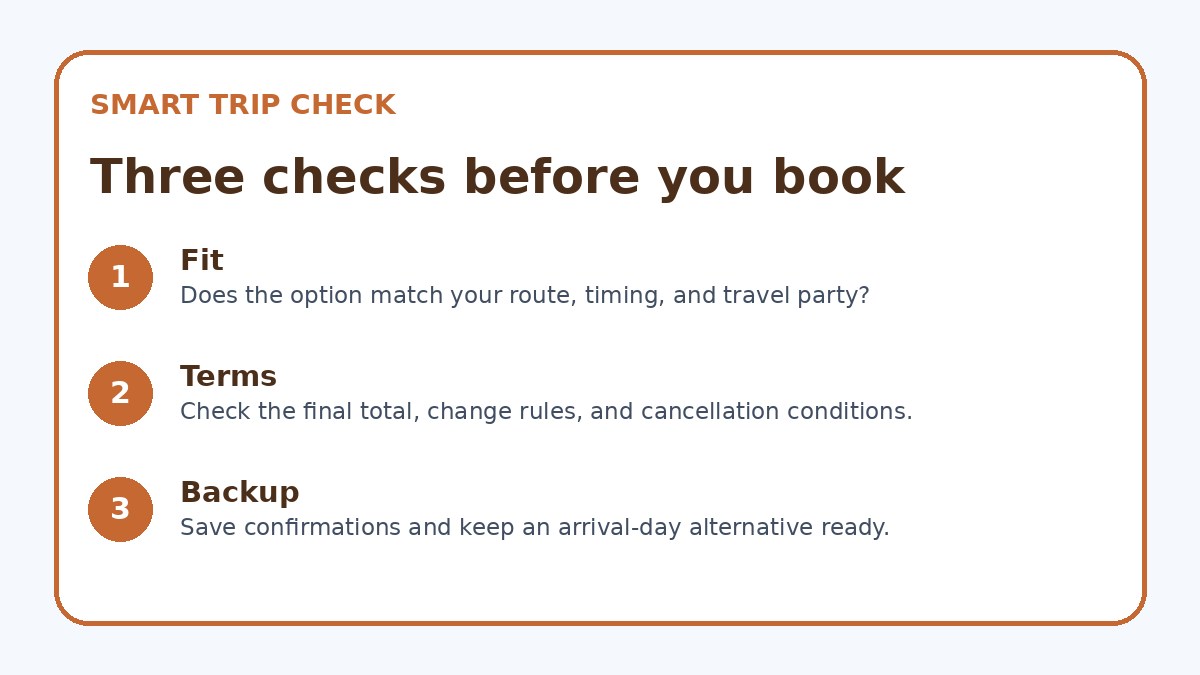
Before booking anything, check these items on the provider’s final page: exact pick-up location, whether luggage is included or restricted, payment methods, cancellation or waiting policies, and contact options in English. If the provider requires a connection (for example, bus to subway), plan buffer time and confirm how to find the connecting stop. Make a backup plan for arrival delays: print or screenshot directions, have the address in Korean, and store local emergency contacts. That way, any transfer choice becomes a predictable part of your solo trip.
Frequently asked questions
Can I rely on English signage and help when I arrive in Busan?
Many major transport hubs in Busan display signage in Korean and English, and station staff often assist with basic directions. However, the level of English support can vary between smaller stops and late-night hours. For a solo traveler who prefers step-by-step assistance, consider a transfer option with an English-speaking meet-and-greet or bring the address written in Korean to show to drivers and staff. Having a translation app or a screenshot of directions also removes most small-language barriers.
How should I choose between taking a taxi and an airport bus?
Decide by comparing door-to-door convenience versus cost and traffic risk. If you arrive during rush hour and the subway is an option, it may avoid road delays. Choose an airport bus if you want a single-seat ride to a central area without transfers and are happy to walk a short distance to your hotel. Choose a taxi if you value door-to-door service, have lots of luggage, or arrive when public transport is limited. Always confirm the exact stop or pickup point before committing.
What should I verify on a private transfer provider’s booking page?
Look for clear pickup instructions (meeting point and how the driver will contact you), explicit waiting-time allowances for flight delays, vehicle type and passenger capacity, and accepted payment methods. Also check the provider’s cancellation and refund policy and whether any extra charges apply for late-night pickups or additional stops. If the operator lists local contact details, save them; if they link to partner pages like Trip.com for availability, use those only to compare then verify specifics directly with the supplier.
Final planning note
For solo travelers, the right Busan airport transfer depends on your tolerance for transfers, amount of luggage, and arrival time. Subways and airport buses minimize cost but may involve walking or connections; taxis and private transfers give door-to-door ease at a higher cost and need you to confirm pickup details. Decide by listing your priorities—speed, convenience, or savings—then verify pick-up points, luggage rules, and waiting policies on the provider’s final booking page. With a clear backup plan and the address in Korean saved offline, you can land calm and head straight toward whatever part of Busan you’re excited to explore.
Continue planning
Check current options and final conditions
Use the provider page to confirm live availability, the final total, cancellation terms, and every condition that matters to your trip.
This evergreen planning guide was created with AI-assisted drafting and a structured quality review. It does not display live prices, schedules, availability, visa guidance, or provider rankings. Verify current details before booking. Some links are affiliate links; we may earn a commission at no additional cost to you.