
If you're renting a car in Los Angeles for business, the two contract clauses most likely to affect your expense reports are the fuel policy and mileage allowance. Practically speaking: decide whether to refuel yourself before returning the car, inspect and photograph the tank level at pickup and drop-off, and confirm any per-mile charge thresholds listed in your rental agreement. These steps cut surprises on the final invoice and make corporate reimbursement straightforward. Read the fine print on fuel purchase options (prepaid, full-to-full, or fuel-service charges) and on whether unlimited miles are included or restricted by vehicle class. Where a vendor-specific detail matters—like fuel grace amounts, airport surcharges, or per-mile fees—verify those exact terms on the rental company’s final booking page before you confirm.
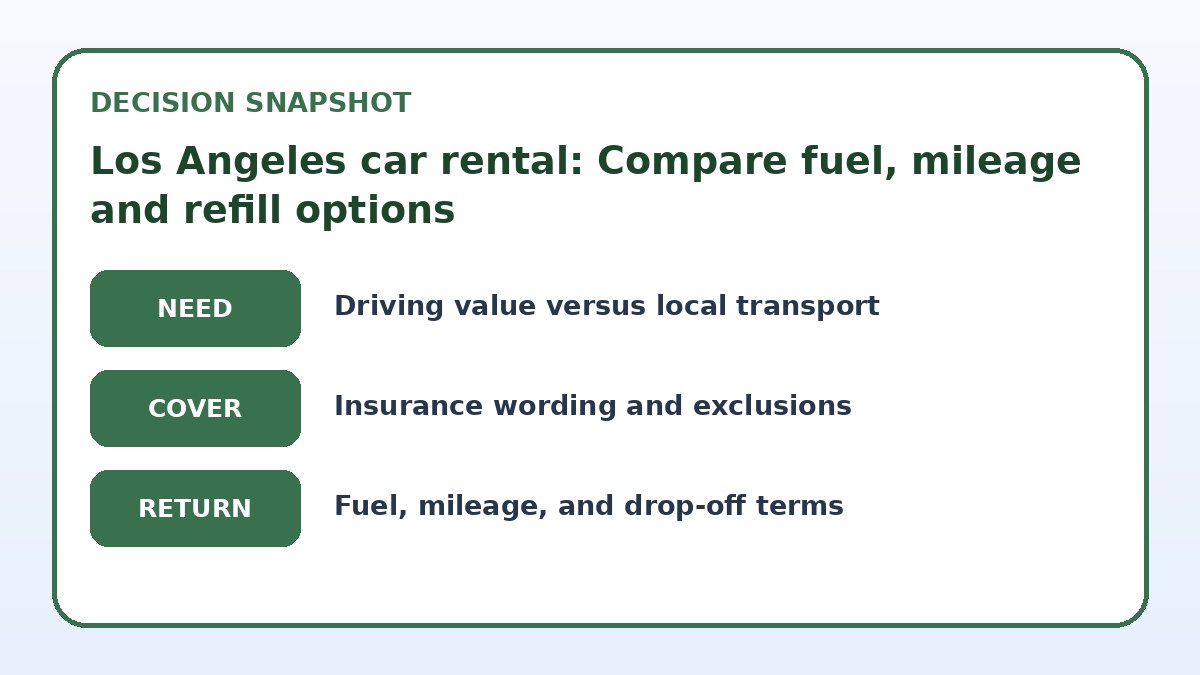
See current options before you compare the details
Availability and final conditions change. Open Trip.com now or keep reading for the practical comparison.
How fuel policies work and what they mean for business expenses
Rental companies typically offer several fuel options: return full (full-to-full), prepay fuel (buy a tank upfront), or have the company refuel for you and charge a fuel service fee. For business travelers who want clean expense reporting, full-to-full is often the easiest: you pay only for what you use and can show a receipt from a local pump. Prepaid fuel might look time-saving, but it often charges for a full tank regardless of actual consumption, complicating reimbursement if your company requires proof of cost.
When you choose a fuel-service option where the company refuels for you, scrutinize the per-gallon rate and service fee; those are commonly higher than local pump prices. At pickup and return, document the tank level with time-stamped photos and note pump readings if asked. If your employer uses a corporate card or fuel card program, check how the rental company accepts that card and whether fuel charges will post correctly for reconciliation.
Mileage allowances: what to check in your Los Angeles rental contract
Mileage rules range from unlimited mileage to daily or per-rental caps. Many U.S. rentals offer unlimited miles for standard cars on domestic reservations, but specialty vehicles, one-way rentals, or certain long-term rates may include limits and per-mile penalties. For business travelers planning a Los Angeles day with airport transfers and regional trips (Santa Monica, Pasadena, or beyond), confirm whether trips across county lines or multi-day usage could trigger charges for excess miles.
If your itinerary includes out-of-area driving—airport-to-convention-center shuttles, client site visits outside LA, or a day trip up the coast—estimate the total miles and compare that to the contract cap. If the booking page is ambiguous, ask the rental agent to add a written note clarifying unlimited or capped mileage. Save any email confirmations and capture the mileage clause in screenshots during booking so finance teams can verify the agreed terms during expense review.
| Approach | Best for | Tradeoff to check |
|---|---|---|
| Full-to-full fuel policy | Travelers who want accurate, verifiable fuel costs and minimal invoice surprises. | Requires stopping to refuel before drop-off, which costs time but usually saves money. |
| Prepaid fuel | Those with tight schedules who prefer skipping a refuel stop at return. | Often charges for a full tank regardless of usage, complicating cost control and reimbursement. |
| Company refuels (fuel service by rental) | Travelers prioritizing convenience and immediate return-time flexibility. | Typically the most expensive per-gallon plus service fees; needs strong justification to expense teams. |
| Unlimited mileage vs capped mileage | Unlimited: multi-stop regional travel; Capped: short city-only trips with predictable miles. | Unlimited removes per-mile worries but may come with higher base rates; capped requires careful mileage estimates. |
Ready to check the option that fits your plan?
Use your exact dates and traveler details so the provider page can show the current total and conditions.

Choosing between convenience and cost when refueling in Los Angeles
Los Angeles traffic and schedules may push business travelers toward convenience: returning a car without stopping to refuel can save time between meetings. But that convenience often comes with a premium. The rental company’s refueling charge typically includes a per-gallon markup plus a service fee, which can exceed local pump prices. If your company reimburses actual costs, full-to-full with a quick fill before return is usually the most economical and defensible option.
Factor time, meeting commitments, and corporate policy into the decision. If you’re short on time after a late meeting, prepaid fuel might avoid late returns and potential penalties, but document the original booking terms to show why you chose the prepaid or refuel-for-me option. Where possible, use an off-site gas station close to the drop-off location to minimize time lost; ask the rental counter for nearby stations that accept company cards if needed.
Before you book
- Photograph the odometer and fuel gauge at pickup and again at drop-off, and save images with timestamps or booking confirmation numbers.
- Confirm on the booking page whether the rental uses full-to-full, prepaid, or refuel service; save a screenshot of the exact clause.
- Estimate total trip miles and verify the contract’s mileage allowance; request a written note if the booking page is unclear about caps or charges.
- Keep all gas receipts and the final rental return receipt; submit them with your expense report to justify actual fuel costs.
- Ask the rental agent at pickup to initial the rental agreement where fuel or mileage terms are listed and get a printed copy.
- If you expect after-hours return, confirm how fuel level and mileage will be documented and how charges will be calculated.
Documentation and dispute steps to protect your expense reports
At pickup, photograph the vehicle’s exterior, interior, fuel gauge, and odometer. Repeat the same photos at drop-off and request a printed or emailed return receipt from the rental desk showing final tank level and mileage. These records are essential if the final invoice shows a fuel-service charge or mileage fee your finance department didn’t expect. Keep all gas receipts, the rental agreement copy, and any agent initials or notes in one folder for reimbursement.
If an unexpected charge appears after you return the car, contact the rental company immediately with your documentation and the booking confirmation number. Escalate to the company’s dispute or billing team if the initial agent won’t remove an erroneous fee. If your employer has vendor relationships or a corporate account number, involve your travel manager—corporate channels often resolve billing disputes faster. Remember to verify final terms on the provider’s booking page before submission; that’s where charges are disclosed and where you should confirm fuel and mileage language.
Frequently asked questions
Is prepaid fuel ever worth it when renting in Los Angeles for business?
Prepaid fuel can be worth it for high-pressure schedules where stopping to refuel would risk missed meetings or late returns. It eliminates the need to search for a station and avoids return delays. However, prepaid plans typically charge for a full tank up front and don’t refund unused fuel, so they often cost more than local pump prices. For companies that reimburse exact expenses, full-to-full with receipts is usually preferred. Always capture the prepaid option’s exact terms on the provider’s booking page and keep that screenshot with your records.
How can I prove I didn’t exceed a mileage limit after returning the rental?
The strongest proof is a combination of evidence: time-stamped photos of the odometer at pickup and drop-off, the rental company’s printed or emailed return receipt showing final mileage, and the original rental agreement listing the mileage allowance. If you received GPS logs from a corporate telematics program or used a mileage-tracking app, include those. If the billing shows unexpected miles, present these documents to the rental company’s billing team and your corporate travel manager to dispute charges promptly.
Do airport rentals in Los Angeles have different fuel or mileage rules than downtown locations?
Airport locations sometimes apply additional fees or different inventory rules—these can affect vehicle class availability, which in turn can change whether a rate includes unlimited miles. Fuel policy options themselves are generally the same across locations, but ancillary charges (airport surcharges, concession recovery fees) can increase the total invoice and occasionally interact with fuel billing practices. Always verify the pickup location on the booking page, read the fuel and mileage clauses specific to that location, and check whether any airport-specific surcharges are listed in the final terms.
Final planning note
For business travelers in Los Angeles, clarity on fuel and mileage rules prevents disputes and speeds expense reimbursement. Prioritize full-to-full where you can document pump receipts, or choose prepaid only when schedule constraints make a refuel stop impractical. Always capture odometer and fuel-gauge photos at pickup and drop-off, save screenshots of the booking-page terms, and request agent initials on any in-person notes. Before finalizing a reservation, confirm the exact fuel and mileage language on the provider’s booking page—this is the definitive source for what you’ll be billed. If you want to compare current policies and availability, Trip.com is an optional place to check listings, but rely on the rental company’s final contract for billing details.
Continue planning
Check current options and final conditions
Use the provider page to confirm live availability, the final total, cancellation terms, and every condition that matters to your trip.
This evergreen planning guide was created with AI-assisted drafting and a structured quality review. It does not display live prices, schedules, availability, visa guidance, or provider rankings. Verify current details before booking. Some links are affiliate links; we may earn a commission at no additional cost to you.