
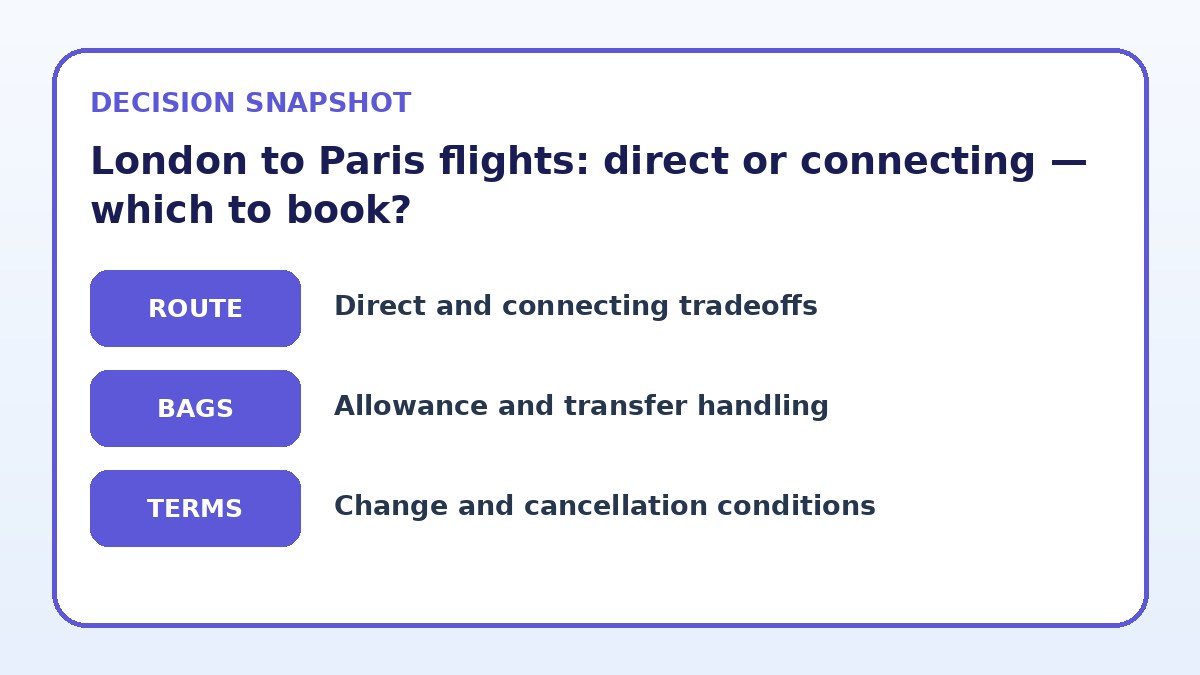
Practical answer first: for most families traveling with young children or lots of luggage, a direct flight or a single-train transfer (if available) usually reduces stress and hidden effort; connecting options can save money or open schedules but add complexity. Your choice depends on priorities: minimizing time and movement between terminals; avoiding extra check-ins or reclaims for strollers and car seats; or reducing price by accepting a longer journey. This article lays out the tradeoffs clearly and gives step-by-step decision criteria so you can evaluate available options for your exact travel dates. It explains where to verify luggage/transfer rules on carrier pages and when to prefer rail+flight combinations or a scheduled flight with a connection. Read on for quick comparisons, family-focused tips, a four-row decision table, a practical checklist to follow before you book, and answers to common family questions.
See current options before you compare the details
Availability and final conditions change. Open Trip.com now or keep reading for the practical comparison.
How direct flights simplify family travel
Direct flights reduce the number of separate movements you and your family must manage. Fewer transfers mean less worry about keeping children entertained through multiple terminal changes, and fewer opportunities for lost or delayed bags. With a single flight you usually check luggage once and collect it only at the destination, which simplifies strollers, car seats, and packed snacks. Boarding a direct service also helps maintain nap schedules, since a continuous block of travel time makes it easier to plan sleep and mealtimes for young children.
Direct services also reduce procedural complexity: fewer security lines, fewer passport checks, and less chance of missing a tight connection. For families with mobility needs or extra equipment, the convenience of one-seat travel and fewer corridors to navigate can make a trip genuinely more manageable. The tradeoff is that direct flights might have fewer daily times or cost more; nonetheless, the emotional and logistical savings for family wellbeing can outweigh the price difference for many parents.
When connecting flights make sense for families
Connecting flights can be attractive when budget limits, schedule constraints, or seat availability block direct options. If a connection offers a much better departure time that fits children’s routines, or the price difference allows you to upgrade comfort at other stages of the trip, a single connection may be worthwhile. Connections are also useful when your chosen route uses rail+air combinations—taking a short Eurostar or regional train plus a short flight might beat a long direct airport transfer, depending on your starting point in London and final address in Paris.
However, connections introduce more variables: the amount of minimum connection time, whether baggage transfers automatically between carriers, and whether you have to pass through customs and security again. For families, it’s crucial to examine whether a connecting itinerary requires moving between terminals or airports, how long each transfer lasts, and whether airlines allow gate-to-gate assistance or priority transfers for families with children.
| Approach | Best for | Tradeoff to check |
|---|---|---|
| Direct flight | Families prioritizing simplicity, fewer handoffs, and minimizing stress with young children. | May have fewer schedule options or a higher fare compared with connections. |
| Single connecting flight on one ticket | Families seeking lower fares or a better departure time while retaining through-checked baggage protection. | Requires careful check of minimum connection times and through-baggage rules. |
| Separate carriers or mixed rail+air | Families flexible on logistics who want more schedule options or lower-cost segments. | Increases risk of re-checking baggage, missed transfers, and added complexity if delays occur. |
| Long connection with overnight stop | Families who prefer to break the trip into manageable days or explore a stopover city. | Adds nights of accommodation and more transit phases, increasing packing and coordination needs. |
Ready to check the option that fits your plan?
Use your exact dates and traveler details so the provider page can show the current total and conditions.
Key decision criteria for family bookings
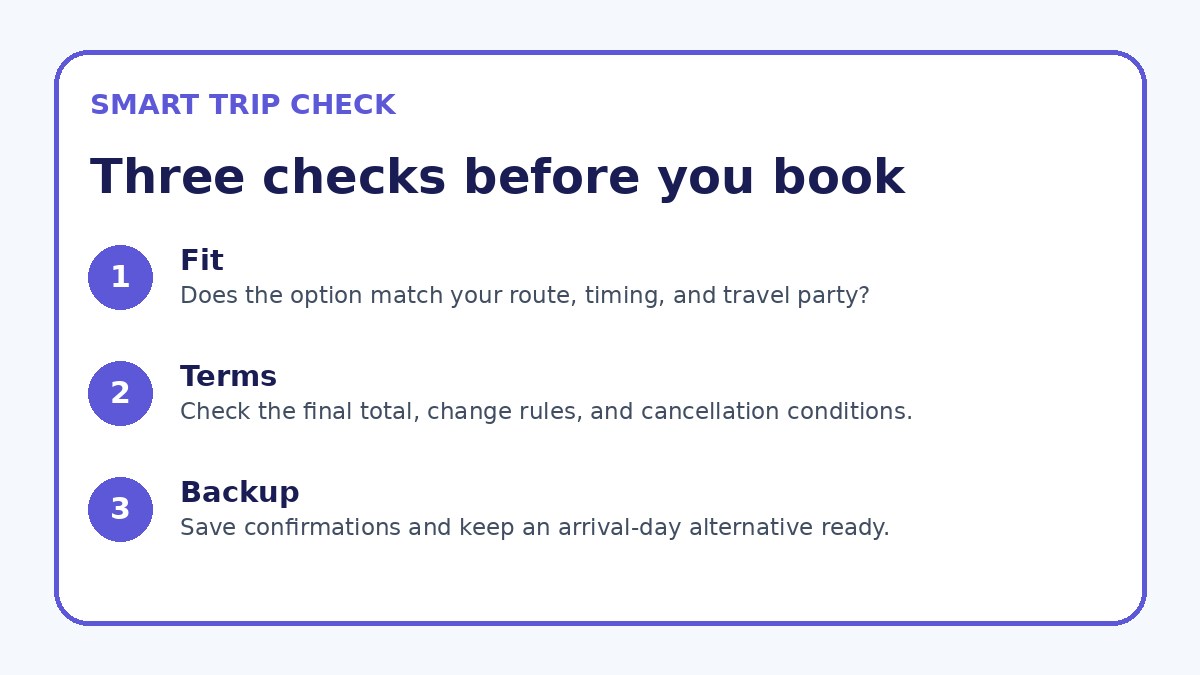
Start by listing priorities: total trip time versus cost, how much luggage you’ll bring, ages of children, mobility needs, and tolerance for airport time. Compare door-to-door estimates, factoring in travel to each airport, check-in times, and expected transfer durations. Use the airline’s and airport’s published guidance to verify whether baggage will be checked through on connecting itineraries and whether infant seats or strollers can be gate-checked or require a separate bag. If you have medical equipment or mobility aids, confirm assistance services and allow extra time on all segments.
Next, check booking rules and protections: does the ticket include protections for missed connections? Are the flights on the same ticket or separate carriers requiring independent connections? If you see an appealing connection with different carriers or a low-cost regional partner, confirm whether baggage transfer is automatic and what happens if one leg is delayed. Always verify seat assignment options for family seating together and the availability of bassinets, child meals, or priority boarding directly on the carrier’s booking page before committing.
Before you book
- Confirm whether your chosen itinerary is sold on one ticket (through-checked baggage and rebooking protection) or as separate tickets between carriers.
- Verify baggage allowances, stroller/car seat policies, and whether these items are checked through or must be reclaimed at connections.
- Estimate door-to-door time including airport transfers; compare that with total flight time to decide if a connection actually saves time.
- Check minimum connection times and whether transfers require terminal or airport changes, then add buffer time for family needs.
- Reserve seats together and request any child-specific services (bassinets, infant meals, special assistance) on the carrier’s final booking page.
- Prepare a condensed carry-on with essentials in case checked luggage is delayed—include medications, a change of clothes, snacks, and comfort toys.
Practical tips to reduce stress on travel day
Pack a concise family carry-on kit that includes spare clothing, snacks, basic medication, comfort items, and chargers. Bring items that are easy to access during transfers: a lightweight travel blanket, a compact activity bag for each child, and any documentation you may need for quick checks. If you plan a connecting itinerary, put essentials in your carry-on in case checked bags arrive on a later flight. Label strollers and car seats clearly, and consider brightly colored luggage straps to reduce confusion at busy reclaim areas.
Make use of family services: request early or priority boarding if available, and ask airlines in advance about gate assistance or stroller handling. Allow generous connection times for restroom breaks and unplanned delays—better to arrive earlier at the next gate than to sprint with tired kids. Finally, have a simple back-up plan: know where customer service desks are, save carrier contact numbers in your phone, and keep a printed copy of your itinerary and important documents in case your device loses power.
Frequently asked questions
Is it safer for a family to choose a direct flight from London to Paris?
Safety in the sense of aviation is comparable across direct and connecting services; both operate under the same regulatory standards. For families, 'safer' often means fewer opportunities for something to go wrong—lost bags, missed connections, or travel exhaustion—so a direct flight typically reduces those practical risks. If you mean health and security, check the airline and airport pages for their current safety measures and assistance services. For connections, confirm whether the ticket protects you in case of a delay that causes a missed onward flight.
How much connection time should I allow when traveling with small children?
There’s no universal minimum because connection complexity varies by airport, terminal layout, and whether you must change terminals or clear passport control. For families, build at least the carrier-recommended minimum plus an extra cushion for diaper changes, snack breaks, and restroom stops—often 60–90 minutes for the same terminal, more if you must change terminals or re-clear security. Always verify the airport’s transfer procedures and the airline’s suggested minimum connection time on their official pages before booking.
What if my connecting flight is with a different airline—will my luggage be transferred?
Whether luggage is transferred depends on whether the flights are on the same ticket or involve partners with interline agreements. If all legs are on one itinerary sold by a single carrier or a partnered booking, baggage is commonly checked through, but you must verify this on the booking confirmation. For separate tickets or unpartnered carriers, you may need to reclaim and re-check bags, which adds time and complexity. Always check the baggage transfer rules on the booking pages for each airline or ask customer service before you finalize purchase.
Final planning note
Choosing between direct and connecting London to Paris flights for your family comes down to balancing simplicity against cost and schedule flexibility. Direct flights reduce handoffs, simplify luggage and strollers, and usually lower the day-of-travel stress—valuable if you travel with babies, very young children, or mobility needs. Connecting options can offer more choices and potentially lower fares, but they require diligent checks of connection times, baggage transfer policies, and whether you must change terminals or airports. Use the checklist to verify critical details on carrier pages, and prefer single-ticket itineraries with through-checked baggage when possible. If you want to compare current availability and conditions quickly, you can check Trip.com as one place to view options, but always confirm rules and protections on the final airline or rail carrier booking pages before you commit.
Continue planning
Check current options and final conditions
Use the provider page to confirm live availability, the final total, cancellation terms, and every condition that matters to your trip.
This evergreen planning guide was created with AI-assisted drafting and a structured quality review. It does not display live prices, schedules, availability, visa guidance, or provider rankings. Verify current details before booking. Some links are affiliate links; we may earn a commission at no additional cost to you.