
If you and your partner want stress-free plans in Ho Chi Minh City, pick a hotel booking type that matches how fixed or flexible your trip will be. For short stays or festival-season travel, flexible rates with free cancellation up to a certain date give you breathing room. If you’re certain of dates and want to reduce upfront cost, prepay or nonrefundable options may save money but reduce flexibility. Before you click confirm, decide how likely your dates are to change, whether you need to transfer hotels inside the city, and whether you want add-ons like late check-out or breakfast included. Read the provider’s final booking page to confirm exact cancellation windows, any administrative fees, whether modifications are allowed, and what documentation (ID, credit card used) will be required at check-in.
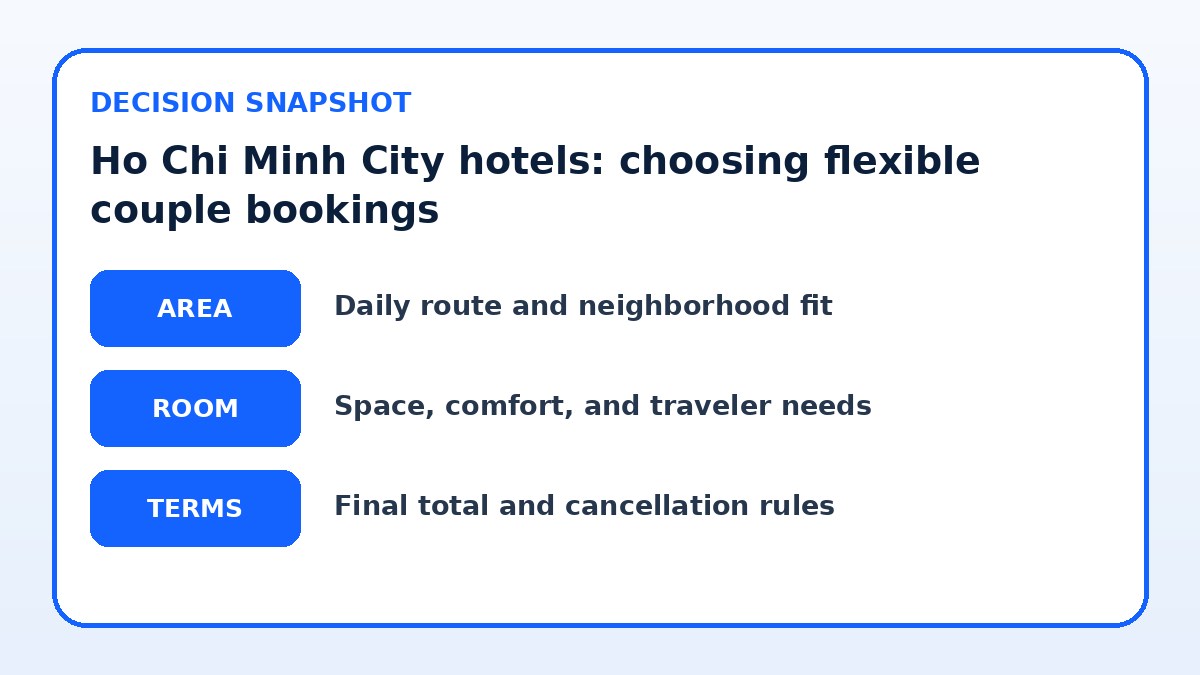
See current options before you compare the details
Availability and final conditions change. Open Trip.com now or keep reading for the practical comparison.
How flexible booking types work and what couples should prioritize
Hotels typically offer three broad approaches: pay-later refundable rates, partially prepaid refundable rates, and nonrefundable prepaid rates. Pay-later refundable bookings let you reserve without immediate payment and cancel by a specified deadline for a full refund. Partially prepaid refundable options require a deposit or partial charge but still allow refunds within a stated window. Nonrefundable prepaid bookings charge the full stay in advance and rarely allow refunds. Couples should prioritize flexibility if either partner’s work schedule, visa paperwork, or health could change. If you need peace of mind, a pay-later refundable option with a clear 24–72 hour cutoff or a longer window before arrival is often worth the modest premium.
Beyond the refund window, read the terms for amendments: can you change dates without a fee, swap room types, or add a night? Some hotels treat amendments the same as cancellations and may reprice the booking according to current rates. Also check whether the hotel requires the same credit card at check-in used to guarantee the booking, or if a security deposit is collected on arrival. For couples sharing responsibility for planning, choose a rate that accommodates the most likely change scenario—short notice flight changes, a delayed partner arrival, or an unexpected extension of stay—while balancing cost and convenience.
Common tradeoffs: price, certainty, and logistical friction
The fundamental tradeoff is price versus certainty. Nonrefundable rates are cheaper because they transfer cancellation risk to the guest; the hotel can resell the room and uses the prepayment to secure revenue. Refundable rates cost more because the property holds the room without guaranteed payment. For couples on tighter budgets, a nonrefundable deal can free funds for experiences, but if either partner expects possible changes, that short-term saving can be lost if you must rebook or cancel. Consider also whether the hotel’s flexible rate includes extras—breakfast, airport transfer, or late check-out—which can shift the value equation.
Logistical friction matters: flexible rates often make last-minute changes simpler, but not always free. Some hotels permit date changes with no fee within a timeframe; others allow changes but charge the rate difference. International couples should also check passport name-change policies—if you book under one partner’s name but the other checks in, the hotel may require proof of relationship or ID. If you plan to hop between districts in Ho Chi Minh City, consider whether the hotel’s amendment policy lets you shorten or extend without penalty so you can adjust plans without unnecessary charges.
| Approach | Best for | Tradeoff to check |
|---|---|---|
| Pay-later refundable rate | Couples with uncertain travel dates or flight plans | Higher nightly rate but free cancellation by a stated deadline; may require a card on file. |
| Partially prepaid refundable rate | Couples who want some commitment but still expect possible changes | Lower cost than pay-later but deposit may be forfeited if you miss the refund window. |
| Nonrefundable prepaid rate | Couples with fixed schedules seeking lower upfront cost | Cheaper upfront but little to no refund or flexibility if plans change. |
| Flexible package (refund + extras included) | Couples who value convenience like breakfast and late check-out | More expensive but bundles services and may restrict changes to preserve package price. |
Ready to check the option that fits your plan?
Use your exact dates and traveler details so the provider page can show the current total and conditions.

How to compare cancellation and amendment clauses step by step
When comparing hotels, use a checklist focused on the specific clauses that most affect couples: exact cut-off date and cut-off time for free cancellation, conditions for partial refunds, fees for date changes, and whether the hotel refunds taxes and third-party fees. Start by noting the absolute last moment you can cancel without charge (for example, 48 hours before check-in) and translate that into your itinerary deadlines—flight change windows, visa issuance, or work obligations. If the language is vague (terms like "flexible" or "subject to availability"), contact the hotel or booking platform to get written clarification before booking.
Also compare practical application: does the policy apply per reservation or per guest, are there blackout dates (holidays or major events) when refunds are limited, and does the property require the original card for refunds or take processing fees? If you’ll be booking through an OTA or aggregator, confirm on the hotel’s own page or final booking confirmation because some platforms display different terms. Trip.com can be used as one place to compare current availability and conditions, but always verify critical terms on the provider’s final booking page to avoid surprises.
Before you book
- Confirm the exact free cancellation cutoff (date and time) on the hotel’s final booking page before you pay or finalize.
- Ask whether the credit card used to book must be shown at check-in or if a different card is accepted with authorization.
- Verify whether taxes, service charges, and third-party fees are refundable under the policy.
- Check whether the hotel accepts name swaps, date changes, or room-type upgrades without charge and under what conditions.
- If traveling internationally, confirm what ID or passport information the hotel requires at check-in and for any refunds.
- Request written confirmation (email or booking screenshot) of any verbal exceptions or amended terms before arrival.
Special circumstances for couples: deposits, ID, and shared responsibility
Couples should consider who is listed on the reservation and who pays. Some hotels require the credit card used to book to be presented at check-in; others will accept a different card but may ask for a security deposit. If only one partner’s name appears, confirm the hotel’s policy about additional guests or partners checking in. For international couples, clarify whether both passports are required on arrival and whether any local registration or tourist-tax collection requires a credit card imprint. These operational details affect whether a flexible booking truly gives you freedom or whether administrative friction will make adjustments costly.
If you expect to split payments or have one partner pay while the other handles check-in, communicate this with the hotel ahead of arrival. Ask whether they will accept a payment authorization form, whether they charge incidentals to a different card, and what identification is needed to release a prepaid booking. Clear communication can prevent delays at reception and ensure that an otherwise flexible rate doesn’t become a practical barrier because the hotel needs the cardholder present or a signed authorization to modify or cancel.
Frequently asked questions
If I book a refundable rate and my partner’s flight is delayed, how quickly can I change dates without penalty?
Refundable rates differ by property. Some allow free changes up to the cancellation cutoff; others charge for date changes even within the refund window. Always check the hotel’s amendment clause on the final booking page to see whether date changes are treated as cancellations (subject to the same cutoff) or handled separately. If the wording is unclear, contact the hotel and get written confirmation of any flexibility for flight delays before you rely on it.
Can I switch a nonrefundable booking to a refundable one after I pay?
Generally, nonrefundable bookings cannot be converted into refundable ones after payment; a hotel would need to offer a rebooking or a new, differently priced rate. If flexibility is important, inquire at booking about any upgrade options the hotel provides and whether they sell a refundable add-on or travel insurance. Some properties allow paid modifications or rebookings for a fee, but those options must be confirmed on the provider’s final booking page before assuming they exist.
Should couples buy travel insurance instead of choosing a flexible hotel rate?
Travel insurance can cover cancellations for a broad set of reasons—illness, certain travel disruptions, or supplier insolvency—depending on the policy. A flexible hotel rate offers a direct contractual right to cancel with the hotel’s specific refund terms. Consider buying insurance if you want protection beyond the hotel’s stated reasons (for example, worldwide medical issues or missed connections). Compare the insurance policy exclusions, the hotel’s refund policy, and whether the insurer requires documentation for claims; both tools can be used together for greater protection.
Final planning note
For couples planning a Ho Chi Minh City stay, the right booking depends on how stable your travel dates are and how much administrative hassle you’re willing to accept. If one partner’s schedule or visa timing is uncertain, a pay-later refundable rate usually reduces stress at a modest extra cost. If dates are firm and you want to save money, consider prepaid nonrefundable options but confirm amendment rules and whether the hotel will accept a different card at check-in. Always verify the exact cancellation and amendment language on the provider’s final booking page, and get written confirmation for any exceptions. Use an OTA like Trip.com to compare live availability, but rely on the hotel’s confirmed terms before you commit.
Continue planning
Check current options and final conditions
Use the provider page to confirm live availability, the final total, cancellation terms, and every condition that matters to your trip.
This evergreen planning guide was created with AI-assisted drafting and a structured quality review. It does not display live prices, schedules, availability, visa guidance, or provider rankings. Verify current details before booking. Some links are affiliate links; we may earn a commission at no additional cost to you.