If you have a meeting or event in Hiroshima and are leaving from Osaka, prepare the travel day so the transit itself supports, not disrupts, your business agenda. Start with the two practical questions: what arrival time does your meeting require, and how resilient do you need the journey to be against small delays? Once you know those answers, you can choose whether to prioritize speed, predictability, or cost and then layer in luggage, mobility, and in-transit work needs. This article gives a compact decision framework and concrete tasks to finish before departure, plus tradeoffs to help you weigh express trains, slower regional options, or flying, and what to verify on provider booking pages before you commit.
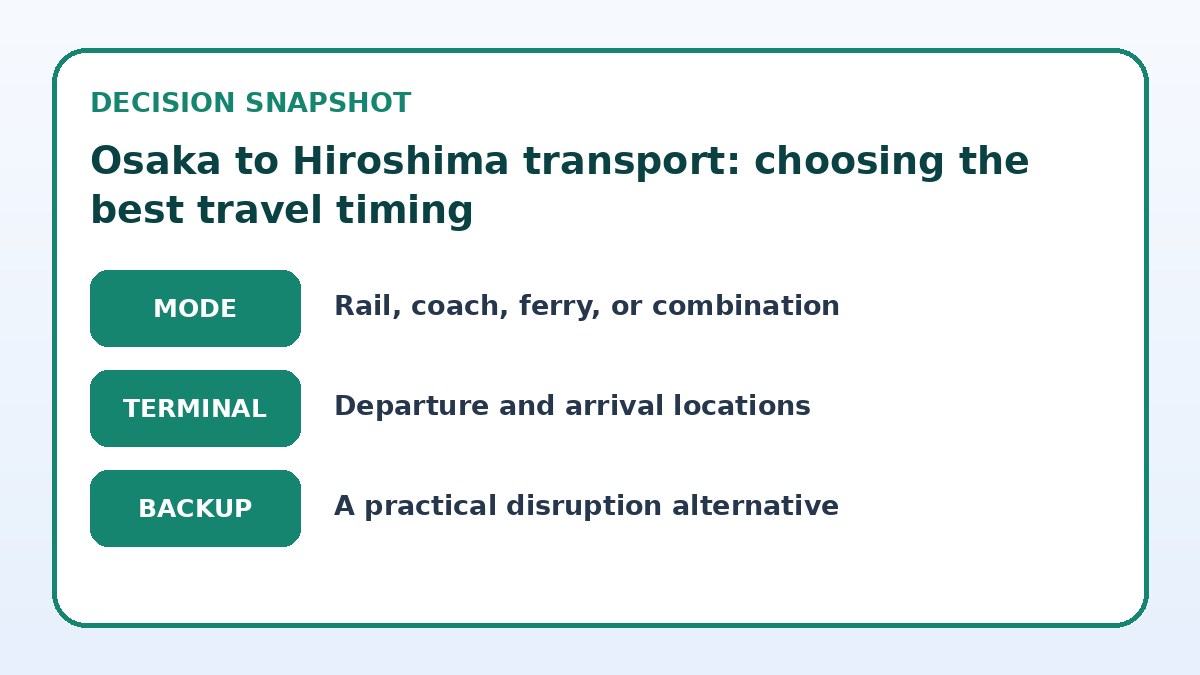
See current options before you compare the details
Availability and final conditions change. Open Trip.com now or keep reading for the practical comparison.
Choose the right transport approach for your schedule
Start by mapping the meeting start time backward to a reliable arrival window at the venue. For business travelers, that usually means arriving at least 45–90 minutes early if you have presentations, need to set up AV, or prefer to prepare quietly. If the meeting is informal or you only need to be present, a smaller buffer may suffice. Once you set this arrival window, evaluate total door-to-door travel time: include transfer time in Osaka, any wait for boarding, the in-transit duration, and the trip from Hiroshima station to the meeting location.
When comparing transport modes, don’t just look at advertised travel time. Consider how predictable each option is for your specific day and time: peak-hour congestion, station crowding, and transfer risk can add unpredictable minutes. If you must be flexible mid-journey, choose options that let you switch to a later service or reroute without large penalties. Also think about in-transit productivity—some train segments give reliable Wi‑Fi and table space, while others are cramped; decide how much uninterrupted work you need en route.
Luggage, carry-on, and in-transit working setup
For a business day trip, luggage choices affect speed and resilience. A single carry-on sized for overhead storage keeps you agile during transfers and reduces wait time at arrival. If you need a checked bag, know where luggage storage or delivery services operate at both Osaka and Hiroshima stations so you can leave nonessential items and move quickly to a meeting. Label all pieces with contact information and your meeting address so staff can help if a bag is misplaced.
Set up a compact in-transit workstation: charged devices, a portable charger, noise-cancelling earphones, and a small pouch with presentation materials or backup documents. If you expect to join video calls, verify whether the transport mode reliably supports calls and whether you should instead book a quiet compartment seat. When you rely on public Wi‑Fi, plan for secure access—use a VPN and avoid sensitive work on open networks. Pack an analog backup (printed slides or notes) in case digital access fails.
| Approach | Best for | Tradeoff to check |
|---|---|---|
| High-speed express train | Travelers who need predictable travel time and comfortable workspace aboard. | Higher fare and possible seat reservation requirements reduce last-minute flexibility. |
| Regional or local trains | Those prioritizing lower cost and multiple departure times across the day. | Longer door-to-door time and more transfers can increase the risk of delays affecting meetings. |
| Air travel (with transfer time) | When distance or schedule makes flying faster door-to-door for select city pairs. | Airport procedures and ground transfers can be unpredictable and add hidden time costs. |
| Driving or private car service | When you need direct door-to-door pickup with flexible timing and privacy. | Traffic, parking, and urban congestion may make total travel time highly variable. |
Ready to check the option that fits your plan?
Use your exact dates and traveler details so the provider page can show the current total and conditions.
Station and last-mile logistics to protect your schedule
Understand the layout and services at both your Osaka departure and Hiroshima arrival stations before the travel day. Know which exit connects to taxis, hotel shuttles, or local transit, and where to find station lounges or quiet areas for last-minute prep. If you must transfer within Osaka between terminals or stations, allocate extra time and confirm transfer options in advance. Check whether luggage lockers or porter services are available if you need to store items between arrival and meeting time.
Pre-arrange or at least check options for the last mile: reserve a taxi, arrange a hotel or company pick-up, or map the local subway or bus route from Hiroshima station to your destination. When booking, verify the provider’s pickup point, possible surge conditions, and any downtown traffic that may affect travel time at your arrival hour. Keep a fallback plan—another later train, a ride-hailing app, or a remote-join option for meetings—so a single disruption won’t derail the whole day.
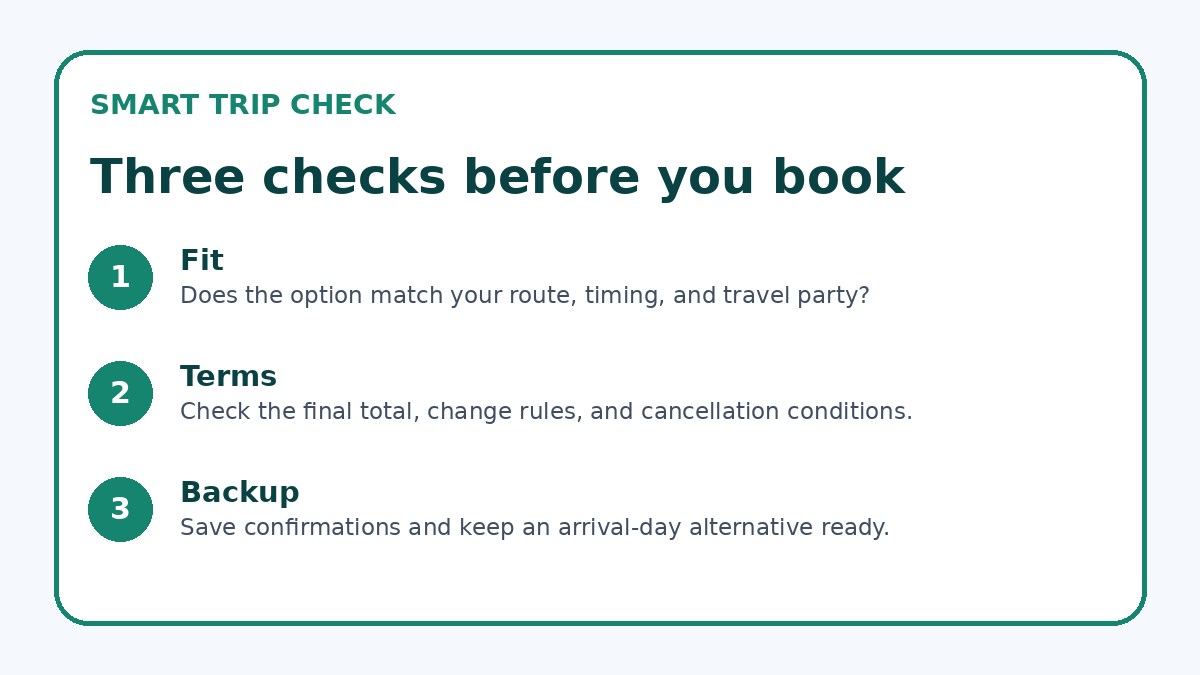
Before you book
- Confirm your meeting's required arrival time and add a 30–60 minute buffer for station transfers and unexpected delays.
- Choose a transport option that matches your need for predictability, then verify direct versus transfer routing on the operator’s booking page.
- Pack essentials in a carry-on business kit: charger, power bank, presentation backup, headphones, and printed documents.
- Reserve or identify last-mile pickup (taxi, shuttle, or transit) and note the exact station exit you will use in Hiroshima.
- Check luggage policies, seat reservation rules, and rebooking/cancellation terms on the provider’s final booking page.
- Prepare a fallback plan: later trains, alternate routes, or remote-join meeting details if you cannot arrive in person.
Booking checks and what to verify before you commit
Before you finalize bookings, confirm the exact departure and arrival stations, platform access rules, luggage allowances, and any seat reservation or ticket exchange limitations that could affect flexibility. If a provider shows multiple routing options, check whether a given option is direct or involves a transfer, and whether you’ll need to change platforms or stations. For flights, verify total door-to-door time including recommended airport arrival, security, and transfer to the terminal. Always read the provider’s final booking page to confirm cancellation, rebooking, and baggage terms that matter to your business flexibility.
When comparing options online, include the practical follow-ups: confirm what in-station services (lounges, business rooms, lockers, meeting spaces) you can rely on, whether high-speed services accept reservations for a guaranteed seat, and whether refunds or changes are straightforward if your meeting time shifts. If you use an intermediary to compare availability, note that you should verify the actual carrier’s or operator’s page for up-to-date schedule and policy details. Trip.com is one optional place to compare current availability and conditions, but always confirm specifics on the provider’s own booking page.
Frequently asked questions
How much time should I allow between leaving my Osaka hotel and a morning meeting in Hiroshima?
Work backward from when you must be at the meeting venue and include all transfer elements: time to reach the Osaka station from your hotel, check-in or ticket collection, boarding buffer, in-transit duration, and the trip from Hiroshima station to the venue. For professional meetings, many travelers build in an extra 45–90 minutes beyond the nominal travel time to cover station navigation, possible minor delays, and time to set up at the meeting site. If your meeting is early or subject to strict timing, choose an earlier departure and a transport option with fewer transfers.
Can I work reliably on the trip from Osaka to Hiroshima?
Whether you can work depends on the mode and the specific service. Many high-speed trains offer stable seating, tables, and power outlets that support laptop work; some also provide station-to-station Wi‑Fi research. Local trains may be crowded during peak hours and offer less space for focused work. Flights generally have limited usable time because of boarding and airport procedures. In all cases, carry backups: a charged laptop, a portable battery, noise-cancelling headphones, and printed materials if you must present without access to a screen or internet.
What should I verify on a booking page before I finalize transport to Hiroshima?
On the final booking page confirm the exact departure and arrival stations, whether the journey is direct or requires transfers, luggage allowances, and seat reservation policies. Check rebooking and cancellation terms in case your meeting time changes, and look for any restrictions on refunds or name changes. If you depend on amenities—power outlets, Wi‑Fi, or quiet cars—verify whether those are offered on the specific service. If you need ground pickup, ensure the station exit and pickup location are clearly stated and confirm any pre-booked taxi or shuttle details.
Final planning note
Business travel between Osaka and Hiroshima is a logistics problem you can largely control by deciding your required arrival window, choosing the transport approach that fits your tolerance for risk, and confirming critical details before you book. Prioritize predictability if missing the meeting has high consequences, and favor flexibility or cost savings if your schedule can absorb minor delays. Prepare a compact carry-on business kit, pre-arrange last-mile pickup, and verify routing and policies on the operator’s final booking page. With those steps completed, the travel day will be an orderly part of the work trip rather than its main challenge.
Continue planning
Check current options and final conditions
Use the provider page to confirm live availability, the final total, cancellation terms, and every condition that matters to your trip.
This evergreen planning guide was created with AI-assisted drafting and a structured quality review. It does not display live prices, schedules, availability, visa guidance, or provider rankings. Verify current details before booking. Some links are affiliate links; we may earn a commission at no additional cost to you.