If you're traveling from Paris to Amsterdam with more bags than usual, the single most useful thing you can do is pick a travel plan that matches the size and handling needs of those bags. That means comparing door-to-door options (train with a transfer, direct trains, or private transfer) against how much walking, lifting, and waiting you’re willing to accept on travel day. Pack strategically for mobility: keep valuables and an outfit in a carry-on, and consolidate heavy items in one rollable suitcase to simplify transfers. Decide in advance whether you'll check large bags at a station or keep everything with you; both change which platforms, ticket types, and station entrances are easiest to use. Later sections explain how to weigh tradeoffs—speed, cost, and physical effort—and list exact checks to make on booking pages, including luggage rules, platform baggage services, and transfer times.
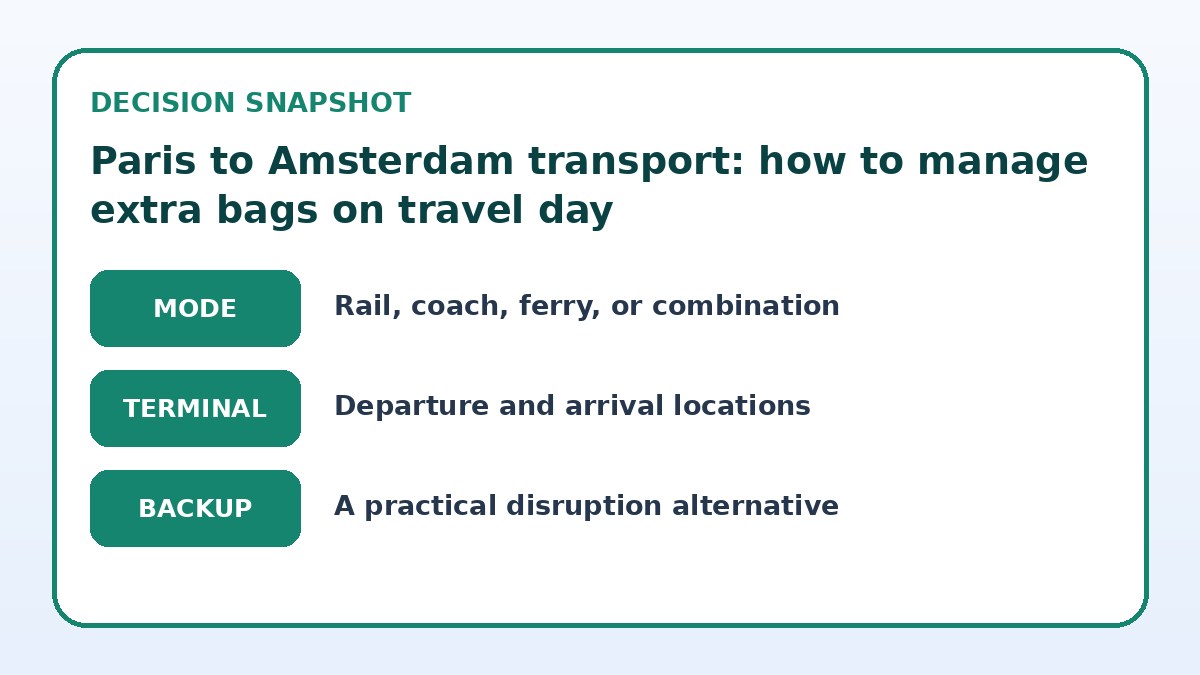
See current options before you compare the details
Availability and final conditions change. Open Trip.com now or keep reading for the practical comparison.
Which transport mode reduces handling on travel day
On the Paris–Amsterdam corridor you typically choose between direct or connecting trains, long-distance coach services, or private shuttle and taxi transfers. Direct rail options that let you stay on a single service from start to finish generally reduce repeated lifting and the need to move bags between vehicles. If a direct train is available and has accessible doors and level boarding at your departure and arrival stations, it is often the least physically demanding choice for extra luggage. However, direct services may have limited luggage space in aisles or racks, so check how luggage is stored on the specific service before you book.
Private car or van transfers bring bags to the vehicle and drop you at the door of your accommodation, eliminating heavy platform transfers and long station walks. The tradeoff is that vehicle size and trunk capacity vary—confirm maximum bag dimensions and number with the operator before booking. Coaches are budget friendly but often require lifting into a luggage bay and walking to bus stops; they can cost you extra time loading and unloading. Weigh how much handling you can tolerate versus the convenience of a single vehicle.
How to prepare bags and packing for smooth transfers
Pack with transfer points in mind. Place daily essentials—medications, documents, a lightweight change of clothes, chargers—in a compact carry-on or daypack you keep with you. Use packing cubes and zip bags to keep items organized so you can pull things quickly without unpacking full suitcases. For heavier items, a wheeled suitcase with a durable telescoping handle and 360-degree spinner wheels eases movement across station tiles and short cobblestone stretches common near older stations.
Label every bag with your name, phone, and destination address, and add a bright strap or ribbon so you can spot it in a crowded baggage area. Consider balancing weight between bags: a single very heavy suitcase is harder to lift into a vehicle or onto a high luggage rack than two medium-weight cases. Use luggage protection like a cover or rainproof sack for longer walks, and put fragile items in your carry-on. Finally, measure and photograph bags before departure so you can accurately report sizes if a transfer company asks.
| Approach | Best for | Tradeoff to check |
|---|---|---|
| Direct train | Minimizing transfers and walking with luggage | May have limited onboard storage and stricter carry-on rules |
| Private transfer (car/van) | Door-to-door convenience and minimal handling | Requires confirming vehicle trunk size and may be costlier |
| Long-distance coach | Simple booking for many bags with large external bays | Lifting into bays and walking to bus stops increases handling |
| Split plan (city train + short taxi) | Balancing cost and convenience for awkward or extra-sized items | Involves at least one additional handover and timing coordination |
Ready to check the option that fits your plan?
Use your exact dates and traveler details so the provider page can show the current total and conditions.
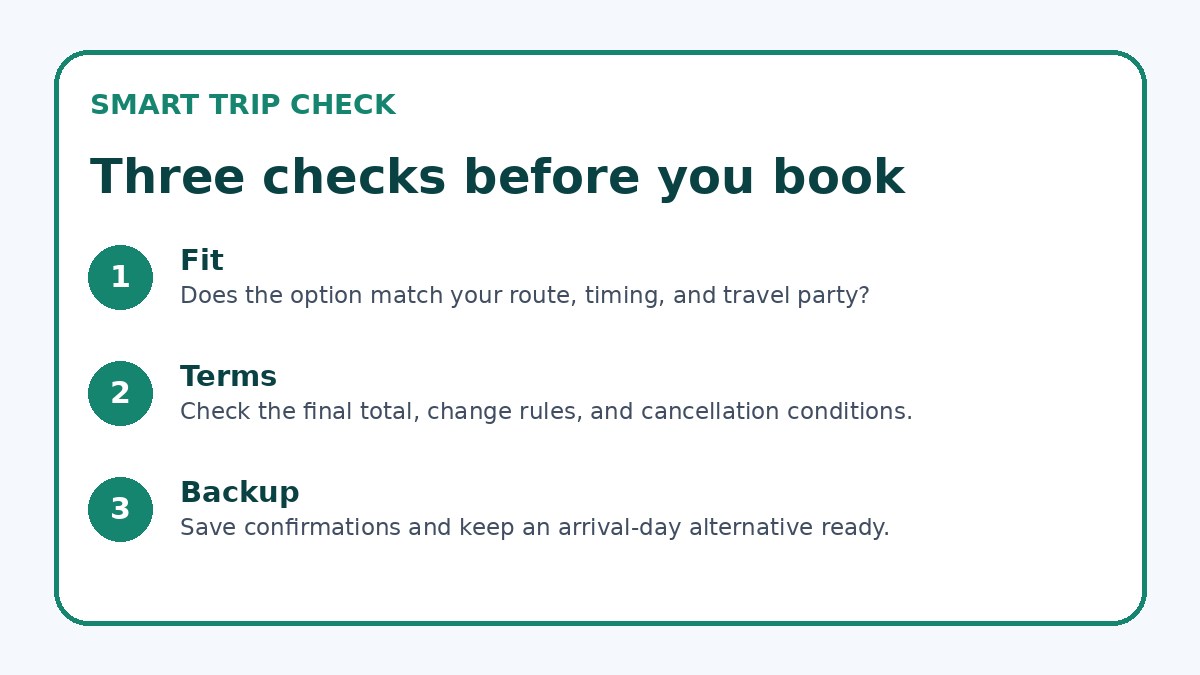
What to check on booking pages and at the station
On any booking page, verify the luggage policy: permitted number of bags, maximum dimensions, and whether oversized items require a special booking or surcharge. Look for details about boarding: are there level-entry platforms, steps, or a mandatory lift? For private transfers, confirm the vehicle type and trunk capacity; ask whether drivers assist with loading and unloading. If the service description mentions station or platform names, cross-check them on station maps so you know exactly where to meet the vehicle or where the luggage storage is located.
At the station, find elevator and escalator locations as soon as you arrive—don’t assume the main entrance is closest to your platform. Train stations often have marked lines for taxi stands and ride-hailing pickup zones that avoid stairs. If you plan to store luggage at the station temporarily, verify size limits and operating hours at the storage kiosk. When you collect tickets or seat reservations, ask staff explicitly about luggage placement on the specific train or coach; policies and available space can differ between services.
Before you book
- Measure and photograph each bag; note dimensions and weight for transfer or carrier requirements.
- Confirm luggage allowances, door access, and elevator availability on the operator’s booking page before paying.
- Pack essential items in a carry-on you keep with you and place fragile objects in that bag.
- Choose a single wheeled suitcase plus a carry-on to simplify lifting and spotting at busy stations.
- Reserve transfers or seat reservations that explicitly state luggage policies and vehicle type.
- Save offline copies of bookings and station maps; identify elevator locations and taxi pick-up points on arrival.
Timing, contingencies, and realistic expectations
Plan extra time for every step: arrival at the station, finding elevators or ramps, ticket and baggage checks, and boarding. Adding 30–60 minutes to a typical timetable gives you breathing room for lifting bags, waiting for a freight elevator, or dealing with last-minute ticket validations. If you have a tight connection in either Paris or Amsterdam, choose options that minimize platform changes or allow ample transfer time—short walks multiply stress when you are handling multiple pieces of luggage.
Have contingency plans: a local taxi app or station taxi stand as a backup if an elevator is out of order; a small collapsible trolley for last-minute heavier loads; and a list of nearby bag storage services if you want to explore briefly without all your bags. Keep a snapshot of your tickets and booking references offline so you can show them if mobile data fails. Finally, factor in fatigue—longer travel days are physically tougher with extra luggage, so consider breaking the trip with an overnight in a convenient location if you prefer lower exertion.
Frequently asked questions
How much extra time should I allow at Paris stations when I have large luggage?
Allow at least 30–60 extra minutes beyond normal check-in time when navigating major Paris stations with heavy or multiple bags. Large railway hubs can require extra walking between entrances, ticket counters, and platforms; elevators or escalators may be busy or out of service. If you need to check bags or use station lockers, add additional time for queuing and handling. For private transfers, confirm the pickup point and allow time for the vehicle to unload and load luggage safely.
Are there practical ways to avoid lifting heavy bags onto overhead racks on trains?
Yes. Use a single manageable wheeled case that sits on the luggage rack or fits in a dedicated space rather than repeatedly hoisting bags overhead. Choose trains and carriages advertised as having low-floor or level boarding and check seat reservation pages for luggage storage notes. If possible, book seats near doors where floor space and larger racks are often available. For very heavy or oversized items, arrange a private transfer where the driver can load the trunk, or inquire about station porter services where available.
Can I rely on station luggage storage if I need to drop off a bag before leaving Paris?
Station luggage storage can be a good option but verify size limits, operating hours, and any advance reservation requirement before you rely on it. Some facilities accept oversized items but may require a different counter or reservation. Read the station’s storage policy on the official site or booking page and confirm that pickup times match your schedule. If storage isn’t suitable, consider a local luggage-handling service or a private transfer that lets you leave bulky bags at your hotel if you arrive the day before departure.
Final planning note
Traveling from Paris to Amsterdam with extra luggage is mainly a matter of matching your physical capacity and time tolerance to the transport option you choose. Reduce strain on travel day by consolidating bags, keeping essentials in a carry-on, and selecting a route with the fewest transfers or easiest platform access. Before booking, verify luggage policies, vehicle size, and station access details on the provider’s final page—and confirm pickup points, elevator locations, and baggage storage availability at the stations. For current availability and service details you can compare options on aggregator sites such as Trip.com, but always read the operator terms on the booking page to make the final decision that suits your luggage needs.
Continue planning
Check current options and final conditions
Use the provider page to confirm live availability, the final total, cancellation terms, and every condition that matters to your trip.
This evergreen planning guide was created with AI-assisted drafting and a structured quality review. It does not display live prices, schedules, availability, visa guidance, or provider rankings. Verify current details before booking. Some links are affiliate links; we may earn a commission at no additional cost to you.