
If you’re traveling from London to Paris with extra or oversized luggage, the practical answers you need are: choose a transport mode that handles bulky bags comfortably, stage your luggage the night before, allow extra time for transfers and security, and confirm luggage rules on provider booking pages. For most people that means comparing long-distance trains (with under-seat and rack space plus simpler city-center-to-city-center travel), ferries or Eurostar plus connections, and flights only when time beats convenience. The rest of this article helps you decide which approach fits your priorities—cost, door-to-door hassle, mobility during the day, and how much you’re ready to handle personally versus paying someone else to move bags for you. I’ll also list the exact things to check on provider pages so you don’t rely on assumptions about size limits, transfer rules, or carriage options.
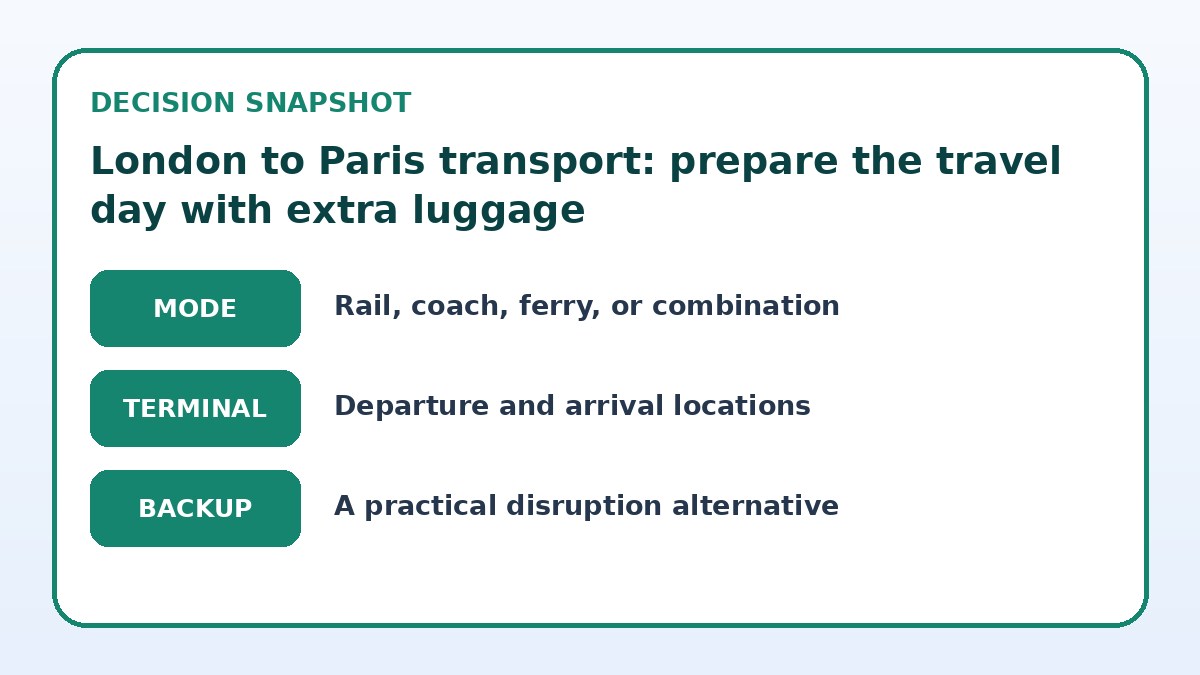
See current options before you compare the details
Availability and final conditions change. Open Trip.com now or keep reading for the practical comparison.
Decide how many transfers you can tolerate
Every extra transfer multiplies the handling of heavy bags. Trains that run between central London and central Paris typically reduce the number of hand-offs because you arrive in city centers and often walk less between accommodation and station. Flights, by contrast, add airport commutes, check-in queues, and security lines—each step means loading and unloading your luggage. Think honestly about whether you can manage stairs, platform gaps, and short walks with wheeled cases; if not, limit transfers or book a door-to-door service.
To make a choice, map your door-to-door chain from where you sleep in London to where you want to be in Paris. Count each transfer: hotel to taxi, taxi to station, platform to train, train to taxi, and hotel arrival. Each count is a potential lift or roll. If you prefer minimal physical handling, prioritize options that keep transfers under three, and factor in taxi or porter help at either end—verify the availability and costs on the provider’s booking pages before you commit.
Staging luggage and short-term storage options
Staging means preparing luggage so the travel day runs smoothly. The night before, consolidate items you’ll need during travel into a small day bag and place it where it’s easy to grab. Move heavy suitcases near the door, test wheel functionality, and secure loose straps. If your accommodation won’t let you hold bags after checkout, consider nearby short-term luggage storage services or station left-luggage facilities, but always confirm opening hours and size restrictions on the provider’s current pages.
If you use a paid storage service or lockers, check the precise size limits and liability policies. Some services accept oversized or irregularly shaped items but require advance notice or special handling. When comparing options, weigh cost against the value of traveling hands-free for a few hours: leaving heavy bags in secure storage can let you sightsee or move between stations with a single, lighter bag rather than managing all items through multiple transfers.
| Approach | Best for | Tradeoff to check |
|---|---|---|
| Direct city-center train | Travelers who want minimal transfers and can handle lifting onto racks | May require onboard lifting and limited space during peak times |
| Flight with airport transfers | Those who prioritize fastest in-air time and accept airport handling | Adds airport commutes and more hand-offs for each bag |
| Luggage courier/forwarding service | Travelers who want to avoid carrying bulky items entirely | Requires trust in delivery windows and may have strict size rules |
| Split approach: store then travel light | Sightseeing or long waits between departure and arrival | Extra step to collect stored items and potential storage fees |
Ready to check the option that fits your plan?
Use your exact dates and traveler details so the provider page can show the current total and conditions.
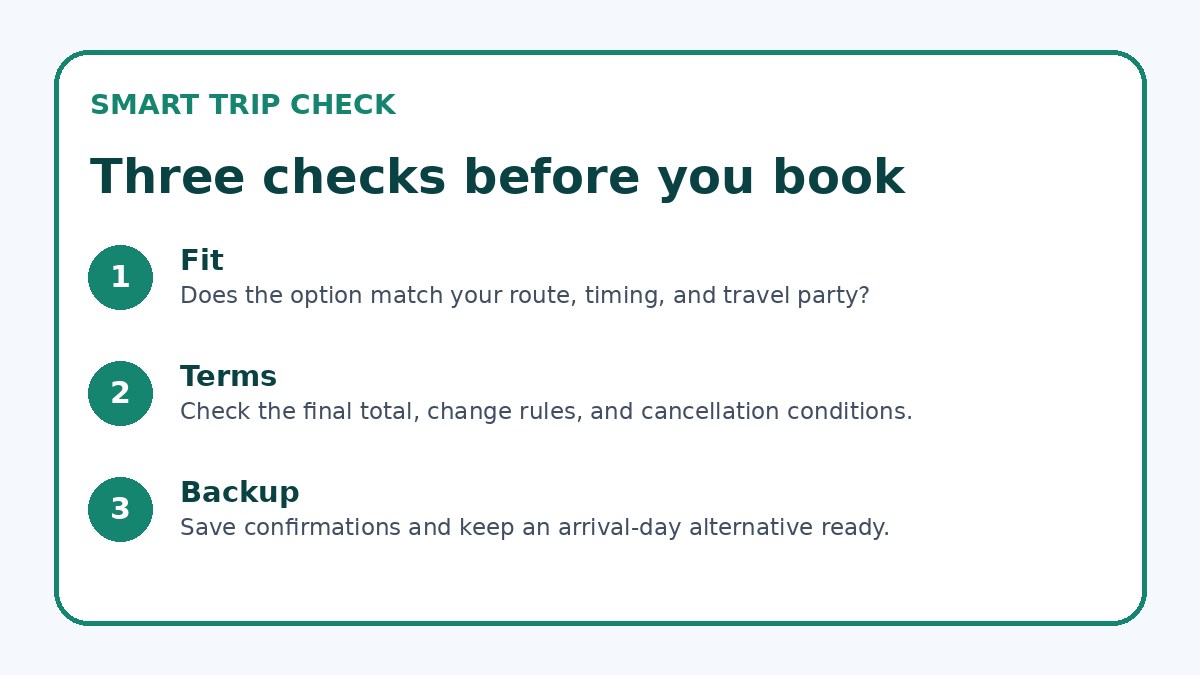
Transport mode tradeoffs for bulky and multiple bags
Trains offer convenient carriage space, usually with luggage racks, under-seat room, and fewer required transfers; that simplicity often outweighs a slightly longer scheduled travel time. However, trains may have limited dedicated storage areas during peak times and require lifting luggage onto racks or into vestibules. If you’re traveling with very large items, check the carrier’s guidance and consider splitting items between wheeled cases and compact carry gear to ease onboard handling.
Flights move you faster over the air but add the friction of airports and checked luggage processes. Flights can suit travelers who prioritize speed and don’t mind handing bags to airline staff—but remember to confirm size and weight limits, and whether oversized items need pre-notification. A courier or luggage-forwarding service can be ideal when you want to avoid physical handling entirely, but weigh the certainty of delivery windows and insurance coverage against the convenience you gain.
Before you book
- Confirm the exact baggage size and weight limits on the chosen carrier’s final booking page before purchasing tickets.
- Stage luggage near the exit the night before and test wheels, handles, and locks to avoid surprises on departure day.
- Reserve or pre-book any luggage storage or courier service and note pickup/drop-off windows and liability terms.
- Pack a small day bag with documents, chargers, medications, and essentials in case checked bags are delayed.
- Arrange transfer help (taxi, porter, or ride-share) at both ends and verify where the driver will meet you.
- Photograph luggage and contents labels, then keep copies of booking confirmations and receipts accessible on your phone.
On the travel day: timing, equipment, and backup plans
Allow at least 50 percent more time than you would for a solo carry day when moving extra luggage—more if you need to collect or drop off stored bags. Pack a compact trolley, heavy-duty straps, and a small toolkit for zippers and wheels. Wear comfortable shoes and layers, and designate one person to manage documents and tickets while another handles bags when traveling as a pair. Keep phone numbers for hotel, storage provider, and station customer service easily accessible.
Also prepare for contingencies: have copies of booking confirmations, a charged power bank, and a contingency plan if a connection is missed or a transfer takes longer. If relying on a third-party luggage transfer, confirm how late the company accepts departures and where exactly they pick up at your property. Before finalizing bookings, check provider pages for real-time baggage rules, booking deadlines, and drop-off instructions; Trip.com can be used to compare current availability, but always verify specifics on the carrier’s own site.
Frequently asked questions
Can I take oversized luggage on trains between London and Paris?
Many trains accept large suitcases, but rules vary by operator and may change. Check the carrier’s official baggage policy on their booking or information page before you travel. If your item is unusually large or heavy, contact the operator in advance to confirm whether it can be carried without special arrangements. Also inspect platform and train access at your departure and arrival stations—some platforms have gaps or steps that make moving oversized baggage harder. Finally, consider using a luggage courier if the operator requires advance notice or limits oversized items.
Is it safer to send luggage ahead with a courier than to manage it myself?
Using a courier can remove physical strain and reduce transfers, but it introduces dependence on schedules, tracking, and the courier’s liability limits. Before booking, verify pickup and delivery windows, insurance coverage for loss or damage, and whether the courier will deliver to a hotel or only to an address where someone must sign. Balance the convenience of not carrying heavy items against the potential cost and the need for precise delivery timing—if your trip timetable is tight, confirm that the courier’s guaranteed delivery window aligns with your plans on their booking page.
How early should I arrive at stations or airports when traveling with extra bags?
With heavy or multiple bags, add extra time for check-in, secure storage, and moving between platforms or terminals. Arriving earlier gives you margin to handle unexpected delays, access elevators, and stack luggage neatly. Check specific station or airport guidance for recommended arrival windows, and allow additional time if you need to drop bags at a storage facility or if you’re using a courier collection. Always verify any required pre-booking deadlines for oversized baggage or special assistance on the provider’s final booking page.
Final planning note
Preparing the travel day from London to Paris with extra luggage is mostly about limiting hand-offs and planning for the physical realities of moving heavy items. Decide whether you prefer fewer transfers (favoring direct trains), faster in-air time (favoring flights despite added airport handling), or outsourcing the lifting (via a courier). Stage bags the night before, confirm baggage rules and delivery windows on provider pages, and carry a compact day bag with essentials. When you build margin into your schedule and verify the exact baggage policies and pick-up/drop-off instructions, you turn a potentially stressful day into a manageable one.
Continue planning
Check current options and final conditions
Use the provider page to confirm live availability, the final total, cancellation terms, and every condition that matters to your trip.
This evergreen planning guide was created with AI-assisted drafting and a structured quality review. It does not display live prices, schedules, availability, visa guidance, or provider rankings. Verify current details before booking. Some links are affiliate links; we may earn a commission at no additional cost to you.