
If you travel to Dubai for business, price alerts can save time and reveal helpful patterns — but they also tempt you into impulse bookings that disrupt itineraries and budgets. The practical approach is to treat alerts as signals, not instant offers: set focused alerts for the routes, cabins, and dates you actually need; pick clear decision triggers (e.g., a refund-friendly fare, a preferred connection window, or a corporate travel policy match); and give yourself a fixed review window before committing. Use alerts to compare alternatives rather than force a purchase the moment an email arrives. This keeps you responsive to genuine opportunities while preserving flexibility for meeting schedules, client needs, and company expense controls.
See current options before you compare the details
Availability and final conditions change. Open Trip.com now or keep reading for the practical comparison.
Design alerts that match business constraints
Start by defining the non-negotiables for your Dubai trips: acceptable departure/arrival times relative to meetings, minimum connection buffers, and whether you require refundable or changeable fares. Configure alerts to those parameters only. For flights, that means creating alerts filtered by specific airports, preferred carriers, and acceptable layover durations. For hotels, focus on neighbourhoods near meetings or the exhibition centre, and on room types with a flexible cancellation policy. Narrow alerts reduce noise and make any triggered offer immediately relevant to your schedule.
Include corporate rules in the setup: allowable cabin classes, preferred suppliers, and maximum nightly rates if your company sets limits. If your employer has negotiated rates or a travel management company, match alerts to those channels and compare externally only when company policy permits. Using a dedicated email folder or app label for Dubai travel deals helps separate business signals from personal offers. That separation reduces the cognitive load of decision-making and helps you escalate offers to your travel manager faster when approvals are needed.
Set clear decision triggers and a waiting discipline
Before an alert fires, decide what would make you book it: is it a refundable fare within policy, a direct flight that reduces total travel time, or a hotel with flexible check-in tied to client needs? Write those triggers down and attach a time window for action — for instance, review within 48 hours only if the fare meets all triggers. This prevents emotional responses to a sudden price drop and ensures you treat deals as options to evaluate rather than automatic purchases.
Adopt a waiting discipline: give yourself a short cooling-off period after an alert and use that time to verify the itinerary details, cross-check other providers, and ask for corporate approval if required. During the wait, check connection times, cancellation rules, seat availability, and whether matching loyalty or corporate rates exist. If the alert still meets your criteria at the end of the window, move forward; if not, archive it and let the alert reset.
| Approach | Best for | Tradeoff to check |
|---|---|---|
| Immediate booking on alert | When meeting schedules are fixed and fare conditions match corporate policy | May lock you into restrictive terms that are costly if plans change |
| Cooling-off review window (24–72 hours) | Most business travellers who want to validate an alert against policy and other options | You might miss an ultra-short sale, but reduce impulse and avoid costly rebookings |
| Book only refundable/changeable fares | Trips with high uncertainty or frequent schedule changes | Typically higher upfront cost but lower risk and administrative overhead later |
| Use alerts for monitoring, book through corporate TMC | Teams with travel managers or negotiated corporate rates | Smoother approval and invoicing, but sometimes slower reaction time to public sales |
Ready to check the option that fits your plan?
Use your exact dates and traveler details so the provider page can show the current total and conditions.
Compare tradeoffs: speed versus flexibility
Fast bookings can lock in low fares but often limit flexibility, which is costly for business travellers who face changing meeting schedules. When an alert appears, weigh the benefit of a lower fare against restrictions that could force expensive rebooking or missed connections. Ask whether a slightly higher fare with free changes, a longer connection buffer, or a refundable hotel rate would reduce risk and total expected cost. Treat the risk of a schedule change as a budget line item when comparing alerted offers.
Also consider the non-monetary tradeoffs: a cheaper flight with an inconvenient arrival time could reduce rest and productivity, while a hotel closer to meetings might justify a higher rate through saved transit time. Use a simple scoring system — for example, punctuality, flexibility, total travel time, and cost — to compare alerted options. This structured comparison prevents single-metric decisions and helps you choose an option that supports your work performance in Dubai.
Before you book
- Define non-negotiable trip constraints (arrival window, minimum connection, cabin class) and input them into alerts.
- Set alerts only for preferred airports and hotel districts in Dubai to reduce irrelevant notifications.
- Record explicit booking triggers (refundability, maximum change fee, acceptable total travel time) before an alert can prompt purchase.
- Wait through a pre-decided review window (24–72 hours) and compare the alerted option to at least one alternative.
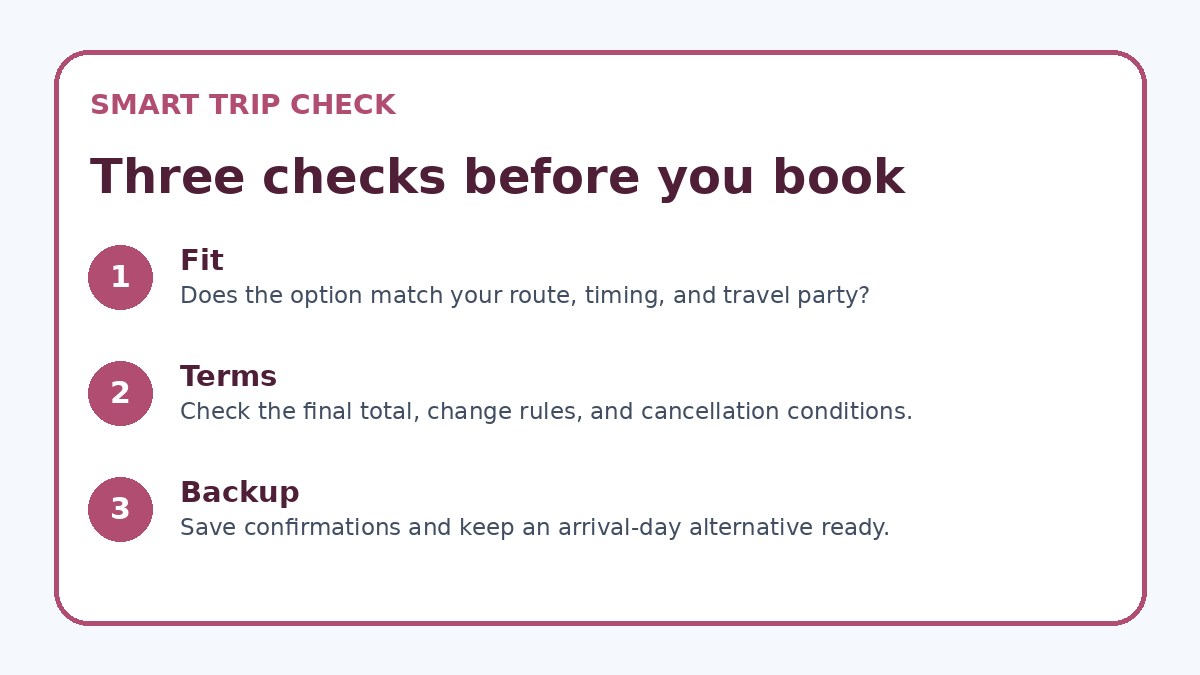
- Verify full fare rules, baggage allowance, change/cancellation fees and corporate invoicing requirements on the supplier page.
- Capture and save screenshots of the final booking page and confirmation for expense and dispute resolution.
Verify provider details before you click purchase
Alerts are useful summaries, but provider pages contain the binding details. Always confirm fare rules, change and cancellation fees, baggage allowances, and the exact itinerary on the airline or hotel booking page before you finalise. If your company requires specific invoice elements or an IATA number for expense processing, verify those fields match company requirements. If you rely on corporate points or loyalty benefits, check whether the fare qualifies on the provider’s final booking screen.
When multiple channels show similar Dubai travel deals, compare the same itinerary across them to find the version that best meets your decision triggers. If you use a third-party site or an aggregator like Trip.com to compare availability, treat its listing as one data point and always complete the booking on — or verify — the official supplier page when rules or refunds matter. Save screenshots of the fare rules and booking confirmation pages in case you later need them for expense or dispute resolution.
Frequently asked questions
How many price alerts should I run for a single Dubai business trip?
Run a small number of highly specific alerts rather than many broad ones. Two to four focused alerts usually work: one for a preferred direct flight or carrier, one for an acceptable connection window, and one for a refundable or changeable ticket. If you need a hotel, add a single alert for the required district and room type. Narrow alerts reduce false positives and make decision criteria easier to apply when a notification arrives.
Can price alerts account for corporate negotiated rates and loyalty benefits?
Alerts may show public fares but they won’t automatically reflect every negotiated corporate rate or loyalty benefit. Use alerts to monitor the market, but always check your company travel portal or speak with your travel manager to compare corporate-negotiated rates and loyalty-eligible fares. Confirm on the provider’s or TMC’s booking page whether the alerted fare actually qualifies for corporate discounts, invoicing details, or loyalty accrual before completing the booking.
What should I prioritise if an alert shows a cheap flight that conflicts with meeting times?
Prioritise meeting reliability and personal readiness over a marginal fare saving. Consider total door-to-door time, arrival time relative to meetings, potential delays, and sleep quality. If the alerted flight reduces time but increases risk of missed meetings due to tight connections, it likely isn’t worth it. Use a simple scoring system — for example, 40% schedule fit, 30% flexibility, 30% cost — to decide objectively whether the cheaper option supports your business objectives.
Final planning note
Price alerts are a powerful tool for business travel to Dubai when used with rules and discipline. Treat alerts as signals to investigate, not as instructions to buy immediately: limit alerts to matching constraints, define clear booking triggers, and enforce a short review window. Compare alerted fares against refundable or corporate-negotiated options and verify all fare rules on the supplier’s final booking page before purchase. This approach reduces impulse spending, protects your schedule, and keeps travel aligned with company policy while allowing you to capture legitimate opportunities.
Continue planning
Check current options and final conditions
Use the provider page to confirm live availability, the final total, cancellation terms, and every condition that matters to your trip.
This evergreen planning guide was created with AI-assisted drafting and a structured quality review. It does not display live prices, schedules, availability, visa guidance, or provider rankings. Verify current details before booking. Some links are affiliate links; we may earn a commission at no additional cost to you.