
If you’re traveling from Seoul to Jeju with extra luggage, the practical answer is to prioritize the airport that gives you the simplest ground logistics and the most flexible checked-bag terms for your carrier. For many travelers that means choosing the airport where your airline’s baggage allowances, checked-bag size limits, and special-equipment handling are clearest and easiest to process — and where getting to and from the airport with large bags is least stressful. Before you buy a ticket, compare the baggage rules and excess-fee policies shown on the airline’s final booking page, confirm check-in and oversized-baggage handling options, and factor in how you’ll get to the terminal with big bags (car, subway with elevators, or airport shuttle). Below I explain the tradeoffs between Seoul’s two main departure airports, how to compare routes, and practical steps to keep your extra luggage from turning a short domestic flight into a logistics headache.
How the two Seoul airports differ for heavy luggage
Gimpo and Incheon serve different traveler needs. Gimpo (closer to central Seoul) is convenient for short domestic hops and often has simpler terminal layouts, shorter transfers, and quicker access from central neighborhoods. That proximity reduces the time you spend moving large suitcases through public transport and decreases the number of transfers between modes (train to shuttle to terminal). If your priority is minimizing transit distance with bulky bags and you want to avoid complicated multimodal trips, Gimpo’s neighborhood access can be a decisive advantage.
Incheon, by contrast, is a major international hub with more ground-handling facilities and sometimes more flexible options for special equipment or oversized items handled by specialist staff. However, it sits farther west of central Seoul and typically requires a longer transfer by AREX, airport limousine bus, or taxi. For travelers who require additional handling — for example, sports gear, musical instruments, or extra-large checked items that need special crates or palletizing — Incheon may offer more on-site logistics, but at the cost of a longer commute from central Seoul.
Baggage rules and where to verify them
Airlines set baggage allowances, size limits, and excess-fee rules; airports do not override those conditions. Before booking, open the final booking or confirmation page for the flight you intend to buy and read the baggage policy linked there. Look specifically for checked-piece limits, maximum linear dimensions, weight limits per piece, and the defined procedures for oversized or odd-shaped items. If the booking page is unclear, contact the airline’s baggage or customer service team to confirm whether items like surfboards, skis, or oversized boxes can be accepted and how they are charged.
Also verify the check-in deadline and where oversized baggage is processed at the airport you plan to use. Some carriers route oversized items to special counters or cargo departments, which may be located in different terminals at Gimpo versus Incheon. When comparing options, note whether the airline requires you to handle oversized declarations at a cargo desk (potentially extending the time needed at the airport) or whether you can check these items at the regular domestic counter. Trip.com can be used as one comparison stop to view current availability, but always confirm final baggage terms on the airline’s page before payment.
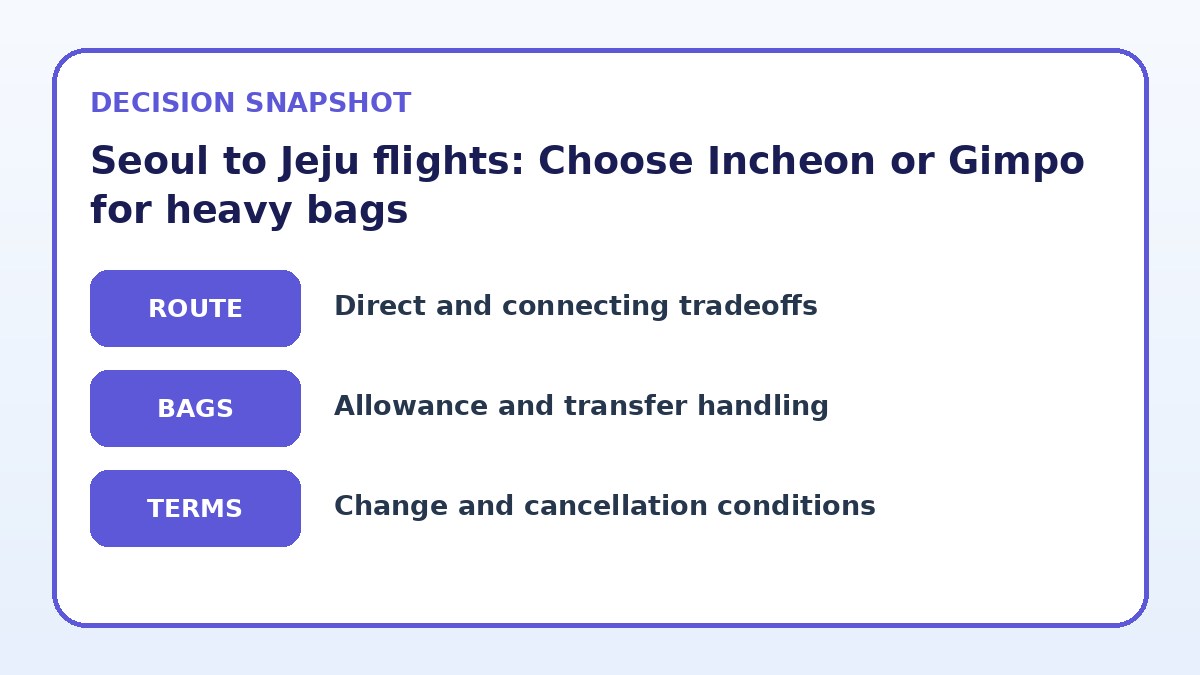
| Approach | Best for | Tradeoff to check |
|---|---|---|
| Choose Gimpo for proximity | Travelers prioritizing short transfers and fewer lifts with bulky bags | Fewer specialist cargo facilities and potentially limited oversized-item staffing |
| Choose Incheon for handling options | Those needing specialist oversized-item handling or airline cargo services | Longer travel time from central Seoul and more complex transfers |
| Pick direct flights on any airport | Minimizing baggage handoffs and simplifying pick-up on Jeju | May be limited by carrier baggage allowances or piece limits |
| Accept a connecting itinerary | When direct schedules don’t match your timing or when price and routing demand it | Higher chance of re-checking baggage or managing oversized items between flights |

Ground transport and moving big bags
Think beyond air policies: the door-to-door experience matters most when you have extra luggage. Consider whether you’ll travel to the airport by subway, bus, limousine coach, or taxi. Gimpo’s closer location to central Seoul often means shorter taxi rides and fewer transfers, which reduces the number of times you lift and shift heavy cases. If you rely on public transit, check station layouts for elevators and accessible routes; carrying large suitcases up multiple stairs or long platform ramps can add time and stress.
If you prefer private transfer, calculate taxi or ride-share options that can accommodate large trunks — some services offer larger vehicles for an extra fee. For Incheon flights, also examine whether your hotel provides direct airport shuttle service and whether the shuttle can handle oversized baggage. If you plan to use a luggage-forwarding or porter service, research what sizes they accept and whether they operate between your neighborhood and your chosen airport.
Before you book
- Open the airline’s final booking page and screenshot the baggage allowance and fees for the exact flight you plan to buy.
- Call the airline’s baggage/cargo desk to confirm procedures for oversized or non-standard items and where they are processed at your chosen airport.
- Plan ground transport that fits your luggage: pre-book a taxi with a large trunk or confirm elevator access on subway transfers.
- Allow extra time at the airport if your items require special handling so you can complete any cargo desk paperwork before departure.
- Verify whether your itinerary is on a single ticket that through-checks baggage to Jeju or whether you’ll need to reclaim and re-check luggage.
- Measure and weigh bags at home to avoid surprises and reduce excess-fee risk; adjust packing or split items between cases if possible.
Comparing direct and connecting options with extra baggage
Direct Seoul to Jeju flights are generally simpler for checked luggage: you check once and pick up at Jeju, without intermediate transfers. If a direct flight is available on your airline and you’re within that carrier’s baggage limits, this is usually the fastest, lowest-friction option. But not every carrier offers the same baggage terms, and some low-cost domestic operators limit piece counts or apply strict weight caps that can make direct flights more expensive if you exceed allowances.
If a routing requires a connection, pay attention to how airline partners handle baggage transfers. A connecting itinerary across different carriers may require you to re-check bags during a transfer or to pick up and re-clear oversized items — which can be a significant inconvenience when moving bulky luggage between terminals. When comparing itineraries, check if the itinerary is on the same ticket (single PNR) and whether baggage is through-checked to Jeju; the airline’s final booking page and customer service will confirm whether your bags will travel automatically or require manual handling at a connection.
Frequently asked questions
Should I always pick Gimpo for Seoul to Jeju flights when I have heavy bags?
Not always. Gimpo’s proximity to central Seoul often makes transit with heavy luggage easier, but pick the airport that best matches your airline’s baggage terms and your need for specialist handling. If your airline provides clear, generous checked-bag allowances for domestic flights and you prioritize a shorter transfer from downtown, Gimpo can be the more convenient choice. However, if your items are oversized, require palletizing, or need extra handling, Incheon’s larger cargo operations may be more appropriate. Confirm baggage policies and processing locations on the airline’s final booking page before deciding.
How do I handle sports equipment, musical instruments, or oddly shaped luggage?
Special items often have bespoke procedures: some carriers accept them as checked baggage with specific packaging requirements, others route them through a cargo counter. Before booking, read the airline’s special-item rules on the final booking page and contact the carrier if rules are unclear. Ask which terminal counter processes oversized items at your chosen Seoul airport and whether you must arrive earlier than the standard domestic check-in time. If the airline requires cargo handling, plan for extra time and potentially different drop-off locations than regular check-in counters.
If a connection is cheaper or more convenient, how do I avoid baggage headaches?
First, verify whether the itinerary is on a single ticket and whether baggage will be through-checked; that detail is usually visible on the booking page or confirmed by the airline. If baggage is not through-checked, plan for the time needed to collect and re-check items during the layover. For oversized pieces, confirm where they’ll be processed at the connection airport. When in doubt, contact both carriers involved to confirm transfer procedures, and leave longer connection windows to accommodate extra handling time.
Final planning note
For travelers with extra luggage, the practical airport choice for Seoul to Jeju flights depends on how you balance door-to-door ease against specialized handling needs. Gimpo offers shorter transfers and simpler terminal navigation that reduce the physical burden of moving large suitcases from central Seoul, while Incheon provides more extensive cargo and oversized-item facilities that can handle unusual equipment but require a longer commute. Always verify baggage allowances, oversize rules, and check-in or cargo procedures on the airline’s final booking page before you purchase, and plan ground transport and extra time accordingly. With those checks in place, you can pick the departure airport that minimizes both cost surprises and physical strain on travel day.
Continue planning
Check current options and final conditions
Use the provider page to confirm live availability, the final total, cancellation terms, and every condition that matters to your trip.
This evergreen planning guide was created with AI-assisted drafting and a structured quality review. It does not display live prices, schedules, availability, visa guidance, or provider rankings. Verify current details before booking. Some links are affiliate links; we may earn a commission at no additional cost to you.