
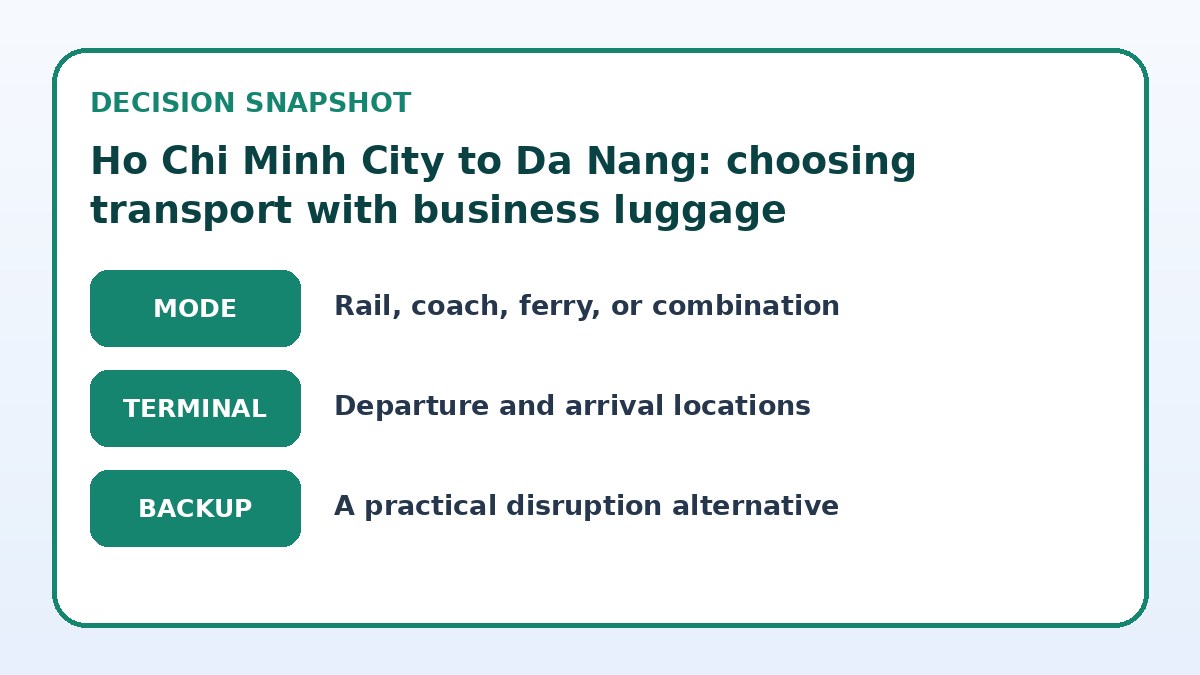
If you need to travel from Ho Chi Minh City to Da Nang with business luggage, pick the mode of transport that matches the amount and type of bags, your meeting schedule, and how much time you can spend on logistics. For quick city-center to city-center movement with a single checked bag and tight schedule, air travel often makes sense. If you have oversized cases, important samples, or prefer a relaxed pace and predictable luggage handling, rail and private car options deserve serious consideration. This article gives clear, luggage-focused criteria for making that choice, outlines tradeoffs you’ll face at each step, and lists the exact things to verify on providers’ booking pages so you won’t be surprised at check-in or arrival.
Compare travel time vs. luggage practicality
Business travelers usually think first of elapsed travel time. Flights from Ho Chi Minh City to Da Nang can be the fastest choice between central urban areas, but total time includes airport transfers, check-in or bag drop, security, and potential waits. If your luggage is a single standard suitcase and you can leave it as checked baggage, the on-paper flight duration can translate to a clear advantage. Factor in the time to clear airports at both ends and any required commute to offices or hotels—those end-to-end minutes matter most for same-day meetings.
Trains and private-car transfers shift the balance because they reduce hands-on baggage handling and eliminate long security queues. Train carriages often provide overhead racks and wide luggage spaces in carriage vestibules, which can suit several suitcases or a mix of boxes and garment bags. Private cars deliver true door-to-door service, useful when you must move samples or equipment that can’t be checked on a flight, but vehicle size limits how much you can take and you must confirm capacity in advance.
Packing and luggage choices that change the best option
Decide first what you absolutely must bring and what can be left, shipped, or rented at your destination. Soft-sided cases and garment bags fit more easily into overhead racks or trunks, while rigid crates or wheeled flight cases may be awkward on trains and require more space in cars. If you carry fragile samples or electronics, invest in protective packing and consider carry-on options where possible to avoid any checked baggage risk. Also consider a compact business backpack for essentials you need upon arrival—keeps documents and devices accessible without opening checked luggage.
The number and dimensions of your items often determine the winning transport mode. If you’re traveling with several large pieces—multiple suitcases, a wheeled presentation case, and a mannequin—private vehicle hire or freight-forwarding options may be the only practical choices. For a single suit bag plus a laptop, flights are usually simpler. When packing, test-fit cases into your typical transfer mode (taxi trunk, train carriage, hotel lift) if you can, or at least measure and compare against the vehicle or baggage allowance information on booking pages.
| Approach | Best for | Tradeoff to check |
|---|---|---|
| Commercial flight | Single standard checked bag, fastest city-to-city travel | Airport transfers and security add time; strict weight/size limits and potential extra fees |
| Intercity train | Bulky or fragile items that need gentler handling | Potentially slower and stations may be farther from city business districts |
| Private car/van transfer | Door-to-door service with multiple large cases or equipment | Higher cost and must confirm exact vehicle capacity in advance |
| Freight or courier service | Oversized crates, samples, or non-urgent heavy loads | Requires lead time and coordination; not suitable for last-minute travel needs |
Booking checklist: what to verify before you buy
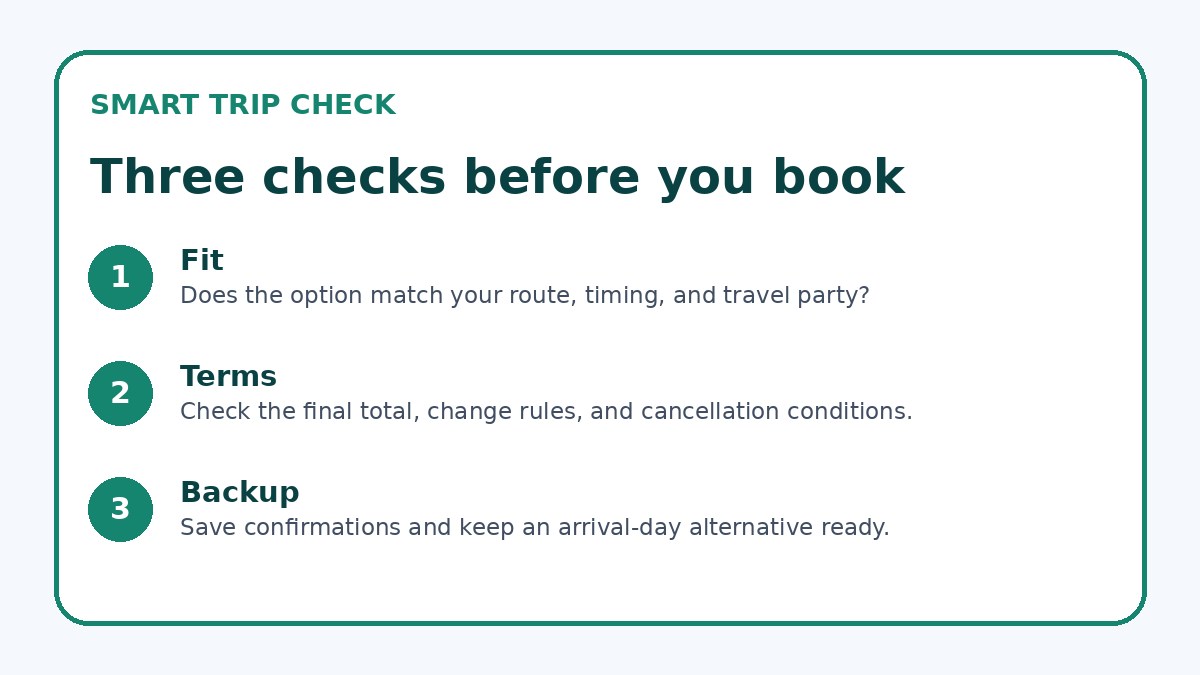
On all booking pages check three luggage-related items: the allowed number and size of free checked items, the fee schedule for extra or oversized bags, and whether an item must be declared in advance. These rules vary by operator and fare class; don’t assume similar-sounding tickets have identical allowances. For ground transfers ask for vehicle dimensions or photographed trunk space and get confirmation that drivers can load and unload at both pickup and drop-off addresses. When you need guaranteed space for awkward items, request vehicle type or reserve a larger transfer category explicitly.
Also verify pick-up and drop-off logistics: airport terminal or station names, recommended arrival times for check-in or boarding, and whether staff assist with heavy or fragile bags. For trains, confirm which platform or station is nearest to your hotel and whether porter services operate. If you plan to switch modes—flight to car, car to train—map the connection times with added buffer for traffic or security. Finally, keep screenshots or PDFs of luggage confirmations so you can show them to staff if policies are misapplied.
Before you book
- Measure and weigh every main bag and note dimensions before comparing provider allowances.
- Confirm baggage allowance and extra-fee rules on the operator’s final booking page and save a screenshot.
- If booking a private transfer, request vehicle trunk dimensions or a vehicle photo and confirm loading help.
- Pack a carry-on with essentials and documents to avoid being stranded if checked luggage is delayed.
- Allow buffer time between connections for traffic, security checks, and luggage handling.
- Label all bags with your phone number and destination address, plus a local contact where possible.
Practical day-of-travel tactics for smoother transfers
Pack a small, clearly labeled kit with chargers, essential documents, and one change of clothes in your carry-on so you can handle delays or baggage mishandling without missing meetings. At pickup, use strong luggage tags with your destination address and a local contact number. If you’re using airport check-in, arrive early enough to account for bags that require extra inspection. If taking the train, position large cases in the carriage vestibule nearest the doors to speed loading and unloading—this saves time when you have a tight connection or a short walk from the station to a meeting.
Communicate clearly with drivers or station staff about where luggage should be placed and who will carry what. For private transfers, label which items go into which trunk or compartment so the driver can load efficiently. If you rely on a courier or freight option for extra-large freight, schedule pickup and delivery windows that align with your meeting times and request tracking updates. Finally, maintain digital copies of airline or train e-tickets, booking confirmations, and any special luggage permissions for quick reference.
Frequently asked questions
Is it better to fly or take the train from Ho Chi Minh City to Da Nang with several suitcases?
If you travel with several large suitcases, trains or private transfers tend to be more practical because they offer easier handling and more continuous space for luggage. Flights can be faster but impose stricter weight and size rules and may charge for extra pieces, meaning you’ll need to confirm allowances before booking. Also consider where stations and airports sit relative to your appointments: the fastest on-paper option isn’t always the most efficient door-to-door choice when you add transfers and loading time.
What specific luggage details should I check on a booking page?
Look for the number of free checked items, maximum weight per bag, and maximum linear dimensions for each checked and carry-on piece. Check the stated fees for overweight, oversized, and extra pieces and whether items like musical instruments or fragile crates require advance notice. For trains and private transfers, check whether the provider lists trunk or cargo capacity and whether assistance with loading and unloading is included or available for an extra fee.
How can I avoid surprises with oversized or fragile business equipment?
If an item exceeds a typical checked-bag size, contact the provider before booking to describe dimensions, weight, and fragility, and request written confirmation that the item can be carried and how it will be stored. For sensitive equipment, consider hard cases, clear labeling, and insurance. When in doubt, arrange a dedicated private transfer or a specialist courier that handles fragile shipments and provides tracking and delivery windows aligned with your meeting schedule.
Final planning note
For business travel between Ho Chi Minh City and Da Nang, the smartest choice depends on what you must carry and how much you value speed versus hassle-free handling. Flights suit travelers with standard luggage and tight schedules, provided you verify baggage allowances and airport transfer times. Trains and private cars give more forgiving luggage space and simpler loading for bulkier or fragile items, though they may add travel time or cost. Before you book, compare end-to-end door-to-door travel time, confirm luggage rules on the provider’s final page, and pick the option that preserves your arrival window and the condition of your cargo.
Continue planning
Check current options and final conditions
Use the provider page to confirm live availability, the final total, cancellation terms, and every condition that matters to your trip.
This evergreen planning guide was created with AI-assisted drafting and a structured quality review. It does not display live prices, schedules, availability, visa guidance, or provider rankings. Verify current details before booking. Some links are affiliate links; we may earn a commission at no additional cost to you.