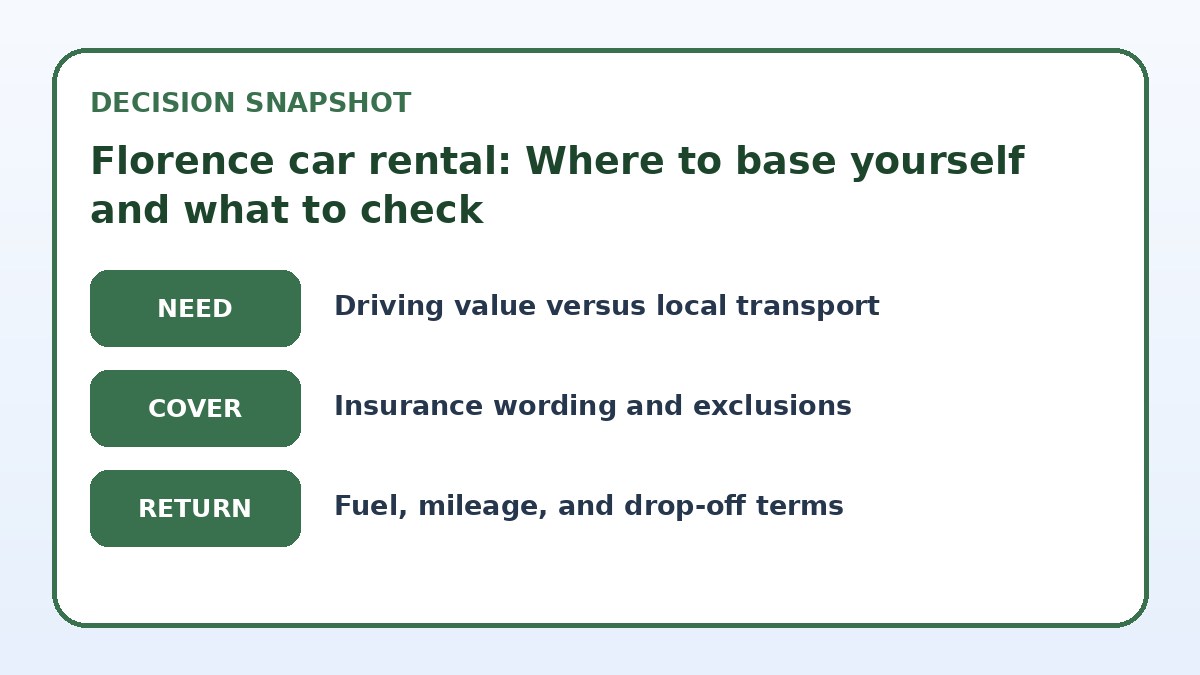
Practical answer first: for most first-time visitors to Florence, skip the car while staying in the historic centre and rely on walking and public transit; rent a car only if you plan day trips into the Tuscan countryside or are staying outside the ZTL (restricted traffic zone). Florence’s compact core is best explored on foot — narrow streets, pedestrian squares, and limited parking make driving slow and costly. A car becomes useful when your itinerary includes hill towns (Siena, San Gimignano, Val d’Orcia), wineries, or multiple stops across the region where public transport would be slow or infrequent. Before you book, match the car decision to your lodging location, how many people and bags are traveling, and whether you’re comfortable with narrow, often one-way historic streets and strict local traffic rules.
How Florence’s layout and ZTL shape the decision
Florence is compact; the historic centro storico is tightly woven with pedestrian streets, museums clustered close together, and many attractions reachable on foot in short sequences. That density is a strength for visitors who enjoy wandering, stopping in cafés, and hopping between galleries without needing to find or pay for parking. The city also enforces a Zona a Traffico Limitato (ZTL) that restricts most private vehicles during set hours. Cameras monitor access points and fines are commonly issued to uninformed drivers who enter the restricted zone, so driving into the centre is riskier than it first appears.
When deciding about a Florence car rental, ask where your hotel or apartment is located relative to the ZTL and whether it provides a private parking space. Some properties will register your plate with local authorities to allow temporary access, but you must verify that directly with the host. Even if you have legitimate ZTL access, parking in the centre is limited and typically charged by hour or night, which adds cost and stress. For short stays focused on the centre, the hassle and expense usually outweigh the benefits of having a car.
When a rental car is the right choice
A car becomes valuable when your itinerary extends beyond Florence into rural Tuscany or includes several small towns where public transit is slow or indirect. Day trips to places like Siena, Montalcino, or the Val d’Orcia are easier on your own schedule with a car, especially when you want to visit vineyards or remote viewpoints that are not served frequently by buses. If your plan includes carrying sports equipment, shopping regional food products, or traveling with young children and bulky gear, a car can make logistics manageable and let you move at your own pace.
Also consider trip length and company: if you’re traveling with two or more people and split the rental and fuel costs, driving can be cost-effective compared with multiple train or tour tickets. But remember that driving in Tuscany involves narrow rural roads, limited signage in small towns, and occasional steep or uneven streets. Make sure you and any drivers are comfortable with such conditions, and be realistic about parking at village centers where spaces can be scarce or located outside the pedestrian cores.
| Approach | Best for | Tradeoff to check |
|---|---|---|
| Rent and drive from Florence centre | Travelers based outside the ZTL or with guaranteed private parking | High risk of ZTL fines, limited parking, and extra time navigating narrow city streets |
| Skip the car and use walking, buses, and trains | First-time visitors staying in the historic centre focusing on museums and dining | Less flexibility for rural day trips and limited access to remote wineries or hilltop villages |
| Rent for a countryside leg only (pick up/drop off outside centre) | Visitors who want the best of both—city convenience and rural mobility | Requires extra logistics to coordinate rental locations and possible one-way fees |
| Use guided day trips or private transfers | Those who want rural access without driving or parking concerns | Less personal flexibility and potential higher per-day cost compared to self-driving |
Alternatives to renting and how to combine options
Florence has strong rail and coach connections to major Italian cities and many Tuscan towns, making trains and regional buses viable alternatives for first-time visitors who plan to stay mostly in urban areas. High-speed and regional trains serve Florence’s Santa Maria Novella station, putting Siena and other destinations within reach when combined with short local transfers. Guided day tours or private drivers provide convenient one-day access to distant sites without the stress of driving on unfamiliar roads or finding parking; they’re worth comparing against the cost and flexibility of a rental car.
A hybrid approach often works well: leave the car parked at an airport or suburban rental location, spend a few days exploring Florence on foot, then pick up the car for a dedicated multi-day countryside loop. This reduces time spent navigating the city by car while still giving you the freedom to explore remote areas. If you choose this split, confirm rental pick-up and drop-off locations and hours, and check whether you’ll need to pay for additional drop-off fees or one-way surcharges on the booking page.
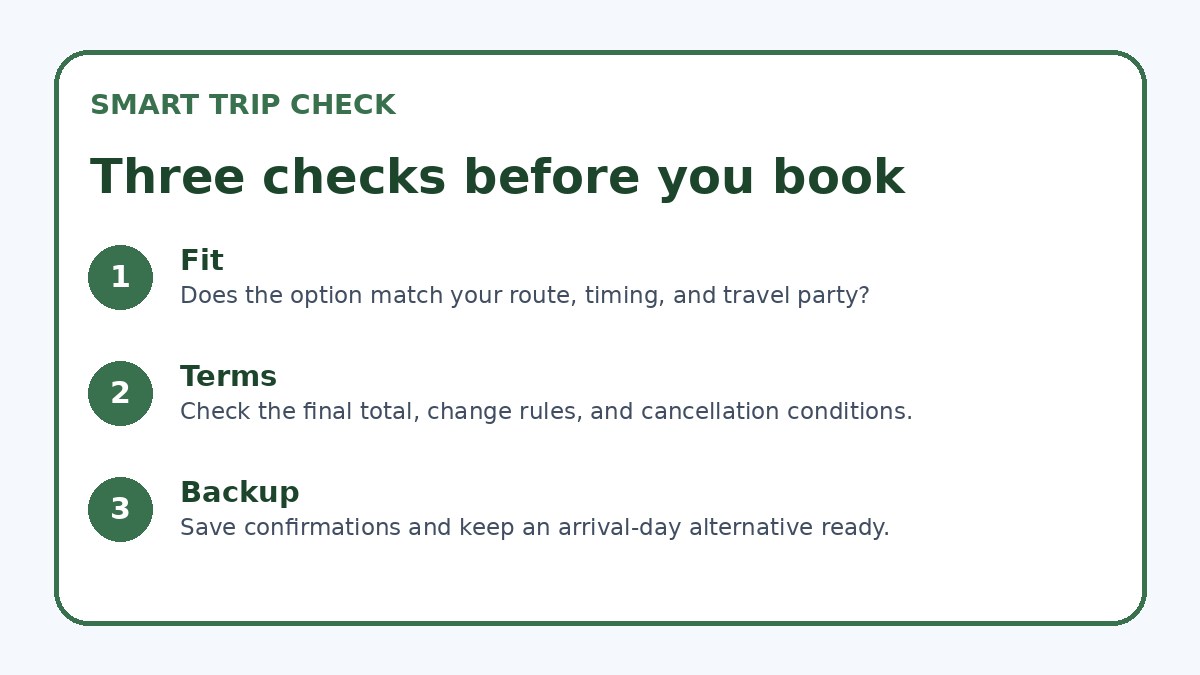
Before you book
- Confirm whether your accommodation is inside the ZTL and whether the host can register your plate to avoid fines.
- Compare pick-up/drop-off locations and opening hours on the rental’s final booking page to avoid late return fees.
- Choose a compact car and specify an automatic transmission if you’re not comfortable driving a manual in narrow streets.
- Verify insurance coverages and excess amounts on the rental contract; consider supplemental coverage if needed.
- Plan parking ahead: identify garage addresses, nightly rates, and whether spaces are reserved or first-come-first-served.
- Map your intended day-trip routes and check road types to ensure drivers are comfortable with rural, one-lane, or winding roads.
Practical checks before you book a rental
Before reserving any vehicle, verify the car rental agency’s fuel rules, mileage limits, and insurance coverages. Pay special attention to collision damage waiver terms, theft protection, and the excess amount you would be liable for after an incident — these can vary widely between companies. If you plan to drive outside Italy or to islands, check cross-border restrictions. Always compare what is listed on the final booking page: deposit amounts, card holds, allowed drivers, and any extra charges for young or senior drivers should be confirmed there rather than assumed.
Also check vehicle size and transmission: narrow streets favor small cars, and if you aren’t comfortable with a manual gearbox, request an automatic when booking. Confirm whether the rental location provides GPS, child seats, or roof storage, and whether these extras incur daily charges. Finally, research local road rules—speed limits, alcohol limits, and parking signage—and learn how to read blue, white, and yellow parking zones in Italy to avoid fines and towing.
Frequently asked questions
Can I drive into Florence’s historic centre with a rental car?
Generally, private vehicles are restricted from entering the ZTL (restricted traffic zone) in Florence without prior authorization. Some accommodations can register a guest’s license plate to allow temporary access for loading or check-in, but you must confirm this directly with your hotel or host and keep written confirmation. Cameras monitor ZTL entry points and fines are typically issued automatically; if the rental company records your plate entering the zone, you may also face handling fees from the agency. Always verify ZTL rules and any necessary permits before driving toward the centre.
Is parking in Florence easy and affordable for rental cars?
Parking near Florence’s main attractions is limited and often priced by the hour or night in public garages and blue-line (paid) street spaces. Free parking is uncommon in the historic centre and may be located farther away, requiring a longer walk or transit connection. Private garages may offer reserved spaces but check the final booking page or contact the property to confirm availability and price. Consider parking in a secure suburban lot and using public transit into the city to avoid time-consuming searches and high central rates.
How do I combine trains and a rental car for a mixed itinerary?
A practical option is to arrive in Florence by train, explore the historic centre without a car, and then pick up a rental from a station-side or airport location when you’re ready to head into the countryside. If planning a split, compare rental terms for different pick-up points, confirm vehicle availability, and check whether the agency charges one-way or after-hours fees. Make sure travel times align — factor in train schedules, rental office hours, and the time needed to transfer luggage between modes. Verify all details on the rental company’s booking page before committing.
Final planning note
For most first-time visitors, Florence is best enjoyed without a rental car while you stay in the historic centre: walking and using local buses keep your days simple and let you soak in the city’s charm without parking stress or ZTL risk. Rent a car when your priorities shift toward exploring Tuscany’s countryside, visiting multiple hill towns, or traveling with bulky luggage and several people. If you choose to drive, plan carefully: confirm ZTL permissions with your accommodation, select a compact vehicle, and verify insurance and pick-up/drop-off details on the final booking page. Thoughtful planning will let you blend Florence’s walkable pleasures with the countryside freedom a car can provide.
Continue planning
Check current options and final conditions
Use the provider page to confirm live availability, the final total, cancellation terms, and every condition that matters to your trip.
This evergreen planning guide was created with AI-assisted drafting and a structured quality review. It does not display live prices, schedules, availability, visa guidance, or provider rankings. Verify current details before booking. Some links are affiliate links; we may earn a commission at no additional cost to you.