
If you’re traveling solo from Seoul to Busan, the practical decision is simple: match how much luggage you bring to the check-in and arrival strategy you prefer. A light carry-on lets you skip checked-baggage lines, move through security faster, and make earlier or later flights with less hassle. Bringing checked baggage can be sensible when you need more gear, but it requires extra time at drop-off and reclaim. Decide first whether you want to prioritize speed, cost visibility, or convenience with larger baggage, then plan airport arrival times accordingly. This article walks through the precise tradeoffs—how bag size affects check-in and security, what to verify on booking pages, and how to choose arrival windows so you won’t be rushed or stuck waiting. You’ll finish with a clear, personalized checklist to use before you leave your accommodation in Seoul.
How baggage choices change the airport timeline
Carry-on only radically shortens the parts of the airport experience you control. You avoid the queue at the baggage drop counter and the wait at baggage claim, and you can often move straight to security after online check-in. That reduces your minimum recommended arrival time at the departure airport. However, carry-ons bring tradeoffs: you must pack to size and weight limits, fit liquids and electronics into security-friendly layouts, and be prepared to gate-check if the flight is full or aircraft storage is tight.
Checked baggage adds predictable conveniences for longer trips or when you need bulky or heavy items, but it lengthens your door-to-airport timeline. Account for the time to drop bags at the airline counter or kiosk and for the extra screening those bags may undergo. On arrival, you should factor in time at the baggage belt, which can add 15–40+ minutes depending on airport flow. Before committing to checked luggage, read the airline’s baggage rules on the official booking page—verify weight, size, fees, and the latest drop-off cutoffs.
Choosing arrival and check-in windows in Seoul
Decide your comfort margin: conservative travelers should aim to arrive earlier than minimum recommendations to absorb unexpected delays, while confident solo travelers with only carry-ons can safely tighten that margin. Check whether your airline offers online check-in and mobile boarding passes; these tools let you skip ticket counters and go straight to security, shaving time off the process. Also consider peak times—morning and early evening peaks often bring longer security queues, so mid-day departures can be quicker at the same airport.
Factor in ground time from where you’re staying in Seoul. Transport options—metro, express bus, taxi, or rideshare—have different variability. Allow extra time if your route requires a metro transfer or could face road traffic. For departures late at night or very early in the morning, double-check the availability of your transfer option; some public transport services run limited schedules. Finally, review the airline’s final booking page to confirm the latest recommended arrival time and any counter or kiosk closing policies that affect when you must arrive.
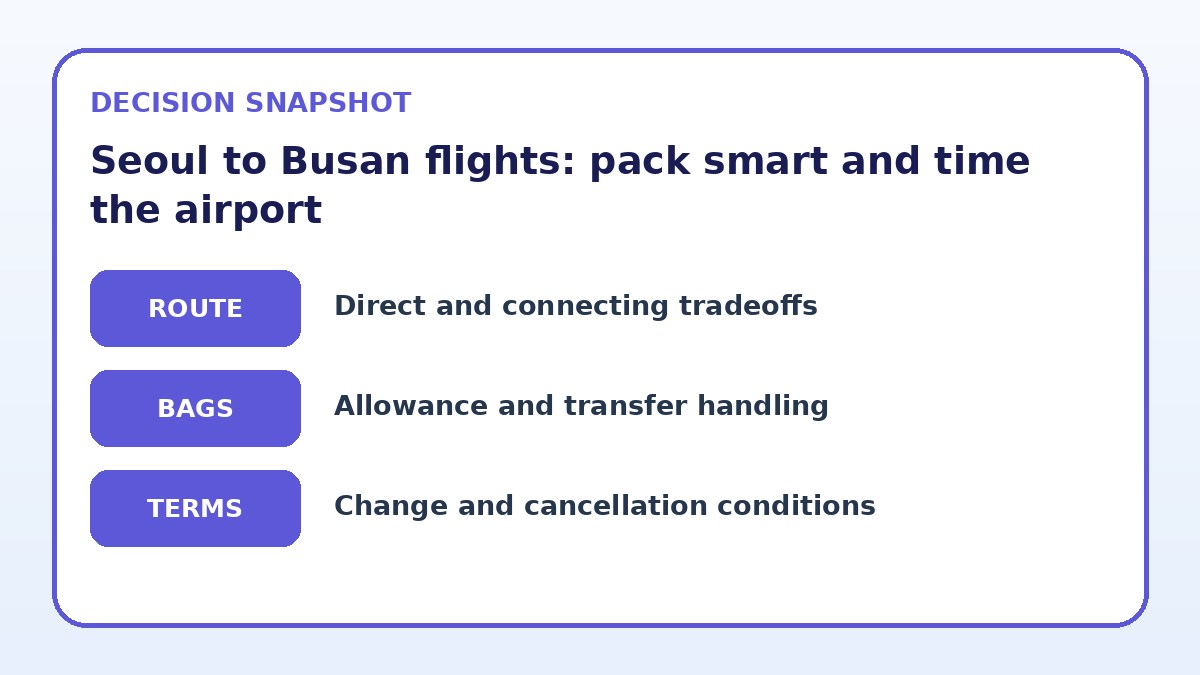
| Approach | Best for | Tradeoff to check |
|---|---|---|
| Carry-on only and later arrival | Speed-focused solo travelers who want minimal airport wait times | Less packing flexibility and risk of gate-checking if the flight fills |
| Checked bag with early arrival | Travelers needing more luggage who value predictability | More time spent at counters and waiting at baggage claim |
| Direct flight with carry-on | Simple, low-stress itineraries with minimal transfer complexity | Limited seat or time options compared with multi-leg routes |
| Connecting flight with checked bags | Those prioritizing schedule options or lower fares despite extra handling | Higher risk of missed connections or needing to recheck luggage |
Arrival in Busan: landing, baggage, and onward connections
On arrival in Busan, your baggage choice continues to shape how quickly you can leave the airport. Travelers with carry-ons can head straight to ground transport or onward flights and trains, while those with checked bags must wait for them at the belt. If you have a strict connection—such as an onward domestic flight, ferry, or long-distance train—plan longer margins when you have checked luggage. If your itinerary involves a private transfer or timed shuttle, confirm pickup windows and give yourself wiggle room for deplaning and walking to the meeting point.
If you need to move into the city quickly, research which terminal services are available: luggage trolleys, short-term lockers, or bus and rail links. Verify on official sources what transport options run from the terminal you arrive at and their operating hours. For solo travelers with heavy bags who want to skip the immediate transit scramble, consider baggage storage or portering options at the airport so you can explore near the terminal quickly before continuing to your accommodation.
Before you book
- Confirm whether your fare includes checked baggage and note the exact weight and size limits on the airline’s booking page.
- Complete online check-in and download or screenshot your mobile boarding pass before leaving your accommodation.
- Measure and weigh your packed bags to ensure carry-on compliance and arrange a small luggage scale at your accommodation if needed.
- Plan ground transport time to the Seoul airport and add 30–60 minutes as a buffer for peak traffic or public-transport transfers.
- If checking bags, arrive early enough for the airline’s drop-off cutoff and save time by using self-service kiosks where offered.
- On arrival in Busan, check baggage belt numbers and ground transport options before you disembark so you head in the right direction quickly.
How to compare direct and connecting options for this route
For Seoul to Busan travel, compare direct flights to options with a connection by weighing total door-to-door time, change of aircraft logistics, and luggage handling. Direct flights generally simplify matters—one boarding, one security pass, and no mid-journey recheck of baggage—so they reduce complexity for solo travelers who want predictability. Connecting itineraries can sometimes lower cost or enable preferred times, but they introduce an additional transfer window where missed connections, terminal changes, or long layovers become risks.
When you consider connecting flights, check how much minimum connection time your chosen itinerary allows and whether luggage is checked through to your final destination. If you must collect and recheck bags during a connection, add substantial cushion and verify local entry rules or terminal transfer procedures. Always confirm on the airline’s or booking page whether connections are protected and if the itinerary requires self-transfer; Trip.com may be a helpful place to compare current availability but verify transfer and baggage policies on the carrier’s official site before booking.
Frequently asked questions
How early should a solo traveler arrive at the Seoul airport for a domestic flight to Busan?
For domestic Seoul to Busan flights, a common approach is to balance caution with efficiency. If you travel carry-on only and have checked in online, you can often arrive with less lead time than a checked-luggage passenger; still, allow extra buffer for security lines and transfer time from your lodging. If you plan to check luggage, add time for drop-off and possible queueing. Check the airline’s official recommendation and counter closing time on the final booking page, then add a personal cushion for transport variability and comfort.
Can I rely on gate check for oversized items if I pack carry-on only?
Gate checking may be available when overhead bins fill, but it’s not guaranteed and depends on aircraft type and load. If you have an oversized or fragile item you prefer to keep with you, verify the airline’s size policy before travel and consider buying a checked-bag allowance if gate-checking would be disruptive. For essential items, plan to keep them in your personal item that fits under the seat. Always check the carrier’s baggage policy on its official site so you understand the conditions under which gate checks happen.
What should I verify on the booking page before finalizing a Seoul to Busan flight?
Before you commit, confirm the fare’s baggage allowance and exact size/weight limits, check whether seats or priority boarding are included or sold separately, and note the airline’s recommended arrival time and counter/kiosk closing times. If the itinerary includes a connection, verify whether baggage is checked through or must be re-claimed and rechecked. Also review the aircraft type if overhead bin size matters to you. Use the airline’s official booking page for these specifics; Trip.com can be used to compare availability, but always confirm operational policies on the carrier’s site.
Final planning note
Packing and arrival choices shape the solo traveler’s Seoul to Busan experience as much as the flight itself. Decide whether speed or luggage capacity matters most: carry-on travel shortens airport time and reduces uncertainty, while checked luggage buys comfort and gear freedom at the cost of extra steps. Use online check-in, measure bags beforehand, and plan realistic transfer time from your Seoul lodging. When comparing direct and connecting flights, pay attention to how baggage is handled through each itinerary and confirm connection protections on the carrier’s booking page. With the checklist above and clear priorities, you’ll choose the flight and timing that fit your rhythm and reduce airport stress.
Continue planning
Check current options and final conditions
Use the provider page to confirm live availability, the final total, cancellation terms, and every condition that matters to your trip.
This evergreen planning guide was created with AI-assisted drafting and a structured quality review. It does not display live prices, schedules, availability, visa guidance, or provider rankings. Verify current details before booking. Some links are affiliate links; we may earn a commission at no additional cost to you.