Practical answer first: most couples visiting central Busan for 3–5 days will find public transport faster, simpler, and cheaper for sightseeing within the city, while renting a car is worth considering if you plan frequent day trips outside Busan, want flexibility for dawn or late-night drives, or prefer private scenic routes along the coast. This article helps you weigh mobility, convenience, cost factors, parking and driving comfort so you can choose with confidence. Read the quick comparison, then use the decision criteria to match your priorities—time budget, luggage, spontaneity, and where you plan to sleep. If you decide to rent, I’ll tell you what to verify with the rental company and what to expect on Korean roads; if you prefer transit, I’ll explain which passes and transfer strategies matter most to couples.
Getting around Busan: the public-transport case
Busan’s subway and bus network reaches most tourist neighborhoods, including Haeundae, Seomyeon, Nampo-dong and Gwangan. For couples who prefer to avoid the hassle of parking and navigating unfamiliar roads, transit reduces decision load and lets you relax—share a seat, people-watch, or nap between stops. Subways are straightforward for east–west travel and connect to major ferry and train terminals, while local buses serve viewpoints, smaller beaches, and cultural areas that aren’t right on a subway line.
Public transport also simplifies evenings and alcohol choices: you can enjoy a dinner and drinks without needing a designated driver. If you plan to stay in a compact neighborhood or base yourselves near a subway line, you’ll save money and time. That said, transit requires walking to and from stops and can be crowded during peak hours; measure how comfortable you both are with multi-modal transfers, stairs, and carrying luggage between stations if you’re arriving or departing by long-distance train or bus.
Driving around Busan: when a rental makes sense
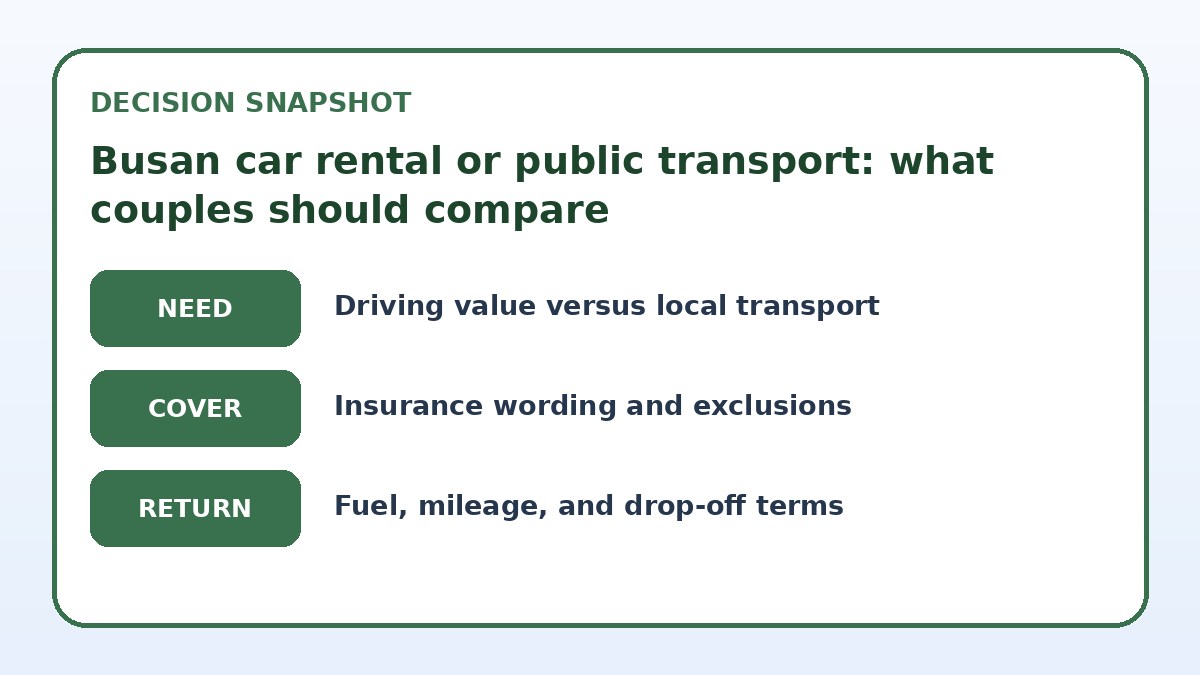
A rental car buys flexibility—start your day earlier or later, detour to seaside viewpoints, and carry picnic gear or surfboards without juggling transfers. Couples who plan multiple day trips to places like coastal villages, mountain temples, or neighboring provinces where train and bus services are infrequent will find driving more convenient. A car also helps when you’re traveling with lots of luggage, have mobility limitations, or want privacy on long drives between attractions.
However, driving in Busan means dealing with traffic, one-way streets, narrow lanes in older neighborhoods, and the need to find and pay for parking. If neither of you regularly drives abroad or you dislike urban driving, those stressors can eat into your enjoyment. Before booking, consider whether the freedom of a car offsets extra time spent searching for parking, setting GPS routes, and handling tolls or local driving customs.
| Approach | Best for | Tradeoff to check |
|---|---|---|
| Public transport (subway, bus, ferry) | Couples staying in central neighborhoods who want low-stress, cost-efficient sightseeing | Less flexibility for remote day trips and more walking between transfers |
| Car rental for day trips | Couples planning multiple off-grid excursions or traveling with lots of gear | Extra time and cost for parking, tolls, and navigating unfamiliar roads |
| Mix: public transport plus an occasional rental | Couples wanting city convenience with targeted private trips outward | More planning and potentially higher combined costs than one consistent approach |
| Public transport plus taxis for short gaps | Couples who avoid driving but need last-mile convenience or late-night returns | Taxi fares add up if used frequently; availability can vary late at night |
Decision criteria: how couples should compare transport options
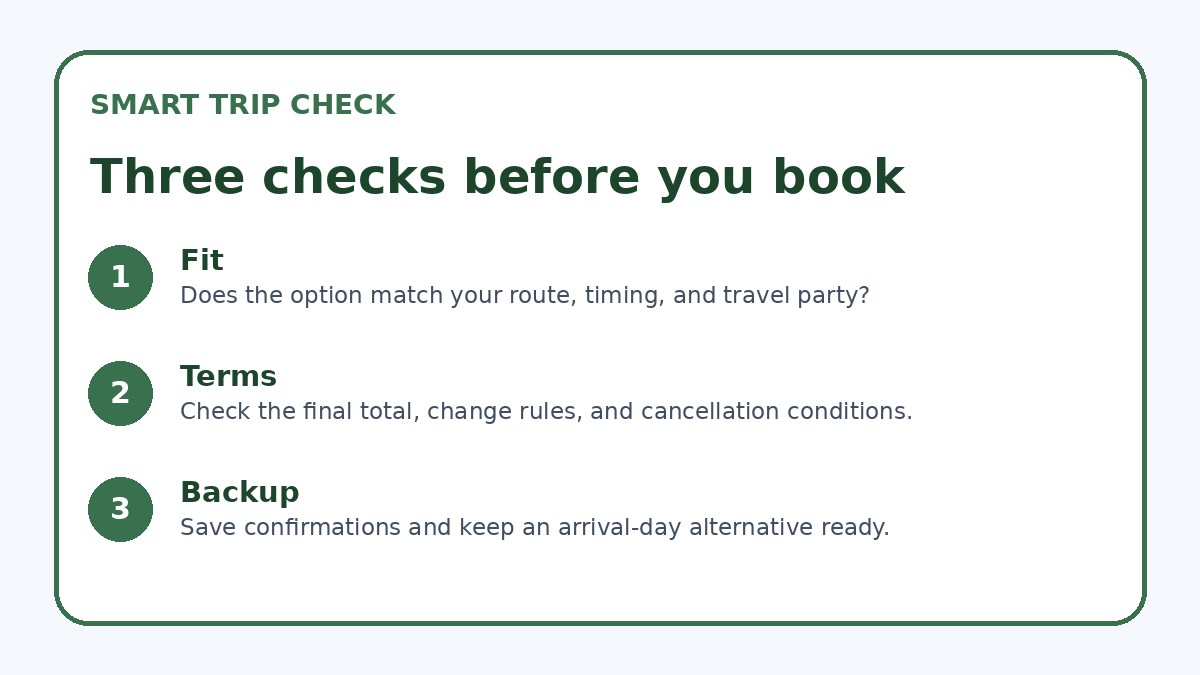
Start with your itinerary: list each day’s destinations and mark those that are off the main transit grid or require early starts or late finishes. If more than one full day needs a car—coastal routes, rural temples, or side trips—renting will likely pay off. Next, quantify intangible priorities: how much do you value privacy, spontaneity, and carrying gear? Assign a simple score to factors like walking tolerance, desire to drink in the evening, and interest in scenic driving to see which mode scores higher.
Also factor costs beyond daily rental rates: fuel, parking, tolls, and potential airport drop-off fees can add up. For public transport, check the need for transport cards or city passes and whether your planned trips fit within their coverage. Finally, account for driver comfort: if one partner will drive extensively but isn’t comfortable with Korean traffic or signage, that may tilt the decision toward transit and taxis.
Before you book
- Map your daily itinerary and mark any destinations not served directly by subway to see how often a car would be needed.
- If renting, confirm international driving permit acceptance, driver age limits, and what insurance is included on the rental booking page.
- Compare total expected costs: rental rate plus fuel, tolls, parking versus transport cards, occasional taxis, and ferry fares.
- Check accommodation locations: prioritize a base near a subway station to maximize public-transit convenience if you plan to rely on it.
- If you plan to drink in the evenings, identify nearby taxi stands or rideshare coverage to avoid needing a designated driver.
- Look up parking options and rules at your hotel and top attractions before booking a car to understand real parking time and cost.
Practical checks before you book a car or rely on transit
If you choose to rent, verify the rental company’s rules on driver age limits, international driving permit requirements, insurance coverage types, and cross-border restrictions (if applicable). Ask whether the car comes with GPS in English or a mobile Wi‑Fi hotspot, and confirm pickup/drop-off locations to avoid extra fees. Always check the final booking page for fuel policies, mileage caps, and any additional driver charges so there are no surprises at collection.
If you plan to use public transport, confirm current train and bus routes for your specific days and seasons—services can change. Look into rechargeable transport cards, whether regional passes offer savings for your itinerary, and peak-hour crowding patterns for the lines you’ll use. For late-night plans, identify taxi ranks or rideshare options in the neighborhoods you’ll visit and check how easily taxis are available after public transport stops running.
Frequently asked questions
Is it hard to drive in Busan as a foreign couple?
Drive difficulty depends on your experience with busy cities and driving on the right-hand side. Central Busan has congested roads, narrow older streets, and complex intersections; GPS makes routes easier but can’t remove parking stress. If you both are comfortable with urban driving and reading road signs, a rental can be manageable. If not, plan a short test drive outside the city or choose public transit and taxis for a lower-stress trip. Always verify driving license requirements and insurance details on the rental provider’s booking page.
Can couples get around Busan without speaking Korean?
Yes—many signs on subways, major bus routes and tourist areas include English, and station staff often speak some English. Apps for maps and transit, plus translation tools, ease navigation for ticketing and transfers. Taxis sometimes have limited English, so carry your destination written in Korean or show it on your phone. For renting a car, request an English GPS option or bring a reliable offline map with turn-by-turn directions to reduce misunderstandings.
How should couples split time between city sightseeing and day trips?
Balance depends on your pace and priorities: if you love relaxed mornings and coastal drives, allocate two full days for day trips and the remaining days for city neighborhoods by transit. If museum-hopping, dining, and nightlife are priorities, keep most days inside Busan and reserve one or two targeted excursions that justify a car. Use the itinerary mapping checklist above to count how many days truly need a car—if it’s one or zero, public transport with occasional taxis is often the most convenient choice.
Final planning note
For most couples visiting Busan’s core neighborhoods, public transport offers a low-stress, efficient way to explore without the overhead of parking and urban driving. Rent a car when your trip includes several day trips beyond the city, when you carry bulky gear, or when private timing and scenic driving are central to the experience. Use the decision criteria and checklist here to compare total costs, convenience, and comfort. If you opt to rent, check the rental company’s final booking page for insurance, permit, and fuel policies; if you rely on transit, confirm route and pass details for your specific travel dates. Either way, matching mobility to your couple’s travel style will keep the trip smoother and more enjoyable.
Continue planning
Check current options and final conditions
Use the provider page to confirm live availability, the final total, cancellation terms, and every condition that matters to your trip.
This evergreen planning guide was created with AI-assisted drafting and a structured quality review. It does not display live prices, schedules, availability, visa guidance, or provider rankings. Verify current details before booking. Some links are affiliate links; we may earn a commission at no additional cost to you.