Practical answer first: for most families, start by comparing direct high-speed trains and private or rental-car transfers for the Florence to Milan leg, then layer in local connections and a simple disruption backup (an alternative train or coach that leaves within a few hours). Choose trains if you want predictable city-center to city-center service with minimal transfers; choose a car when you need door-to-door flexibility, child seats, or multiple stops. A mixed plan—train for the main spine plus a short rental or taxi at each end—often balances comfort and convenience. Whichever you pick, plan around terminal fit, luggage friction, timing flexibility, and a clear disruption plan so your family won’t be stranded if the primary option is delayed or changes at short notice. This article walks through those choices and gives checklists and questions to bring to the booking page.
How to choose between train, coach, car, or a mixed approach
Start by listing what matters most to your family: minimizing transfers, limiting time spent carrying bags, keeping costs manageable, or being able to stop on the way. Trains typically win on shortest door-to-door time in Europe for city pairs because stations are centrally located; coaches save money but may add terminal distance and fewer luggage conveniences. Driving offers the most flexibility for multi-stop itineraries and family luggage, but it shifts the responsibility for navigation and parking to you. A mixed solution—long leg by train and short local hire or taxi at each end—often gives the best balance for families who value comfort without complicated driving logistics.
When comparing options, treat the trip as door-to-door rather than only the ride: measure hotel-to-terminal travel time, the physical effort required to move luggage, and whether strollers or car seats need to be carried or stored. If transfers involve stairs or long ramps, that increases friction for families and may favor modes with fewer handoffs. Also consider whether your schedule needs tight connections (which favor trains with frequent departures) or a flexible day where a car's schedule-free nature helps. Finally, note local rules for child seats and parking when driving, and always verify these details on the provider’s booking pages.
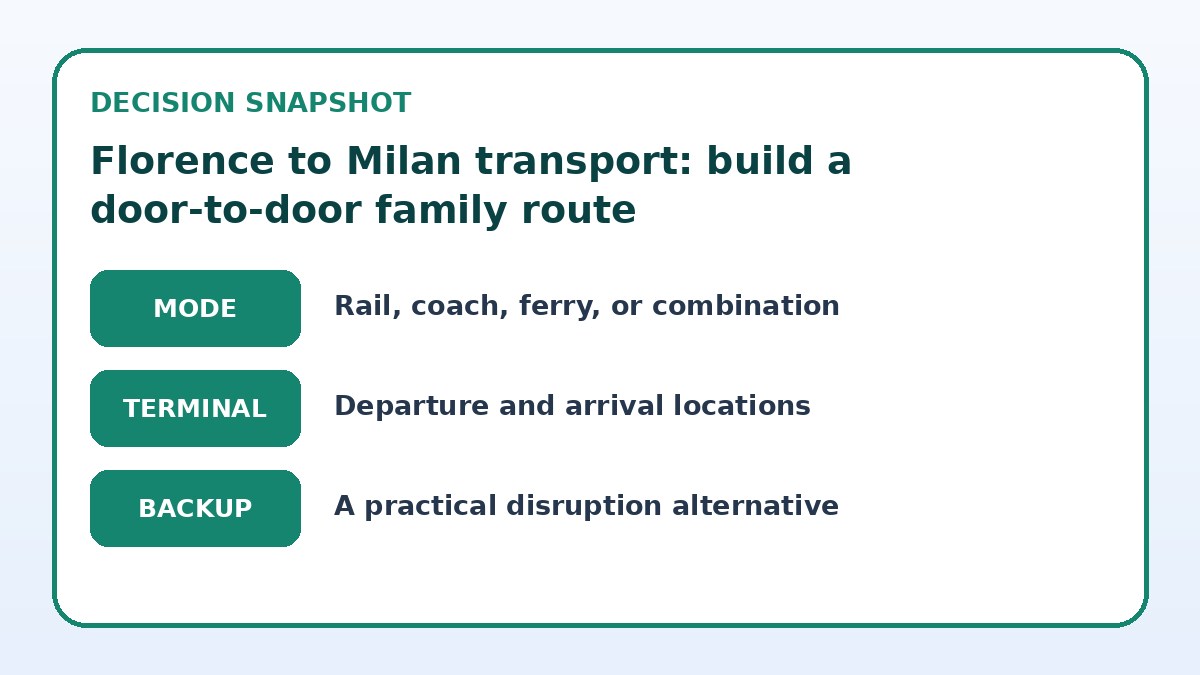
Choose the end-to-end journey plan
| Journey approach | Best for | Friction to check |
|---|---|---|
| Train-only family plan | Families wanting straightforward city-center arrival and fewer transfers | Less flexibility for roadside stops and managing many large suitcases |
| Drive-only family plan | Families needing door-to-door stops, multiple hotels, or lots of luggage | Requires driving, parking, and child-seat logistics; can be tiring for the driver |
| Mixed plan: train plus local hire | Families balancing fast long-distance travel with local door-to-door convenience | Adds a transfer at each end and needs careful scheduling and luggage handling |
| Coach-focused plan with taxi backups | Budget-minded families willing to trade terminal convenience for lower fares | Longer terminals and fewer luggage conveniences; less frequent departure options |
Check live intercity options
Look beyond the ride itself and compare terminals, transfers, luggage, and arrival fit.
Terminal fit and luggage/transfer friction for families
Terminal fit means more than platform numbers: find out how easy it is to get from your hotel to the station or coach terminal with luggage and a child. Look for elevators or ramps, sheltered walkways, luggage trolleys, and close taxi ranks. Consider whether your arrival and departure times intersect with peak crowds—children manage busy terminals worse than adults. If a transfer requires a long underground walkway, multiple escalators, or an uphill walk, that can turn a short-distance option into a tiring ordeal for small kids and caregivers.
Luggage strategy affects mode choice. One large suitcase and a stroller might be fine on a high-speed train if you can store items near your row; multiple large suitcases push toward private transfer or car. For coaches, check how much help is available loading trunks and whether you must handle heavy bags yourself. If you plan to use child seats, determine whether your transfer provider supplies them or whether you need to bring and install your own; for rentals, reserve seats in advance and note where they will be kept between stops.
Timing flexibility and building realistic schedules
Families need wiggle room. Trains typically offer more departure choices during the day, which reduces pressure: if you miss one, the next may be an hour or less away. Coaches and private transfers are more schedule-dependent—coaches run on fixed timetables while private cars are booked to a pickup time. When scheduling, allow extra buffer for bathroom breaks, snacks, and a calm boarding process; plan at least 30–60 minutes beyond the nominal travel time for station arrival, and more if you must manage check-in for car seats or stroller folding.
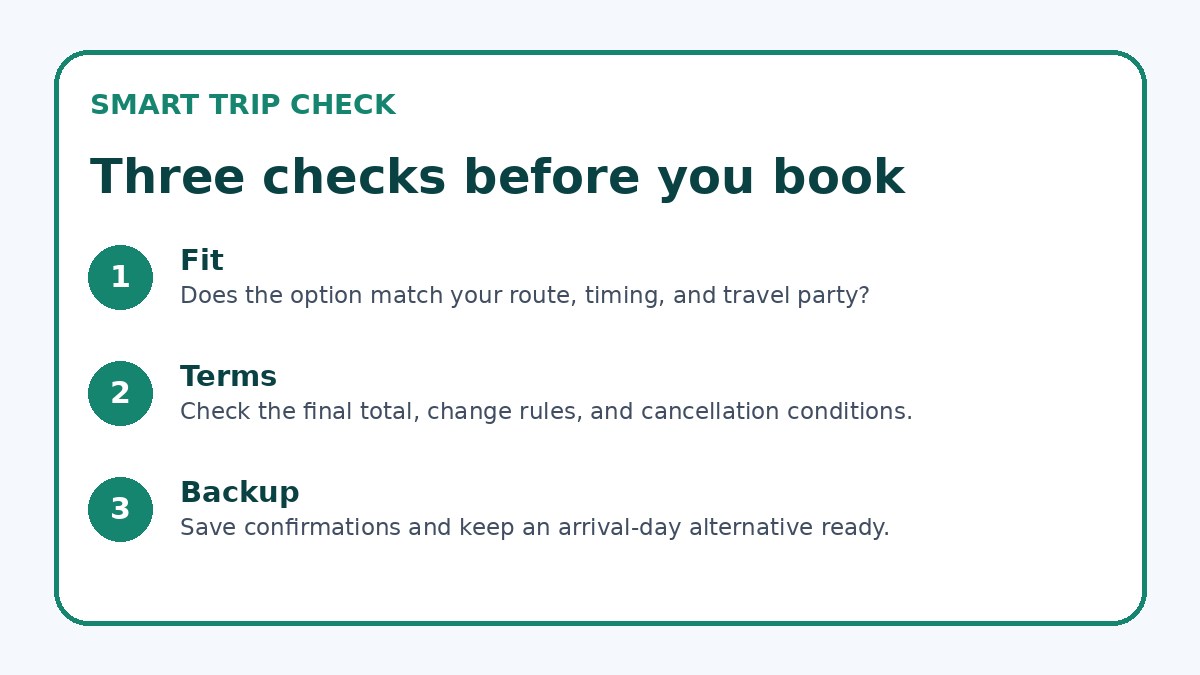
If you have connections at intermediate cities, give longer transfer windows than you would when traveling alone. For mixed-mode itineraries (train plus local hire), choose trains that arrive with time to spare before a planned onward car pickup. Also prioritize later arrivals into your destination on the day of travel if your family does better with daylight arrivals. Verify provider cancellation and change policies on the booking page so you understand how flexible your purchased tickets truly are and whether a missed connection will be penalized heavily.
Compare the practical alternatives
Use the final page to confirm what is actually offered on your dates and save a workable fallback.
Intercity travel checklist
- Map door-to-door time: hotel to departure terminal, planned ride duration, and terminal to next hotel arrival before booking.
- Confirm elevator/escalator access and stroller-friendly routes at each terminal using station maps or provider details.
- Reserve child seats or verify adult supervisors for rentals/transfers and note exact pickup/installation instructions.
- Pick one alternate departure (train or coach) and save booking or ticket-change steps in your phone.
- Download and set up at least one local taxi app and store payment details for quick fallback bookings.
- Pack an emergency family kit with snacks, spare clothes, basic meds, and phone chargers in an easily reachable bag.
Disruption backup: practical, family-focused contingencies
A disruption backup should be simple and executable under stress. Identify one alternate train or coach that departs within a few hours of your primary choice and note where to buy standby tickets or how to change reservations. Keep a secondary pickup option (a taxi app with driver details or a reliable authorized transfer number) if the station is the likely bottleneck. Store these backups in a single place—notes in your phone or a printed sheet so any adult on the trip can act quickly if plans change.
Also prepare a small emergency kit that addresses the most common interruptions: extra snacks, a change of clothes for young children, basic first-aid items, and a lightweight blanket. If you will rely on local taxis as a fallback, download and set up any required apps and payment methods before you depart. Finally, make sure someone at your main accommodation knows your planned arrival window in case you must change plans; a quick call from a hotel concierge can sometimes secure last-minute help or stowed luggage if you arrive on a different train.
Rail & Intercity Transport questions travelers ask
Which mode is easiest when traveling with a stroller and several suitcases?
For a stroller plus several suitcases, a mixed approach often works best: take a train for the long haul between city centers to avoid highway driving, then arrange a short private transfer or taxi at each end to move luggage and fold the stroller at the curb. Trains reduce the amount of time you spend navigating unfamiliar roads, while a local car removes the hassle of carrying heavy bags through stations. Before you book, verify elevator access, platform transfer routes, and whether the transfer provider supplies help with luggage on their final booking page.
How much buffer time should a family leave between a train arrival and an onward taxi or hotel check-in?
Aim for a generous buffer to reduce stress: at minimum 30–60 minutes between train arrival and an onward taxi pickup, and 60–90 minutes if you must manage heavy bags, a stroller, or young children needing a break. If you require a transfer that includes picking up a reserved car seat or crossing between distant platforms, add extra time. Confirm the taxi or transfer pickup point and any meeting instructions on the provider’s booking page so you don’t waste time searching after a tiring journey.
What is a simple disruption backup plan families can use between Florence and Milan?
A practical backup is to identify a nearby alternative departure that leaves within a few hours and to save the necessary rebooking steps or ticket-change phone numbers in your phone. Also pre-install a reliable taxi app and note the hotel’s front desk number for assistance. Keep essential supplies in a day bag so you can wait out delays without returning to baggage storage. Before travel, verify on the booking page whether tickets are changeable and what fees apply to the alternate option so you aren’t surprised if you need to switch.
Final decision note
Families planning Florence to Milan transport should treat the trip as a door-to-door problem: compare terminals, luggage handling, schedule flexibility, and straightforward disruption backups before committing. For many families, trains offer a comfortable and predictable backbone, while local taxis or short hires provide the last-mile ease that children and luggage demand. Driving gives maximum control but carries responsibilities for child seats, navigation, and parking. Use the checklist to verify physical accessibility and booking-change rules on provider pages, set up at least one fallback departure and a taxi app, and pack a small emergency kit. These practical steps reduce stress and keep the day manageable if plans change.
Continue planning
Check current options and final conditions
Use the provider page to confirm live availability, the final total, cancellation terms, and every condition that matters to your trip.
This evergreen planning guide was created with AI-assisted drafting and a structured quality review. It does not display live prices, schedules, availability, visa guidance, or provider rankings. Verify current details before booking. Some links are affiliate links; we may earn a commission at no additional cost to you.