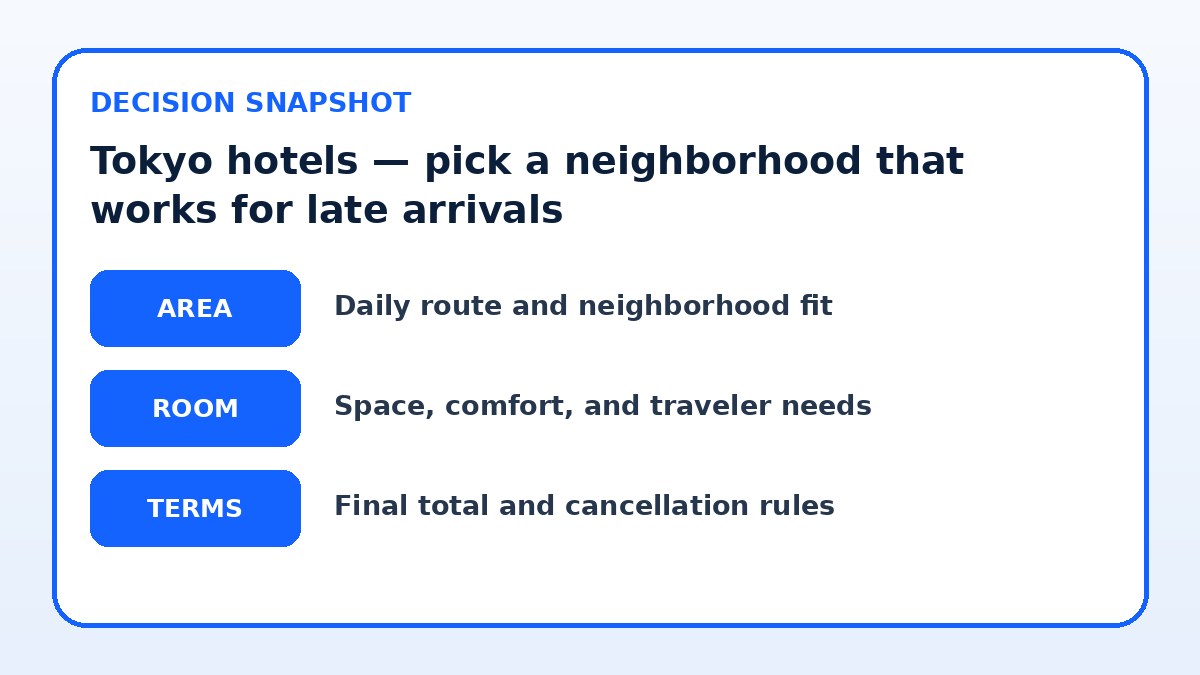
If your flight or train gets you into Tokyo late at night, the first decision is where to book your hotel: pick a hotel in an arrival-friendly neighborhood rather than waiting to hunt around when you’re tired. For most first-time visitors the practical choices are staying near Haneda or Narita transfer hubs, choosing a central station neighborhood like Tokyo Station, or prioritizing lively areas with late services such as Shinjuku or Shibuya. Your pick should reflect how you plan to manage luggage, whether you’ll arrive by late train or airport transfer, and if you need immediate food, ATM access, or a 24-hour front desk. Later sections explain daily-route friction, room and party needs, and final booking terms you must check on the provider’s page. Use this to short-list an area so you can open live inventory and pick a specific hotel knowing it fits your late arrival scenario.

Check live stays in the areas that fit
Use your dates and party size to compare current rooms after you narrow the neighborhood fit.
Neighborhood fit: arrival-focused areas
Start by shortlisting neighborhoods that reduce friction immediately after a late arrival. If you want the shortest ground travel time from Haneda or Narita, look for hotels that advertise transfers or are close to the main airport-limited train lines. Alternatively, staying near Tokyo Station, Shinagawa, or Ueno can put you on straightforward onward connections the next morning. If you’d rather minimize taxi cost and uncertainty, pick a neighborhood with direct evening airport buses or a simple late-night taxi route from the terminal.
Think about basic needs on arrival: will you want a quiet room to sleep right away, or do you need food and a convenience store within a short walk? Neighborhoods such as Shinjuku and Shibuya tend to have late dining and 24-hour convenience stores, while business districts may be quieter and offer earlier closures. For families with luggage or jet lag, proximity to a coin locker, luggage storage service, or an easy hotel baggage hold can be decisive. Narrowing to two or three neighborhoods before checking hotels saves time and avoids disappointment at arrival.
Choose an area-selection strategy
| Area approach | Best for | Tradeoff to check |
|---|---|---|
| Stay near the airport or transfer hub | Minimizing late-night ground travel and quick access to airport services | Farther from central sights; may require extra travel next morning |
| Book near Tokyo Station or Shinagawa | Smoother morning onward travel by Shinkansen or multiple rail lines | Less late-night dining and fewer 24-hour conveniences close by |
| Choose Shinjuku or Shibuya | Lots of late dining, 24-hour shops, and bright streets on arrival | Noisier at night and potentially longer transfers to some attractions |
| Pick a quieter business district or residential area | A calm first night and typically less street noise for sleeping | Limited late-night services and possibly longer taxi rides from the airport |
Daily-route friction: morning plans and transfer logistics
Consider your morning route for sightseeing or onward travel, because a late arrival night often turns into an early-morning start. If your main plan is to head to historic Asakusa, staying near Ueno or Asakusa cuts commute the next day. If you need quick access to the bullet train, Tokyo Station or Shinagawa will make the morning smoother. Map your likely first-day destinations and choose the neighborhood that minimizes walking with luggage and transfers, especially if you’ll be using public transit with limited mobility or small children.
Check transit service frequency for the first morning you’ll travel: compare train lines and bus schedules on the provider’s page and local transit sites, and don’t assume a direct train exists from every hotel area. If you expect to leave early from the hotel, verify the last-mile options the night you arrive — a reliable taxi stand, 24-hour ride-hailing availability, or a short night bus. Where possible, plan a fallback: a neighborhood with straightforward cab access can be worth a slightly longer morning train for the security of an easy exit after a late night.
Now compare like with like
Keep the same dates, guests, room needs, and cancellation preferences while you compare the final choices.
Room and party needs: what to choose for fatigue and luggage
Late arrivals magnify the importance of room layout and bed setup. For solo travelers, a compact single or standard double near an elevator is practical. Couples often prefer a larger bed and quieter facing-away-from-street rooms. Families or groups should prioritize adjoining or connecting rooms, extra beds, or suites with space to spread out; handling luggage in a cramped twin room after midnight is rarely pleasant. If someone in your party needs sleep on arrival, request a high-floor quiet room and communicate noise concerns to the hotel in advance.
Also consider immediate practicalities: does the hotel allow luggage drop-off before check-in, and can they store bags if you plan to go out after a quick nap? If you must work on arrival or catch up with emails, verify whether the room offers a reliable desk, power outlets, and adequate Wi-Fi — but always confirm speeds and access on the booking page. For late-night arrivals that may include last-minute changes, flexibility in cancellation or arrival time changes can remove stress; check those booking terms carefully before committing.

Hotel booking check before payment
- Confirm the hotel’s late check-in policy and how to notify them of a late arrival on the booking page.
- Check whether the hotel offers airport transfers, how to book them, and whether a taxi route is straightforward from your terminal.
- Request or reserve the room type you need (adjoining rooms, larger bed, quiet room) and note any special arrival instructions.
- Verify luggage storage or early baggage drop-off options for use if you arrive before official check-in.
- Ensure a 24-hour front desk or clear self-check-in instructions are available, and save contact details for the property.
- Read cancellation and modification terms so you can change arrival times without losing your reservation.
Final booking terms: what to verify before you pay
Before booking, confirm the hotel’s official late check-in policy and how they handle arrivals past certain hours. Some Tokyo hotels require an advance notice for arrivals after a set time; others operate a 24-hour front desk but still need ID or a credit card imprint on arrival. Look explicitly for the hotel’s stated check-in times, late-arrival procedures, whether they require a pre-authorization or deposit, and any instructions for self-check-in or key pickup after desk closure. Always verify those details on the hotel’s booking page or the hotel’s official website.
Also check practical pages for added services you might rely on: airport transfer options, luggage storage availability, concierge hours, and whether continental breakfast service begins early enough for your schedule. If you plan to use a third-party site to compare availability, you can mention Trip.com to check multiple inventory options, but verify final policies — cancellation, arrival time changes, extra-bed requests, and identification requirements — on the hotel’s own confirmation page before you finalize payment.
Hotel Guide questions travelers ask
What’s the best neighborhood if I arrive very late and want to sleep immediately?
If immediate rest is your priority, choose a neighborhood that minimizes the roadway or train time from your arrival point: near Haneda or Narita transfer routes for airport arrivals, or near major stations like Shinagawa or Tokyo Station for rail arrivals. Pick a hotel with a 24-hour front desk or clear after-hours entry instructions so you don’t have to navigate closed lobbies. Check the hotel’s page for quiet-room requests, elevator access, and baggage handling options, and confirm how to let them know your expected arrival time.
Should I book a hotel close to sightseeing areas even if I arrive late?
That depends on how tired you expect to be and what you plan for the next morning. Staying near your main first-day sights can save commuting time, but arriving late often means you’ll value easy access to food and a 24-hour front desk more than proximity to attractions. If you choose a sight-focused neighborhood, verify evening services and whether taxis are easy to find at night. For a balanced approach, shortlist two neighborhoods — one arrival-friendly and one sightseeing-centric — then pick a hotel in the arrival-focused area for the first night and move if you want.
How do I handle transfers and luggage after a late-night arrival?
Plan in advance: look for hotels that advertise airport shuttles or are within a short, direct taxi ride from the terminal. If you’ll use trains, check the last train schedules for the day you arrive and their first departures the next morning; don’t assume direct routes are available. For luggage, confirm on the hotel’s booking page whether they accept early baggage drop-offs or hold luggage if you arrive before official check-in. Always save the hotel’s local phone number and any late-arrival instructions they provide so drivers or taxis can locate you quickly.
Final decision note
For first-time visitors arriving late in Tokyo, choose the neighborhood before you choose a hotel. That decision—airport-proximate hubs, central stations, lively late-night neighborhoods, or quiet business districts—determines how restful and smooth your first hours will be and influences your morning plans. Once you’ve shortlisted one or two neighborhoods, compare specific hotels for late check-in procedures, luggage storage, room layout, and cancellation flexibility. Use the hotel’s own booking page to confirm arrival policies and operational details, and if you’re comparing several options use a broader search tool such as Trip.com to view current availability before final verification on the property’s page. Planning this way turns a potentially stressful late arrival into a manageable, even calm, start to your Tokyo trip.
Continue planning
Check current options and final conditions
Use the provider page to confirm live availability, the final total, cancellation terms, and every condition that matters to your trip.
This evergreen planning guide was created with AI-assisted drafting and a structured quality review. It does not display live prices, schedules, availability, visa guidance, or provider rankings. Verify current details before booking. Some links are affiliate links; we may earn a commission at no additional cost to you.