Practical answer up front: when planning Gyeongju travel deals for a family, compare the cancellation and change rules for every component—hotel, transport, and tours—before assuming a bundled package is safer or cheaper. Start by matching the same dates, number of travelers, room types, and pick-up/drop-off conditions across any package and separate bookings. If your family values the option to move dates or cancel without heavy penalties, prioritize the product (or bundle) whose individual components have the least restrictive penalties and clearest refund timeline. The rest of this guide explains what to check in inclusions, how flexibility interacts with traveler-specific value, and the final contract terms to read on the supplier’s booking page before you commit.
Test package value fairly
| Booking approach | Best for | Tradeoff to check |
|---|---|---|
| Prebuilt package (single checkout) | Families who want a one-stop booking experience and can tolerate mixed supplier rules. | May hide supplier-level exceptions and vary component flexibility; verify each included supplier’s cancellation terms. |
| Assembled package (same agent, separate tickets) | Families who want a tailored itinerary with one point of contact but prefer some separate vendor control. | Agent handles logistics but refunds may still require contacting individual suppliers; clarify who issues refunds and when. |
| Separate bookings (hotel, transport, tours independently) | Families prioritizing maximum control over cancellation rules and selectively choosing refundable options. | Requires more research and management; potential logistical gaps if a single component is canceled and others must be adjusted. |
| Flexible-rate mix (refundable key components, non-refundable extras) | Families balancing cost and flexibility by protecting the most expensive or disruptive items. | Savings appear on extras but you still bear higher base costs for refundable items; check combined cancellation costs carefully. |
Check current package and separate options
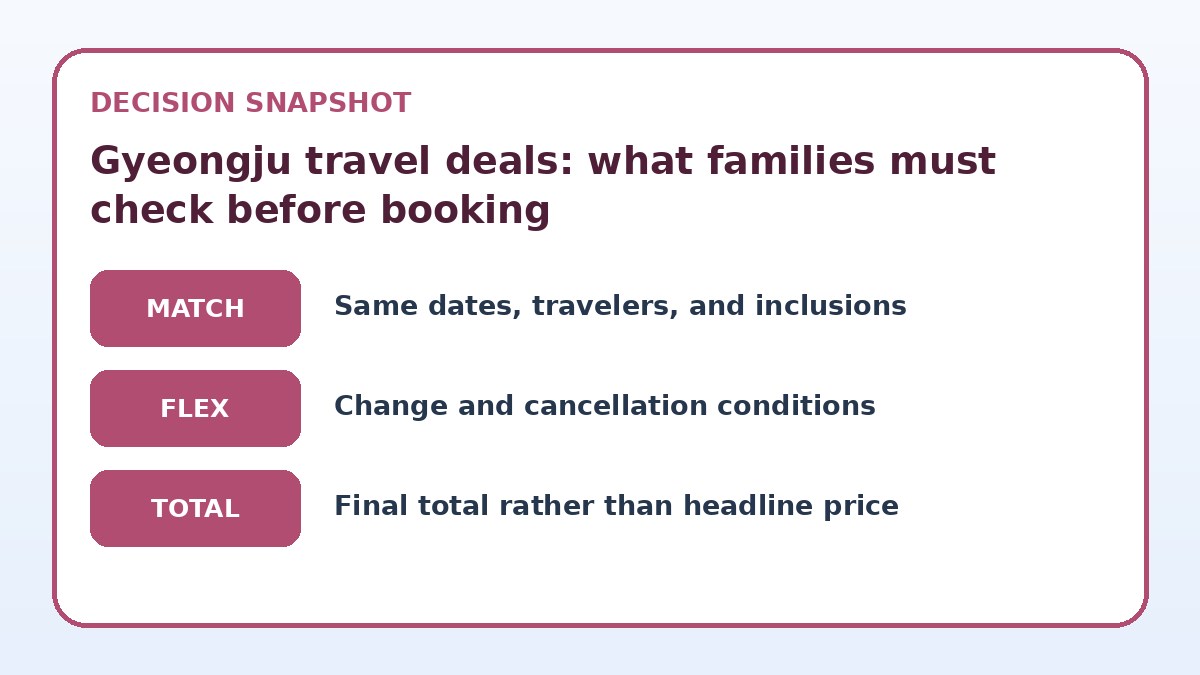
Use identical dates, travelers, room needs, baggage, and flexibility so the comparison stays meaningful.
Inclusions: what the bundle actually covers
Start by listing every service included in a so-called Gyeongju travel deal: accommodation, intercity transfers or trains, local tours, entrance fees, and any meals or seat reservations. Don’t rely on summary lines—open the detailed itinerary and supplier list. For families, inclusions that matter most often include family rooms or connecting rooms, child meal options, and transportation that can accommodate strollers or car seats. If an inclusion is critical (for example, guaranteed adjoining rooms or a private car), require explicit confirmation in writing from the supplier or booking platform.
Next, confirm whether each included item has its own cancellation rules or whether the bundle centralizes refunds. Some packages present a unified cancellation policy but still pass through supplier-level conditions, which can create uneven flexibility—one component may be fully refundable while another is strictly non-refundable. For a family, that mismatch can mean losing the value of a bundled price if you must cancel only part of the trip. Before purchase, capture screenshots or print the detailed inclusion and cancellation sections so you can reference them when contacting the provider.
Flexibility: reading cancellation and change policies
Cancellation flexibility isn’t just a yes/no question. Policies vary by timing, the who/what they cover, and how refunds are processed. Look for time thresholds (how many days before arrival changes are allowed), percentage refunds, administrative fees, and whether credit notes are offered instead of money back. For families, also check child and infant fee rules—the policy for a child’s cancellation might differ from an adult’s. If travel insurance is part of your plan, understand which events it covers in addition to the supplier’s policy; insurance can provide an independent claim route but does not change supplier deadlines.
Pay attention to change policies as well as cancellations. Some suppliers allow free date changes inside a window but charge a fare difference; others permit name swaps or date shifts only with a penalty. For family travel, the ability to move a booking—even with modest fees—can outweigh a lower non-refundable rate. Also verify whether refunds or credits take weeks to process and where they appear (original payment method, account credit, or voucher). These processing terms can affect whether you can rebook quickly or need to wait for funds to return.
Look past the headline total
Compare inclusions and change conditions before deciding whether a package is genuinely useful for this trip.
Deal comparison checklist
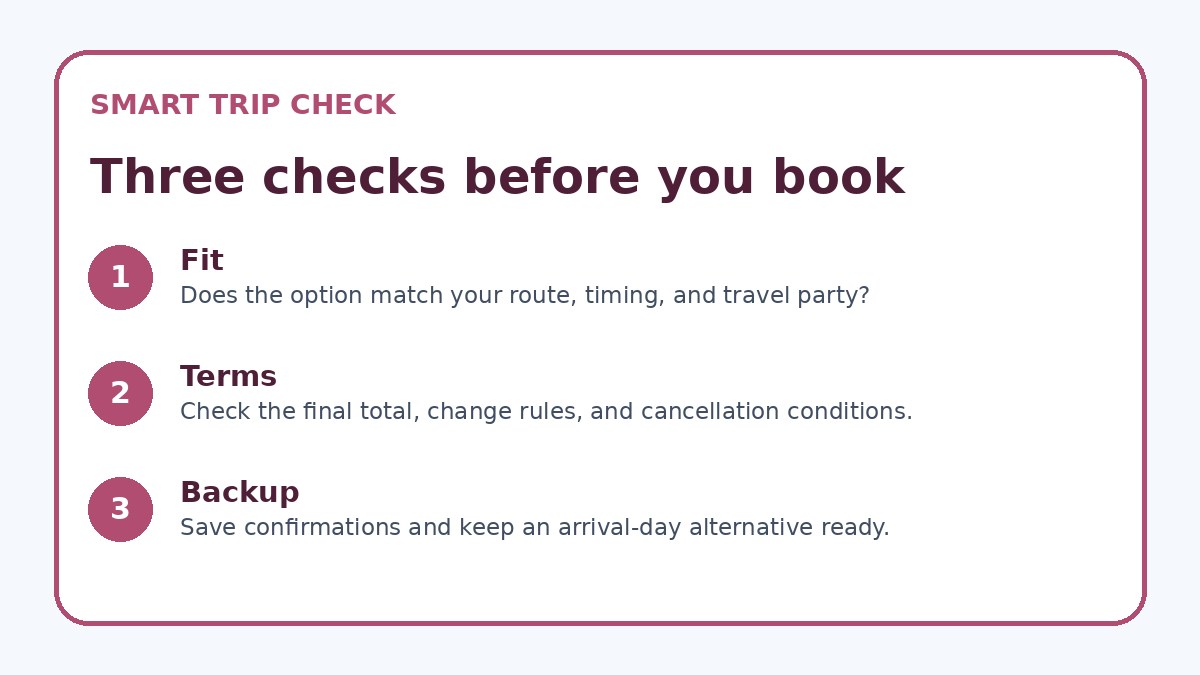
- Match the exact travel dates, traveler count, and room type across all package and separate booking comparisons.
- Download or screenshot the detailed cancellation and change policy for each component before you finalize payment.
- Confirm which party (platform or supplier) issues refunds and the expected processing timeline and method.
- Prioritize refundable or changeable terms for the two components that would be most expensive to rebook.
- Ask the provider in writing whether bundle-level policies override supplier terms and retain that response with your confirmation.
- Check whether any included tour or transfer requires names, documents, or deposit deadlines that are non-refundable.
Traveler-specific value: families’ special needs
Families have different risk tolerances and logistical needs than solo travelers or couples. Consider the ages of children, the likelihood of school or health disruptions, and whether you’ll need features like adjoining rooms, early check-in, or flexible pick-up windows. A slightly higher upfront price for a refundable hotel rate or a train ticket with open change options can be worth it when weighed against the stress and potential cost of last-minute changes. Factor in the cost and time of reorganizing activities in Gyeongju—ample buffer days or refundable local tours reduce pressure on travel days.
Also examine practical conveniences that reduce the chance you’ll need to cancel: hotels that hold rooms for late arrivals, transfer services with flexible pickup, and tours that allow easy name or date changes. For multi-component packages, ensure the critical piece for your family—often accommodation or the main transfer—has the most forgiving terms. If that key component is rigid, the entire package can become risky. Rank components by how costly they would be to rebook, and prioritize flexible terms for the top two items.
Final terms: what to verify on the booking page
Before you click purchase, verify the explicit refund process and timeline on the supplier’s final booking page. Look for exact deadlines (for example, cutoff at 23:59 local time on a specific day), the responsible party for refunds (the platform or an individual supplier), and whether administrative or processing fees apply. If the bundle involves third-party suppliers, confirm whether the platform handles all refunds centrally or if you must contact each supplier directly. Note any exclusions such as non-refundable extras, service fees, or promotional add-ons that might not be covered by the main cancellation policy.
Also check contact details and dispute procedures: who to call for urgent changes, where to send cancellation requests in writing, and how long any promised credit vouchers remain valid. If the booking page mentions travel insurance, read the policy summary and separate insurer terms carefully. When details are unclear or ambiguous, request written confirmation from the provider before paying. Trip.com can be used as an additional place to compare availability and stated conditions, but always verify on the supplier’s own final booking page for binding terms.
Travel Deals & Booking Strategy questions travelers ask
Can a package’s cancellation policy differ from the hotel or tour operator’s policy?
Yes. A package may present a simplified policy, but many operators reserve the right to apply the hotel’s or tour operator’s individual rules. That means part of the bundle could be refundable while another part is not. To avoid surprises, read the supplier list in the booking detail and open each supplier link or policy document. Ask the platform or agent to confirm in writing which policy controls refunds and how partial cancellations are handled; keep that confirmation with your booking record.
Should families always choose refundable hotel rates and flexible transport even if non-refundable options look cheaper?
Not always, but often. Families should weigh the cost difference against the probability and potential cost of needing to change plans. If a non-refundable option saves a small amount but risks losing a major portion of your trip’s value, the refundable rate is usually wiser. Consider the ages of your children, school obligations, or medical uncertainties. Where budget is tight, protect the highest-cost items—commonly accommodation and long-distance transfers—and accept non-refundable choices for low-cost add-ons.
If a supplier’s policy is unclear on the booking page, what exact questions should I ask before paying?
Ask which entity will process refunds, the exact deadline for free cancellation (with local time zone), whether partial cancellations are allowed, and whether processing fees apply. Request clarification about change rules—if date changes are allowed and whether you pay only fare differences or additional penalties. Finally, get written confirmation (email or documented chat) for each answer and keep that with your booking. If the supplier refers to travel insurance for specific scenarios, ask for the insurer’s contact and policy number to review separately.
Final decision note
For families planning Gyeongju travel deals, flexibility comes from careful matching and selective protection rather than assuming a package is inherently safer. Compare identical scenarios across packages and separate bookings, protect the most consequential components with refundable terms, and insist on written confirmations for any ambiguous language. Check who issues refunds, how long they take, and whether bundle-level promises supersede supplier rules. By prioritizing the two components that would be hardest to rebook and documenting policies before you pay, you keep options open for unexpected changes without sacrificing local convenience.
Continue planning
Check current options and final conditions
Use the provider page to confirm live availability, the final total, cancellation terms, and every condition that matters to your trip.
This evergreen planning guide was created with AI-assisted drafting and a structured quality review. It does not display live prices, schedules, availability, visa guidance, or provider rankings. Verify current details before booking. Some links are affiliate links; we may earn a commission at no additional cost to you.