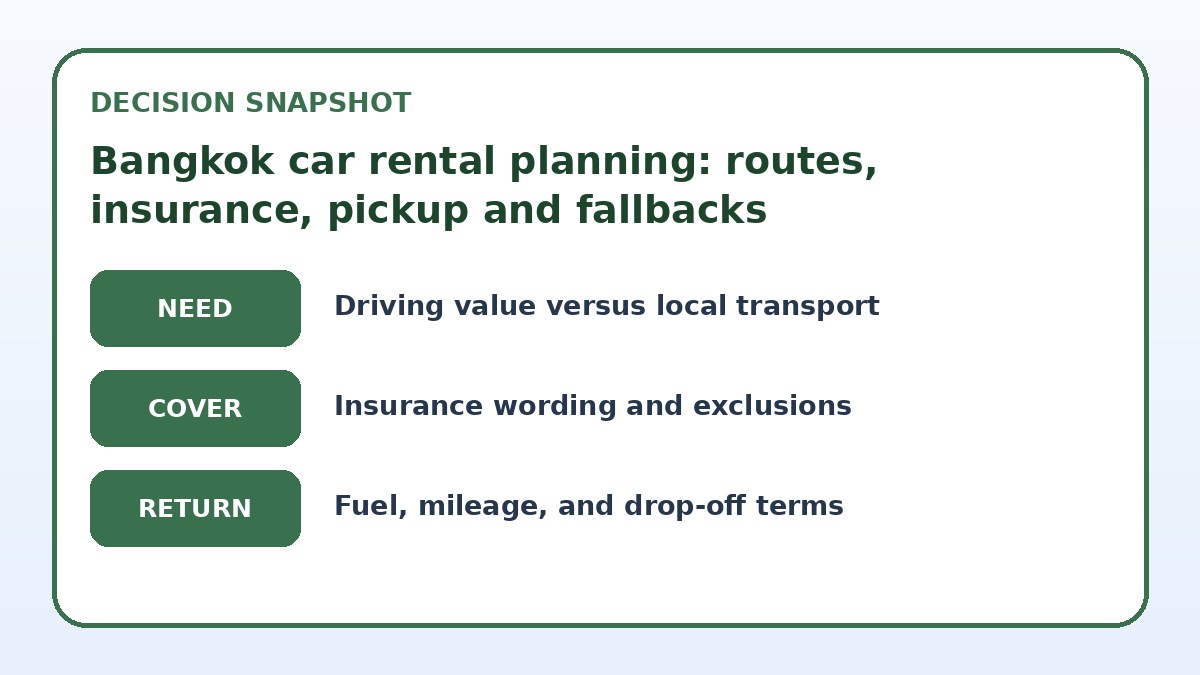
Practical answer first: renting a car from Bangkok can be the smartest choice for families who want flexible access to coastal towns, Khao Yai or cultural stops outside the city — but only if you accept longer drives, occasional traffic delays, and the logistics of child seats and insurance. If your plan is to stay inside central Bangkok and use public transport to reach a few nearby attractions, driving usually adds more hassle than benefit. This guide helps busy parents decide quickly by weighing route value, insurance wording, pickup and return friction, and a clear non-driving fallback. Read the quick decision points, then use the route and insurance sections to test your real itinerary against what rental providers require on their booking pages.
Route value: when the drive adds family value
A family road trip out of Bangkok pays off when your route connects multiple places that public transport serves poorly. Examples include multi-day loops to Khao Yai National Park, beaches in the Gulf of Thailand, or a countryside itinerary that stops at farms, waterfalls and smaller towns. The value comes from door-to-door control: you set departure times to suit naps and meals, carry luggage and snacks easily, and visit places that buses or trains reach infrequently or with long waits.
Measure route value by adding estimated driving times and comparing them to door-to-door public transport options. If drives under three hours link comfortable stops and reduce overall transit changes, a car likely improves the trip. Also factor in parking availability at your intended stops and whether family-friendly facilities (toilets, shaded picnic areas) make longer driving days practical for children.
Decide whether driving earns its place
| Mobility strategy | Best for | Cost or friction to check |
|---|---|---|
| Rent a car for the whole trip | Families doing multiple day stops on country routes who need full schedule control | More driving, parking logistics, insurance checks and higher responsibility for vehicle condition |
| Rent for a single long leg only | Families who want flexibility for one remote stretch without committing to city driving | Extra pickup/return steps and potential one-way fees; still need to manage child seats |
| Public transport plus occasional private transfers | Families who prefer to avoid driving but need convenience for specific connections | Less schedule control and potential higher per-leg cost, but lower logistics and insurance burden |
| Fully public: taxis, buses, trains and river boats | Families staying mainly inside Bangkok or on short excursions where parking is scarce | Limited reach for rural or multi-stop itineraries, and less space for luggage and gear |
Check live rental choices only after the route test
Use the exact driver, dates, pickup point, and return plan to compare current conditions.
Insurance wording: what to check on the booking page
Insurance is the detail that makes or breaks renting for a family. On the final booking page, verify whether the quoted rate includes a collision damage waiver (CDW), third-party liability, theft protection, and what the deductible or excess amount is. Look for explicit statements about coverage for child seats, windscreens, tires and undercarriage — these are often excluded or available only as paid extras. If the rental company requires a credit card to hold a damage deposit, confirm the exact pre-authorization amount before you drive off.
Also check the policy for additional drivers and international licenses: some contracts limit coverage to drivers named on the agreement, and some insurers require an International Driving Permit in addition to your national license. Read exclusions for off-road driving, named driver age limits, and cross-border permissions if your route crosses provincial boundaries. If anything is unclear, request a written clarification from the provider and keep screenshots or PDFs of the booking page showing covered items.
Compare the full rental conditions
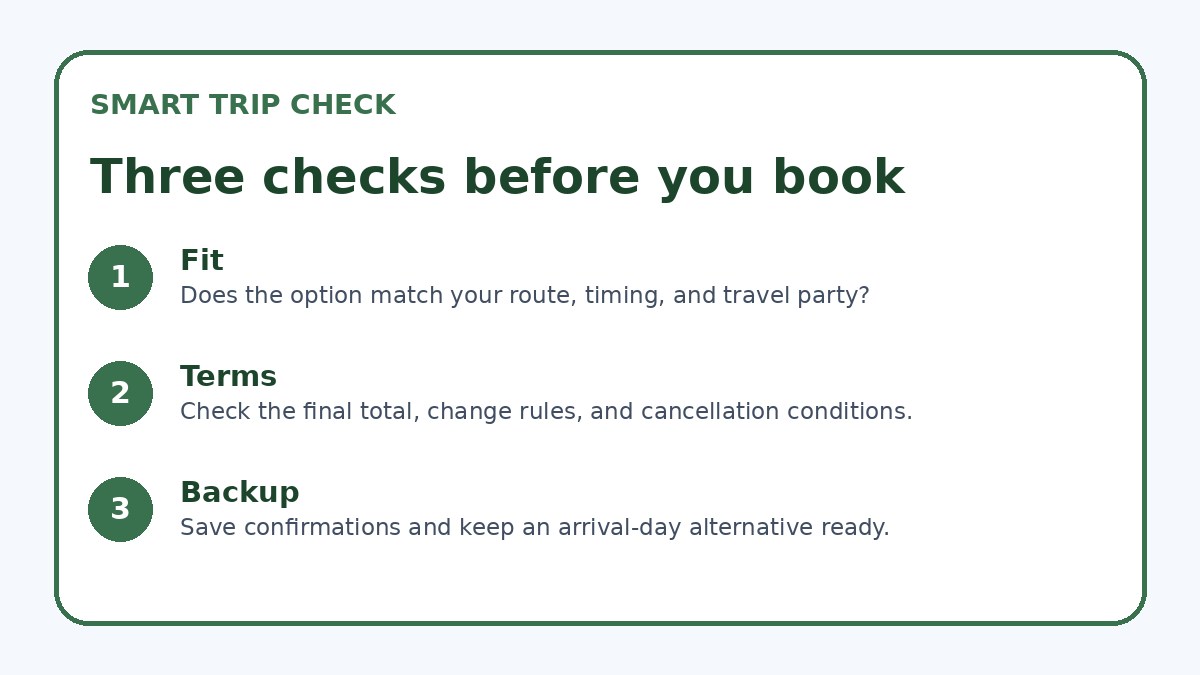
Confirm insurance wording, exclusions, deposit, fuel, mileage, and return terms on the final page.
Pickup and return friction: choose locations and times wisely
Pickup and return friction is a practical, often underrated cost for families. Airport branches can be convenient for flights, but airports add traffic, long queues and sometimes higher fees. City branches near major hotels or transport hubs reduce the chance of missing a pickup due to flight delays and often provide more flexible inspection windows. Wherever you collect the car, schedule pickup during daylight to complete the vehicle inspection with staff present, document existing damage with photos, and confirm operating hours for your return slot.
Plan the return so you avoid peak city traffic: dropping the car off during a morning or late-afternoon rush can turn a simple handover into an hour-long delay, which is stressful with children. If the company charges for after-hours returns, compare that fee to the cost of extending a day to return during business hours. Finally, verify fuel policy on the booking page: full-to-full is usually clearest for families who want predictable costs and to avoid unexpected refueling charges.
Car rental terms to verify
- Confirm the rental agreement’s listed deductible/excess and the exact process for insurance claims before finalizing the booking.
- Verify on the booking page whether child seats are available, compatible with your children’s ages, and whether there’s an extra fee.
- Document vehicle condition with time-stamped photos during pickup and ensure staff sign or timestamp any existing damage notes.
- Choose pickup and return windows during daylight and confirm branch hours to avoid after-hours return fees.
- Compare fuel policies and decide if full-to-full or pre-purchase options fit your family’s driving plan.
- Print or save screenshots of the final booking page showing insured items, additional driver names, and any stated exclusions.
Non-driving fallback: staying flexible with family-friendly options
If driving looks like more friction than benefit, plan a clear fallback using public transport, private transfers for key legs, and short taxi or ride-hail rides within Bangkok. For example, use rail and river services for Bangkok sightseeing, then book private transfers or a guided day trip for any single long leg where a car would have been convenient. This hybrid approach keeps flexibility while removing parking, insurance, and fatigue concerns.
To prepare the fallback, map the exact stops you would have driven to and identify realistic public alternatives. Note departure times, platform or pier locations, and whether a private transfer company can handle child seats. Keep a shortlist of reputable transfer companies (or check current options on Trip.com) and confirm cancellation and change terms so you can swap into a non-driving plan without expensive last-minute penalties.
Car Rental & Road Trip questions travelers ask
Is driving around Bangkok with children safe and practical?
Driving in Bangkok is possible, but it can be stressful because of heavy traffic and complex junctions in central areas. For families, safety depends on using appropriate child seats, planning realistic daily driving distances, and avoiding rush-hour departures. If most of your activities are inside central Bangkok, public transport or short taxi rides are often faster and reduce exposure to traffic stress. If you plan longer day trips or overnight stops outside the city, a car gives safer control over schedules and stops — provided you verify insurance and child seat availability in advance.
What documents and driver qualifications will rental companies typically require?
Rental companies usually ask for a valid national driving license and may require an International Driving Permit depending on the driver’s home country. A major credit card in the primary driver’s name is commonly required to hold a damage deposit. Additionally, companies often need a passport for foreign renters and may insist that all named drivers meet a minimum age and have held a license for a specified period. Check the provider’s final booking page to confirm permitted license types, any age-related surcharges, and whether additional driver names are free or incur fees.
How do I decide between one-way rentals and returning to my pickup location?
Decide by comparing convenience against possible extra fees and logistics. One-way rentals simplify linear itineraries but frequently carry a relocation or drop-off charge; these charges vary by company and must be confirmed on the booking page. Returning to the original pickup point avoids that fee but may force backtracking and extra driving time. For families, consider whether the time cost and child comfort of additional driving exceed the extra rental fee. If uncertain, request written pricing for both scenarios before booking so you can budget the tradeoff.
Final decision note
For many families, a Bangkok car rental enhances a multi-stop road trip beyond the city: it adds flexibility, comfortable luggage space and easier access to attractions that public transport doesn’t serve. But driving inside Bangkok brings friction — traffic, parking and extra insurance details — that often outweigh benefits for city-centric trips. Make the decision by mapping your exact route, checking insurance wording and child seat availability on the final booking page, and planning pickup and return during business hours. Keep a non-driving fallback that combines public transport with private transfers for any legs where driving looks marginal. With those checks done, you’ll be ready to choose the mobility approach that keeps your family safe, rested and able to enjoy the journey.
Continue planning
Check current options and final conditions
Use the provider page to confirm live availability, the final total, cancellation terms, and every condition that matters to your trip.
This evergreen planning guide was created with AI-assisted drafting and a structured quality review. It does not display live prices, schedules, availability, visa guidance, or provider rankings. Verify current details before booking. Some links are affiliate links; we may earn a commission at no additional cost to you.