The practical answer: for most couples prioritising stress-free travel from Singapore to Penang, pick the option that minimizes transfers and gives clear, refundable or changeable ticketing for the longest legs of the journey. That often means booking a single flexible long-haul ticket (if flying) or choosing operators with simple change/cancellation terms and sensible transfer windows when mixing modes. Couples should weigh door-to-door time, where terminals are, how luggage is handled, and what happens if one partner is delayed.
Below I explain the tradeoffs between rail, coach, ferry and mixed itineraries, how to judge terminal fit, luggage friction, timing flexibility, and a realistic disruption backup plan. Use this to compare real provider pages and to ask the right questions at booking: which leg is most rigid, what are transfer minimums, and where can you get same-day changes or refunds if plans shift?
How to choose between rail, coach, ferry, or a mix
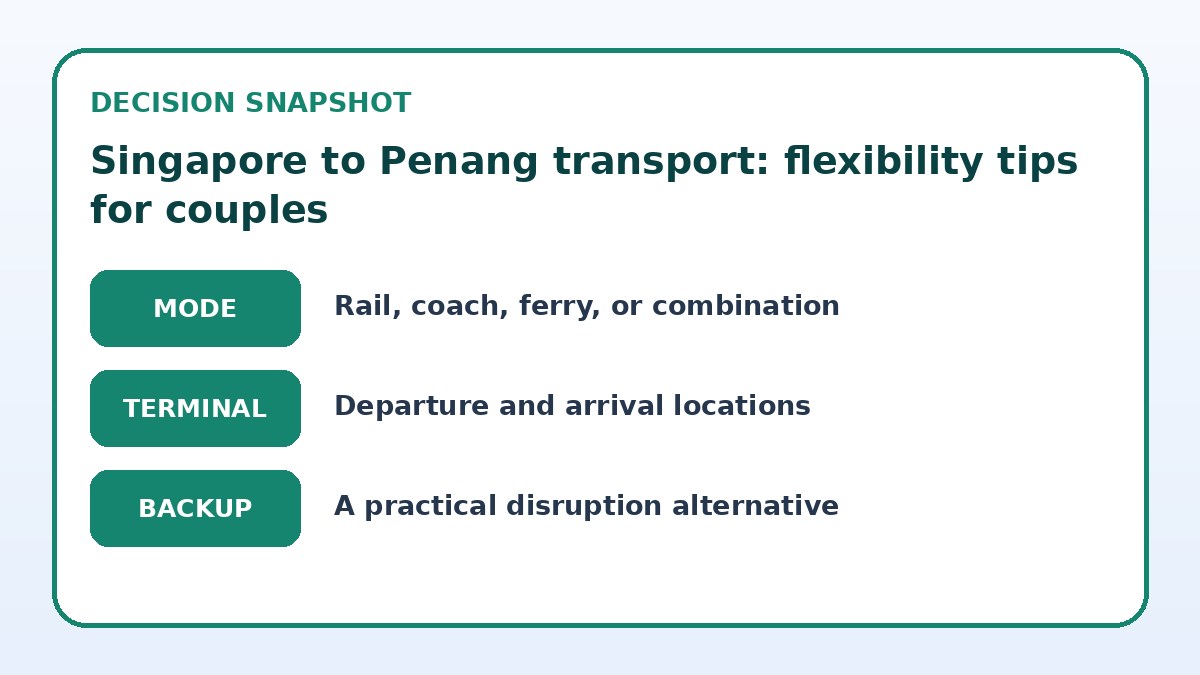
Start by listing door-to-door priorities: convenience, cost certainty, luggage ease, and schedule flexibility. Rail or air may shave hours off the transit but can force stricter check-in and immigration windows; coaches and ferries may be slower but sometimes have more relaxed change policies. For couples, a single continuous ticket that covers your longest leg reduces coordination stress. If you plan to combine modes, pick the most flexible operator for the longest or most vulnerable leg so you can rebook that piece if plans change.
Next, compare how each mode handles same-day changes and group bookings. Some coach and ferry operators allow simple name or date changes with minimal fees, while other modes enforce non-refundable fares on low-cost products. Think about your tolerance for multi-step transfers: two tight transfers double the chance that a delay on one leg disrupts the rest. When in doubt, prioritise fewer handoffs and clearer change/refund rules over theoretical travel-time savings.
Choose the end-to-end journey plan
| Journey approach | Best for | Friction to check |
|---|---|---|
| Single flexible long-haul ticket (one provider) | Couples who want the least coordination and easiest disruption handling | Typically higher base fare or less availability for the most flexible fare class |
| Budget split: lowest-cost legs booked separately | Price-sensitive couples prepared to manage transfers and risk | Higher disruption risk and more time spent rebooking if a delay affects one leg |
| Mixed-mode with flexible longest leg (e.g., flexible flight + cheap ferry) | Couples balancing cost control with protection on the critical segment | Complexity increases—must confirm luggage handover and transfer windows carefully |
| Coach or ferry-only with relaxed change rules | Couples who prefer low-stress, simpler ticketing and minimal terminal transfers | Longer travel time and potential comfort tradeoffs for greater ticket flexibility |
Check live intercity options
Look beyond the ride itself and compare terminals, transfers, luggage, and arrival fit.
Terminal fit and door-to-door practicality
Examine where each service departs and arrives in relation to your accommodation and onward plans. A shorter in-vehicle time can be negated by distant terminals that require extra taxis or long public-transport rides. For couples, moving between terminals or across borders with luggage is simply slower; that makes central departure points or services that link well with local transport a big plus. Look at how easy it is to reach terminals from your hotel and whether the terminal has simple, safe waiting areas where you can settle in together.
Also consider the transfer burden when comparing options: does the route ask you to collect luggage and re-check through immigration, or will your bags stay with you until the final arrival? If you’re using multiple providers, note whether transfers require crossing busy roads, buying a new ticket at a counter, or long queues. On the provider’s booking page check explicit details about terminal addresses, typical transfer times they recommend, and whether they offer combined tickets that simplify the arrival process.
Luggage, timing flexibility and the couple dynamic
Couples often travel with shared gear that’s bulky or valuable. Verify luggage allowances, carry-on rules, and whether extra bags can be added easily online. Some operators permit unlimited small items but charge for checked bags; others bundle one checked bag into a flexible fare. If one partner prefers a later return or side trip, flexible fare options with low change fees let the pair avoid one person being locked into a strict ticket. When booking, confirm exactly which ticket types permit date changes without heavy penalties.
Timing flexibility also includes buffer strategies you can build in: choose services that publish reliable frequency or that let you switch to the next available departure if one of you is delayed. Couples should compare not just the stated timetable but the practical cadence—how many departures per day, how long typical delays are, and whether later departures sell out quickly. On each operator’s final booking page, check the terms for changes, how long before departure you can change, and whether the provider will issue credits instead of refunds.
Compare the practical alternatives
Use the final page to confirm what is actually offered on your dates and save a workable fallback.
Intercity travel checklist
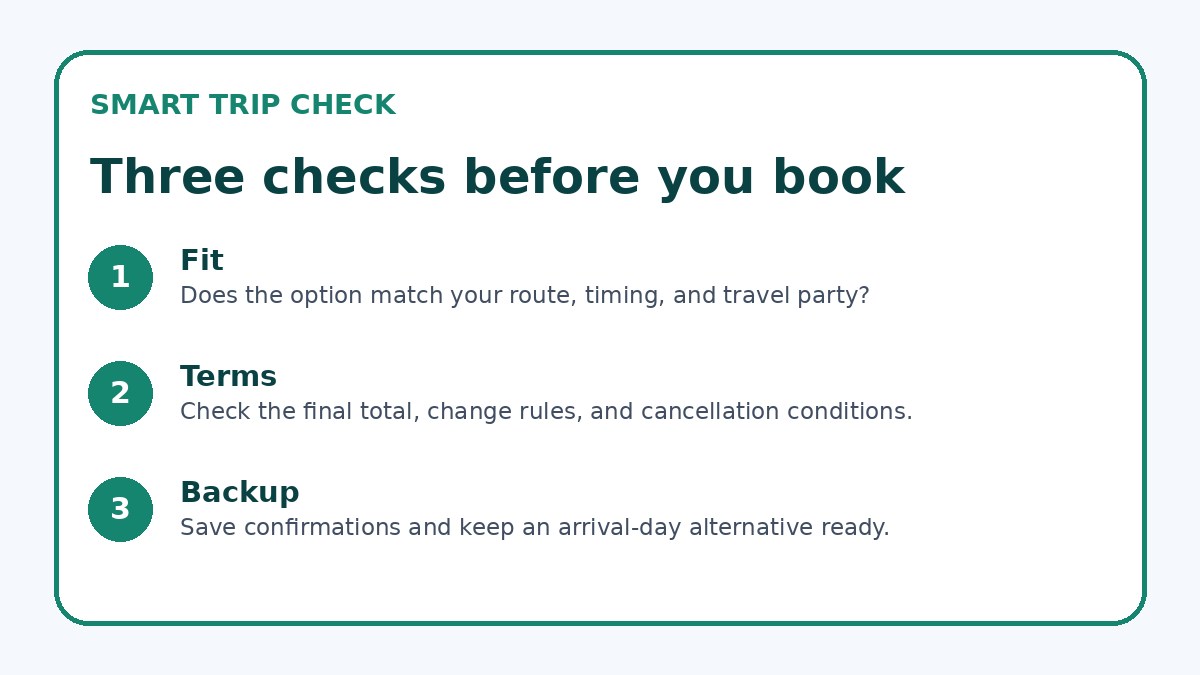
- Compare refund and change rules on each provider’s final booking page, not just the aggregator summary.
- Map departure and arrival terminals versus your accommodation to estimate taxi or transit time and cost.
- Build at least one hour of buffer for local transfers and two hours for cross-border immigration between legs.
- Confirm luggage allowances and how bags are handled when switching operators or modes.
- Decide which leg is mission-critical and book that leg on the most flexible fare available.
- Save screenshots of booking terms and emergency contact numbers for both operators before travel.
Disruption backup: what to plan before you book
Plan a disruption backup that fits your comfort level: for low-risk travel, a basic changeable ticket plus an afternoon buffer might suffice. For higher-risk times (tight schedules, tight connecting windows, or one partner traveling separately later), consider purchasing a flexible fare for the main leg and keeping secondary legs cancellable or rebookable. Always note emergency contacts, local embassy info if crossing borders, and any provider customer-service channels that allow quick same-day support for changes.
Finally, decide who handles decisions should something go wrong. Couples should agree in advance whether you will rebook the next available service, wait for a scheduled connection, or split plans temporarily. If you rely on third-party aggregators, verify on the provider’s booking page whether changes are made through the aggregator or the operator directly. Trip.com can be used as a quick comparison tool for availability and terms, but always confirm policy specifics on the operator’s official booking page before finalising.
Rail & Intercity Transport questions travelers ask
What is the simplest way for a couple to avoid ticketing headaches between Singapore and Penang?
The simplest path is to prioritise a single, open ticket that covers the longest or most complex part of the journey. That reduces the need to juggle multiple operators' rules and gives a single point of contact if you need to change or cancel. If a single through-ticket isn’t available, buy the most flexible fare for the leg most likely to be affected by delays, and keep the other legs as flexible as possible. Always verify the change window, fees, and whether refunds or travel credits are offered on the operator’s official booking page before you commit.
How should couples handle luggage and transfers when using mixed transport modes?
Plan transfers with the physical realities in mind: two people and several bags move slower than one. Check whether you must collect and re-check luggage between legs and whether the operator offers baggage transfer services. Choose terminals that minimise walking and shuttle time. Allow extra time between connections to handle lines, immigration, or unexpected delays. On the booking page, look for explicit statements about luggage limits, required check-in times, and whether baggage is included or charged separately so you can avoid surprises at the terminal.
If one partner is flexible and the other needs fixed dates, how do we book tickets together?
When one traveller needs firm dates while the other can adjust, buy a flexible ticket for the partner who may need changes and a standard ticket for the fixed-date traveller, but coordinate arrival windows to minimise separate transfers. Consider paying a bit more to put both passengers on the same flexible fare if that reduces complexity. If staying on separate tickets, ensure the flexible ticket’s terms permit last-minute date changes and that you understand how refunds or credits work on the operator’s booking page before finalising bookings.
Final decision note
For couples travelling between Singapore and Penang, ticket flexibility is more than a fare class — it’s a plan for how you move together with luggage, how you handle delays, and which operator you rely on for the most important leg. Decide whether simplicity (one flexible ticket), cost (separate cheapest legs) or a hybrid approach serves your priorities. Inspect terminal locations, luggage policies, published change windows and the operator’s customer-service options on the final booking page. With a clear backup plan, a couple can choose the balance of flexibility and value that makes the journey predictable and pleasant.
Continue planning
Check current options and final conditions
Use the provider page to confirm live availability, the final total, cancellation terms, and every condition that matters to your trip.
This evergreen planning guide was created with AI-assisted drafting and a structured quality review. It does not display live prices, schedules, availability, visa guidance, or provider rankings. Verify current details before booking. Some links are affiliate links; we may earn a commission at no additional cost to you.