For most business travelers needing reliable, door-to-door practicality between Osaka and Hiroshima, start by prioritizing time predictability, luggage handling, and minimal transfers. The simplest decision is often between the high-frequency intercity train network and a coach or mixed-route option that may save steps if your origin or destination is away from major stations. Ferries are usually niche for this corridor but can be useful when terminal locations align with your meeting points. In this guide I give the practical answer up front, then unpack the tradeoffs—terminal fit, luggage and transfer friction, timing flexibility, and what to do if something disrupts your plan. Check provider booking pages (rail operator, coach company, or ferry operator) for current schedules, boarding rules, and final availability before you commit; Trip.com can be a convenient place to compare live options across modes.
Terminal fit: where your trip actually begins and ends
Start assessing practicality by mapping origins and destinations to physical terminals. Central Osaka stations have multiple rail options and direct urban connections; if your meeting is in a business district near those stations, a rail-focused plan will reduce transfers and taxi time. Conversely, if you begin or end near an expressway interchange or a suburban bus terminal, a coach or car-based leg might shave minutes from your door-to-door time even if the in-vehicle portion is longer.
Don’t assume station names imply low transfer time: some large terminals force a short walk or an extra platform transfer that matters when you carry a laptop case, a rollaboard, and tight meeting windows. For every candidate route, sketch the end-to-end journey: office/hotel to terminal, transfer complexity at arrival, and final transit to your meeting. That simple map usually reveals which mode actually wins when accounting for real-world door-to-door needs.
Choose the end-to-end journey plan
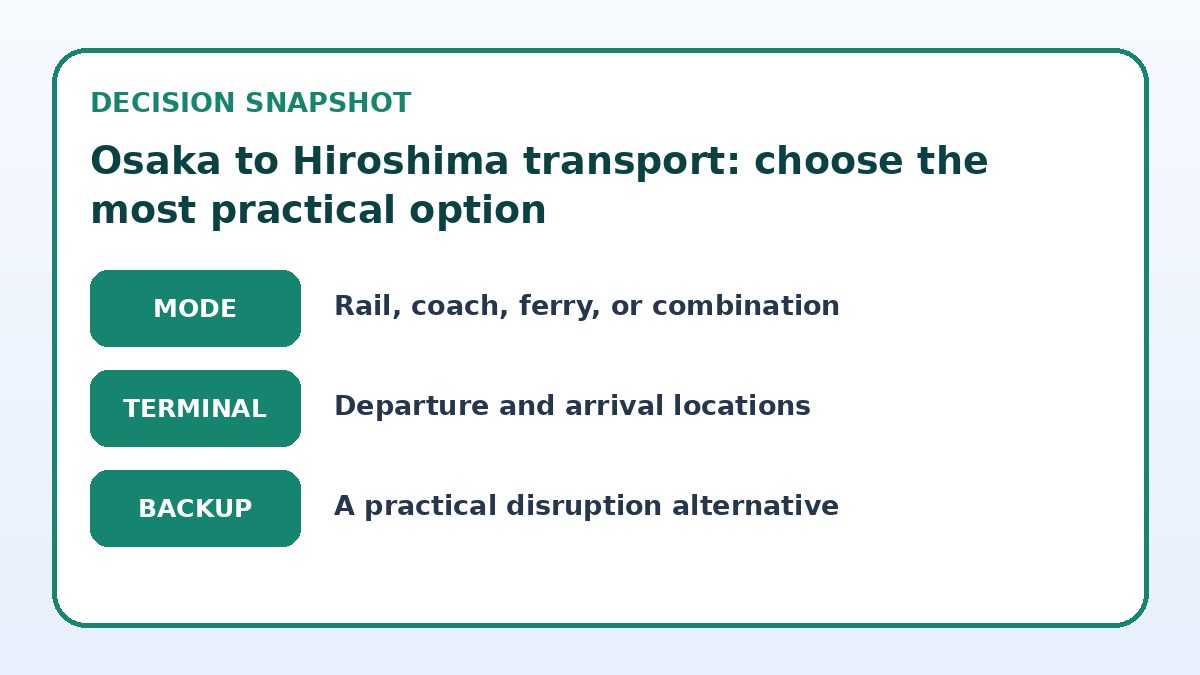
| Journey approach | Best for | Friction to check |
|---|---|---|
| Train-focused plan (frequent rail with short station transfers) | Travelers prioritizing predictable journey time and central station drop-offs. | May require short platform transfers and depends on proximity to main stations for door-to-door efficiency. |
| Coach-focused plan (coach between terminals with taxi last mile) | Origins/destinations near highway interchanges or suburban terminals where coach terminals are closer than main stations. | Longer in-vehicle time and more sensitivity to road traffic, but fewer carrying steps at terminals. |
| Mixed-route plan (taxi or local train to a major line, then intercity rail) | Travelers whose start or end points aren’t near a major terminal but who still want rail reliability for the longest leg. | Adds a short pre- or post-leg transfer, increasing planning complexity and potential points of delay. |
| Ferry-inclusive plan (ferry segment combined with land transfers) | Itineraries that begin or end near ports where ferry terminals sit closer to meeting locations. | Usually niche on this corridor; may be slower overall and requires precise port-to-city transfer coordination. |
Check live intercity options
Look beyond the ride itself and compare terminals, transfers, luggage, and arrival fit.
Luggage and transfer friction: keep it light and predictable
Business travelers should rate each option by how it handles luggage and mid-journey transfers. Trains often provide easier platform-to-platform movement and more space for rollaboards, but confirm whether trains require stair transfers or long corridors at interchange stations. Coaches may offer handled luggage bays so you don’t carry bags through stations, but they also depend on punctual boarding and can occupy a different terminal area that requires a taxi or shuttle before or after.
If your plan involves quick meetings immediately after arrival, prioritize options with minimal last-mile complexity: direct drop-off near your meeting area, short walking distance, or reliable short taxi stands. When comparing providers on their booking page, verify baggage allowances, whether assistance is offered for larger items, and the exact boarding/arrival point so you can estimate transfer time accurately.
Timing flexibility: balancing fixed schedules and contingency time
Decide how much schedule flexibility you need. If your meeting time is strict, choose more frequent services or departures with multiple daily options so you can select a backup within the same day. Trains usually run often between major cities, giving you several reasonable alternatives; coaches and ferries may have fewer departures, which demands planning a wider cushion. Factor in local traffic patterns—peak-hour roads can make coach legs less predictable compared with the rail network.
Also weigh your tolerance for leaving earlier versus arriving later. Earlier departures reduce risk but may require leaving the office sooner; later departures may compress on-site preparation time. For higher reliability, slot your travel around multiple feasible departures and block calendar windows for the journey, so colleagues know when you’ll be unavailable and you can react without scrambling.
Compare the practical alternatives
Use the final page to confirm what is actually offered on your dates and save a workable fallback.
Intercity travel checklist
- Map your actual door-to-door route: home/hotel to departure terminal, terminal layout, and arrival to meeting transfer.
- Compare frequency of departures in your needed time window and pick at least one alternate departure on the same day.
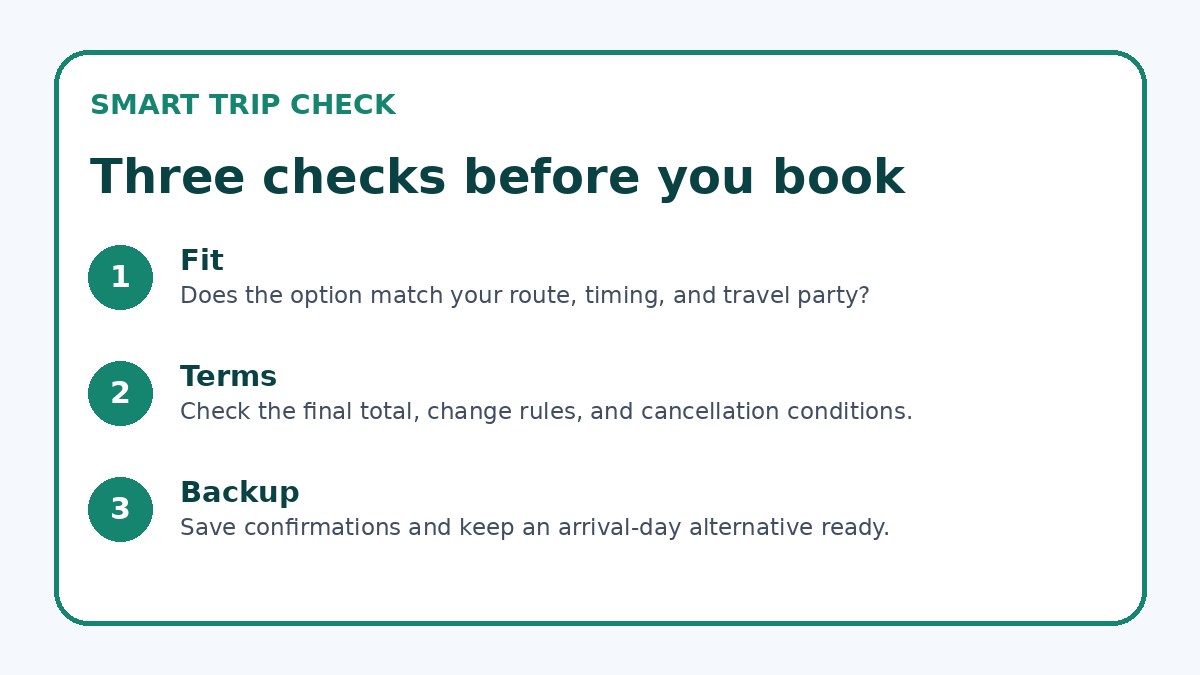
- Verify baggage rules and exact boarding/arrival points on the provider’s final booking page before you buy a ticket.
- Estimate taxi or local transit time at both ends and add that to your calendar buffer for planning.
- Install and test local transit or ride‑hail apps and store payment methods to speed last-mile moves if plans change.
- Notify your meeting contact of an arrival window and exchange a mobile number for real-time updates in case of disruption.
Disruption backup: practical fallbacks if the plan breaks
Prepare at least two concrete backups for the trip. One backup should be a same-day alternative that uses a different terminal type—if your primary choice is rail, identify a coach departure or a different train time; if you plan to use a coach, know the nearest rail terminal and how to get there quickly. Keep local taxi apps and station maps ready so you can pivot between terminals without losing time hunting for routes.
Finally, set expectations with meeting hosts about a realistic arrival window and share contactable details. If you rely on a particular provider, verify their real-time update channels and refund/change rules on the provider’s booking page before you purchase. This preparation minimizes stress and gives you a clear set of actions if delays or cancellations happen.
Rail & Intercity Transport questions travelers ask
Is the train usually the fastest door-to-door choice between Osaka and Hiroshima for business travelers?
Trains often provide the most predictable end-to-end time when both your origin and destination are near major stations. That predictability is what business travelers value most: consistent departure points, frequent services, and central arrival locations that reduce taxi time. However, speed alone is not the full story—if your meeting place is far from the station, or if you prefer a single luggage-handling step, a coach or a mixed approach that shortens last-mile transfers can be more practical. Always sketch the full route from your front door to final destination to judge which mode is genuinely faster for you.
What should I verify on the provider’s booking page before confirming a trip?
On the final booking page check exact boarding and arrival addresses, baggage allowances, refund/change conditions, and any platform or terminal notes. For trains, confirm whether the service is direct or requires transfers and if seats are reserved; for coaches, confirm the terminal location and expected drop-off point. If you include a ferry, verify port boarding procedures and necessary arrival lead time. These specifics directly affect your door-to-door time and your ability to switch plans if schedules change.
How far in advance should I book for business travel and backup flexibility?
Booking behavior depends on your tolerance for change: securing a preferred departure earlier gives peace of mind, but leaving options for same-day changes can be wise when meetings move. If you need an inflexible arrival time, lock in a seat or reservation that offers a clear backup later that day. If schedules are fluid, choose a provider with frequent departures and confirm their change or standby policies on the booking page. Keep at least one alternative route planned in your calendar so you can pivot without delay.
Final decision note
Choosing the most practical Osaka-to-Hiroshima transport for business travel is less about picking the fastest vehicle and more about minimizing transfers, luggage friction, and uncertainty en route. Begin by matching terminals to your actual start and end points, then evaluate how each mode affects your door-to-door time and stress levels. Prioritize options with multiple departures if your meeting time is strict, and prepare two concrete backups that use different terminals. Before buying, verify boarding points, baggage rules, and change or refund terms on the provider’s booking page; Trip.com can be a useful place to compare live options but always confirm details directly with the operator. With this approach you’ll choose the option that keeps you punctual and focused on the business at hand.
Continue planning
Check current options and final conditions
Use the provider page to confirm live availability, the final total, cancellation terms, and every condition that matters to your trip.
This evergreen planning guide was created with AI-assisted drafting and a structured quality review. It does not display live prices, schedules, availability, visa guidance, or provider rankings. Verify current details before booking. Some links are affiliate links; we may earn a commission at no additional cost to you.