Practical answer first: driving in Fukuoka can save time if your group has multiple large suitcases, but only if you confirm fuel policy, daily mileage limits, and how the company treats extra luggage at pickup and drop-off. Many travelers assume a single flat rate covers everything; in reality, fuel policies vary (full-to-full is friendlier for luggage-heavy trips), mileage caps can trigger per-kilometre fees that erase convenience savings, and some rental desks will refuse oversized bags in compact cars. Before you commit, weigh whether the route value—more door-to-door flexibility and easier airport transfers—outweighs the friction of checking vehicle capacity and insurance wording. If you prefer not to drive, strong non-driving options exist in Fukuoka; read on for a simple decision framework, what to verify on a final booking page, and a fallback plan that keeps your luggage moving smoothly.

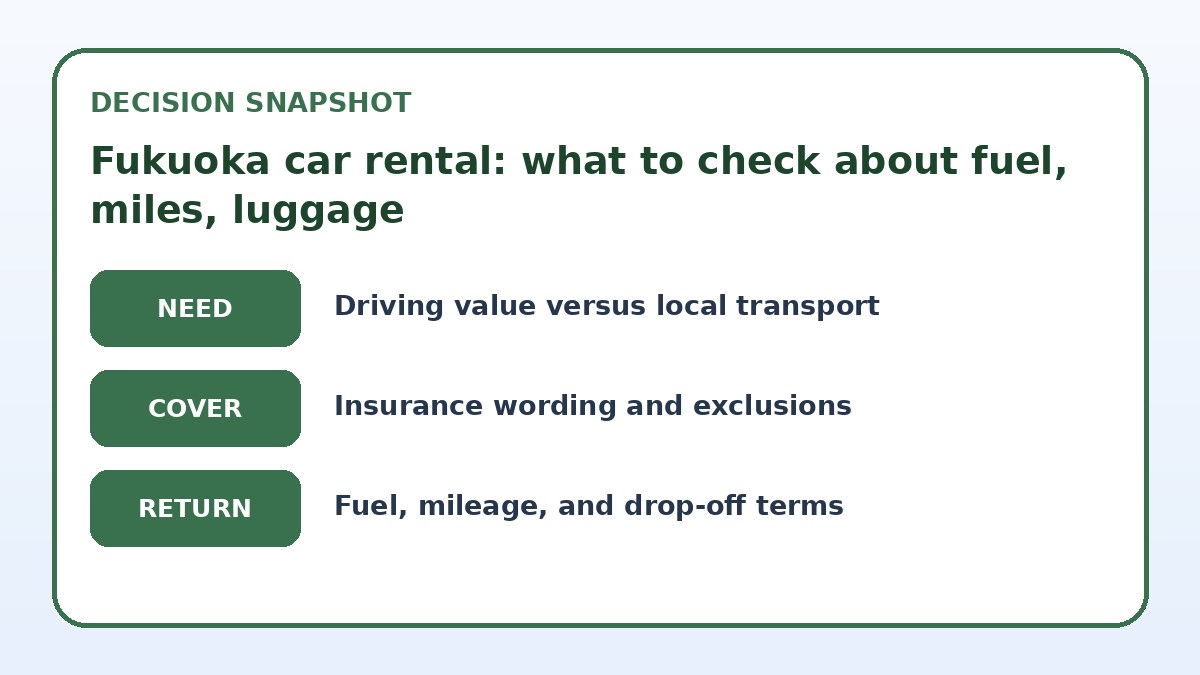
Decide whether driving improves your Fukuoka itinerary
Start by listing the specific places you want to reach and roughly how often you’ll move between them. Driving pays when your plan includes multiple day trips (Dazaifu, Yanagawa, coastal stops), early departures or late arrivals, or when public transit would require frequent luggage transfers. Consider door-to-door time vs. train or subway to each destination and whether a single vehicle would avoid repeated taxi fares or time-consuming transfers. Also factor in parking: if you plan long stints in central Fukuoka, the savings from a car may be reduced by parking fees and time searching for space.
If most of your itinerary stays inside central Hakata/Tenjin and you have few long day trips, public transit with occasional taxis might be simpler. For airport arrivals, a private transfer or an oversized-taxi option can beat the hassle of finding the right rental and fitting everything into a trunk. To decide, sketch two budgets—one for renting (vehicle class, fuel policy, estimated mileage fees, insurance, parking) and one for transit/taxis. Compare the non-monetary costs too: stress, time handling bags, and driving fatigue on unfamiliar roads.
Decide whether driving earns its place
| Mobility strategy | Best for | Cost or friction to check |
|---|---|---|
| Rent a car for the whole trip | Groups with many large bags and multiple out-of-town day trips | Higher daily costs, parking hassles and risk of mileage or fuel surcharges if limits are exceeded |
| Rent a car only for specific day trips | Mostly city-based itineraries that need occasional flexibility | Extra bookings and pickups add time; vehicle availability and one-way fees can complicate logistics |
| Public transit plus luggage forwarding | Travelers who want hands-free city travel and have heavy suitcases | Forwarding adds a fee and requires scheduling; not ideal for same-day, last-minute moves |
| Taxis or airport transfer services with generous luggage allowance | Short routes, airport transfers, or groups unwilling to drive | Can be costly for long distances and may have limits on oversized or many pieces of luggage |
Check live rental choices only after the route test
Use the exact driver, dates, pickup point, and return plan to compare current conditions.
Route value and how mileage rules change the math
Mileage caps and per-kilometre charges can quickly turn a convenient car into an expensive choice. Many local rentals set daily or total kilometre limits; exceeding them incurs fixed per-kilometre fees. Before booking, estimate driving distance for each day and add contingency for detours. If your trunk forces you to split loads or make extra trips to accommodations, that additional driving matters. A vehicle with unlimited mileage usually costs more up front but often saves money for long day trips and sightseeing circuits outside Fukuoka Prefecture.
When planning routes, also check regional restrictions: some rentals charge extra for crossing prefectural borders or returning in a different city; confirm whether the contract allows travel beyond Kyushu without surcharge. Factor in fuel stops on your route and realistic mileage given load weight—heavier cargo reduces fuel economy, increasing both fuel cost and the chance of exceeding mileage allowances. On the final booking page, verify the exact mileage policy text, the per-kilometre charge and any cross-prefecture clauses before confirming.
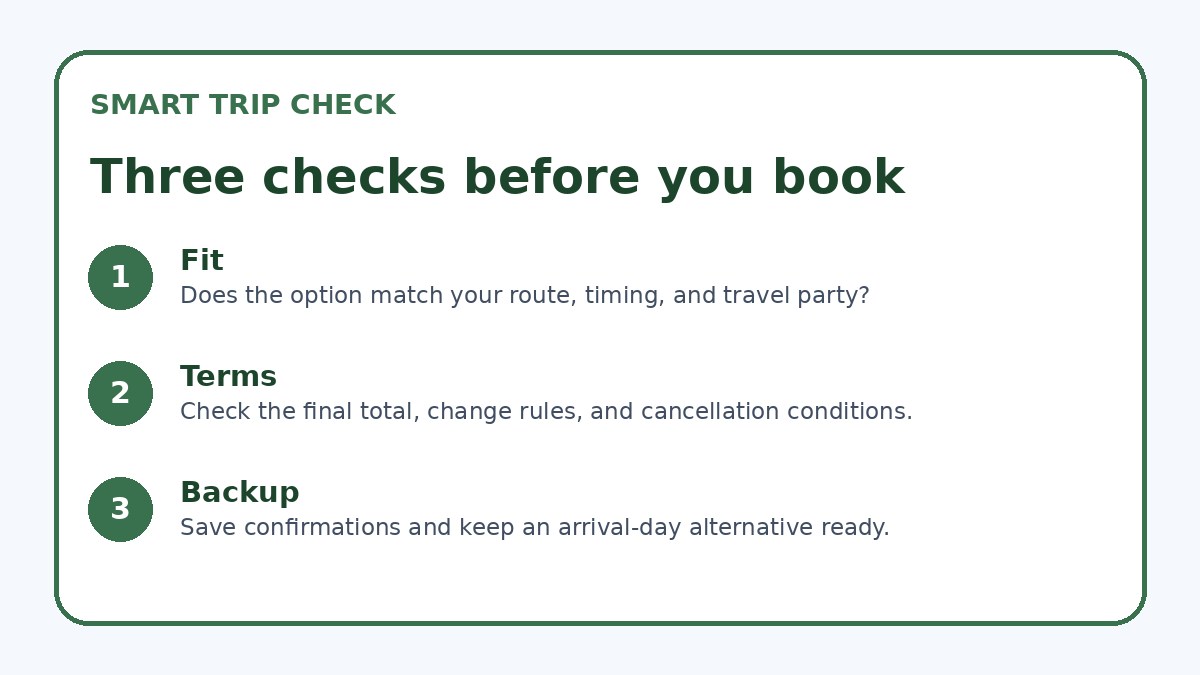
Compare the full rental conditions
Confirm insurance wording, exclusions, deposit, fuel, mileage, and return terms on the final page.
Insurance wording, pickup/return friction, and luggage handling
Insurance language varies and can materially affect whether a claim pays if luggage contributes to damage. Look for exclusions tied to overloaded cargo, unsecured items or roof-rack use. Collision damage waivers (CDW) and supplemental liability coverages differ in deductible amounts and coverage triggers; some waive deductibles only when you buy additional protections. If your luggage requires roof boxes or carriers, confirm whether those are allowed and whether the rental’s insurance covers incidents related to rooftop carriers. Always photograph vehicle condition and trunk space at pickup and keep a signed copy of the vehicle inventory.
Pickup and return steps matter for bulky bags. Small rental desks or tight urban branches may have less staff and slower service when you arrive with oversized baggage. Ask whether the desk has a luggage-friendly check-in lane or whether staff can help with loading. On return, confirm whether the company expects you to refuel to a specific level or charges a refuelling service fee. The final booking page should list exact refuelling rules, drop-off hours, additional drop fees and the process for handing over keys when offices are closed.
Car rental terms to verify
- Measure your largest suitcase and compare dimensions to the vehicle trunk or roof-box dimensions listed on the rental page.
- Confirm the fuel policy wording (full-to-full, pre-purchase, or refuelling fee) and note the required fuel level at return.
- Calculate estimated total kilometers and verify any daily or total mileage caps and the per-kilometre overage charge.
- Read insurance exclusions for overloaded or unsecured cargo and check deductible amounts and optional waivers.
- Ask the supplier how pickup and drop-off handle oversized bags, after-hours returns, and whether staff will assist loading.
- If considering alternatives, get quotes for luggage forwarding, taxi transfers with baggage allowance, and day rentals for comparison.
Non-driving fallback options and when to choose them
If driving looks marginal after checking fuel and mileage rules, choose a fallback that minimizes baggage handling. Strong alternatives in Fukuoka include rail for city-to-city legs plus luggage delivery services (known in Japan as takkyubin or luggage forwarding). Luggage forwarding lets you send large suitcases directly between airports, stations and hotels, so you can travel hands-free on trains or buses. For airport connections, compare airport limousine buses, direct express trains, and taxis that accept oversized luggage; each will differ in how easily they handle bulky items and door-to-door convenience.
Another hybrid approach is renting a small car only for the day or days when you need it and relying on public transport otherwise. This avoids paying for higher daily rates or unlimited mileage and reduces parking and urban driving stress. If you do this, confirm one-way rental fees and whether the vehicle class you need (larger trunk or roof box) is available for short-term hires. Trip.com can be a place to compare current availability, but always read the supplier’s final booking conditions for fuel, mileage, insurance and luggage limits.
Car Rental & Road Trip questions travelers ask
Will rental companies charge extra for having lots of luggage in the trunk?
Most companies do not add a specific "luggage fee" for ordinary checked bags, but charges arise indirectly: you may need a larger vehicle class (at a higher rate), a roof box (an extra accessory fee), or you could cause damage that falls under exclusions. Some smaller cars simply can’t accommodate multiple large suitcases; forcing them may void certain coverages. On the provider’s final booking page, look for vehicle capacity notes, roof-rack availability, accessory pricing and any explicit conditions about cargo and unsecured items.
How do fuel policies affect luggage-heavy trips?
Heavier loads reduce fuel economy, increasing the amount you spend on fuel and the likelihood of needing refuelling between stops. With full-to-full policies you pay only for the fuel you use, which is straightforward for long drives. Pre-purchase fuel or return-with-less policies often look convenient but can be more expensive when you drive farther than planned. Always confirm the precise fuel policy text on the booking page, including any refuelling service fees applied if you don’t return the vehicle to the specified level.
If I need a roof box, what should I verify before booking?
Confirm that the vehicle model supports a roof box and that the supplier offers or permits rooftop accessories; some branches don’t install them. Check maximum rooftop load limits and whether insurance covers incidents related to roof-mounted cargo. Note the installation and removal process and any additional daily or flat fees. On the final booking page, verify accessory availability for your pickup location, the exact cost, and any clauses that limit coverage while using rooftop equipment.
Final decision note
Driving in Fukuoka can be a clear win when you have many large suitcases and a plan with multiple out-of-town stops, but only after you’ve checked fuel rules, mileage limits and insurance exclusions. Start by measuring your luggage, estimating kilometres, and comparing the true cost of a larger vehicle or roof-box against luggage-forwarding and taxi options. Always inspect the rental’s final booking terms: fuel policy language, the exact mileage cap and overage rate, accessory availability and any insurance exclusions tied to cargo. If those terms feel restrictive, opt for a hybrid approach—public transit plus luggage forwarding or a short-term day rental—to get flexibility without hidden surcharges.
Continue planning
Check current options and final conditions
Use the provider page to confirm live availability, the final total, cancellation terms, and every condition that matters to your trip.
This evergreen planning guide was created with AI-assisted drafting and a structured quality review. It does not display live prices, schedules, availability, visa guidance, or provider rankings. Verify current details before booking. Some links are affiliate links; we may earn a commission at no additional cost to you.