If you and your partner are deciding which London airport to fly from to Paris, start by weighing the route-versus-fare tradeoff: a lower fare from a farther airport can be attractive on paper, but extra transfer time, luggage handling, and tighter connection margins often erase that saving for two travelers. For a couple, the cost of stress and the value of convenience usually matter more than a single-digit fare difference. Before you search for flights, choose your exact travel dates, preferred departure windows, and any firm constraints—late arrivals, mobility needs, or checked luggage—and have both travellers’ passport details and contact info ready. With those specifics in hand you can compare direct versus connecting options, necessary transfers to each London airport, and the fare rules that affect changes and baggage. The rest of this article explains how to judge routing, baggage and connection risk, schedule fit, and fare conditions so you and your partner can pick the most practical departure airport.

See live routes for your exact travel day
Compare direct and connecting choices with the same baggage and traveler details.
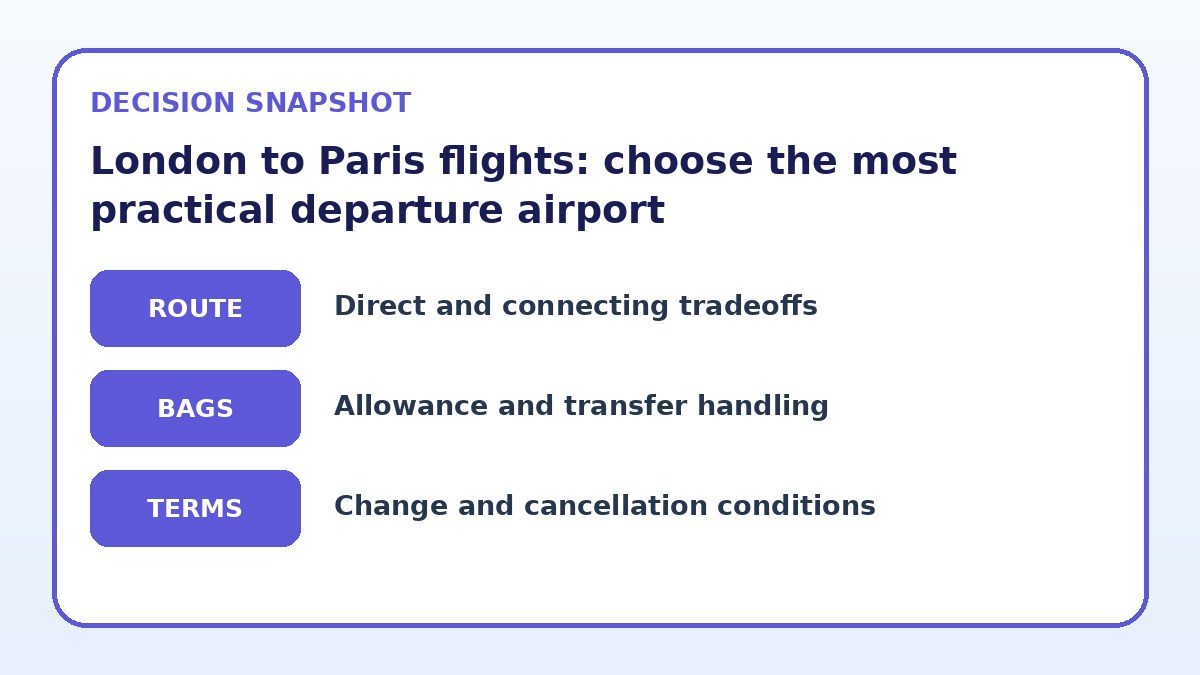
Routing: direct vs connecting and airport access
Compare the number of flight segments, door-to-door transfer time, and transport options when choosing a London departure. Direct flights to Paris (when available) mean fewer moving parts: no intermediate airports, less chance for misrouted bags, and simpler arrival planning. But direct flights may depart from different London airports; check which airports offer nonstop service on your dates. Also evaluate how long it takes to reach each London airport from where you’ll be staying—rail links, coach services, taxi times, and typical urban traffic patterns all matter for couples juggling luggage and each other’s schedules.
For departures requiring a surface transfer within London—rail to airport, long coach rides, or added connection legs—treat those transfers as part of the flight when comparing total travel time. If one partner prefers to avoid late-night or early-morning travel, that preference can narrow sensible airport choices. Confirm local transport frequency and the likely travel time during your planned departure hour, not just off-peak estimates. Finally, when comparing direct and connecting options, note that a seemingly small time saving on the flight itself can vanish if you must add a long train or bus trip to the airport.
Baggage and connection risk for two travellers
Checked bags increase complexity: two checked bags doubles the chance of delay, and different connection styles change that risk. If you choose an airport that requires an extra surface transfer or an inter-airport connection, the risk of a missed flight or delayed baggage rises compared with flying from the nearest airport with nonstop options. When you and your partner both check bags, account for the extra time needed to drop luggage at the airline desk or bag drop, and to collect it at the other end if you plan to connect through a second airport or rail hub.
Also consider how carrier and airport procedures affect baggage handling—low-cost carriers operating from certain London airports may have stricter check-in cutoffs and different baggage inclusion rules than full-service carriers. For couples who want to travel light and skip checked bags, a slightly longer coach or train to an airport with cheaper carry-on-friendly fares could be a sensible trade. Whatever you choose, verify baggage rules and connection allowances on the airline’s booking page before committing, because those conditions determine whether both of you can keep luggage with you or must risk checked handling.
Compare flight-selection strategies
| Flight strategy | Best for | Risk to check |
|---|---|---|
| Fly from the closest London airport with nonstop service | Couples prioritizing simplicity and shorter transfers | May cost more than distant budget-airport options but reduces missed-connection risk |
| Choose a budget-airport for lower headline fares | Price-sensitive couples who travel very light and accept longer transfers | Longer transfers and stricter check-in cutoffs increase stress and baggage risk |
| Pick an airport with frequent daily flights to Paris | Couples needing schedule flexibility or easy rebooking | Higher frequencies sometimes come with higher fares or less predictable seat pairing policies |
| Select an intermediate airport with balanced travel time and fares | Couples who want a middle ground between cost and convenience | May not offer the lowest fare or the fewest steps—requires careful timing and fare-rule checks |
Recheck the complete itinerary
Confirm airports, connection handling, baggage, and change conditions before deciding.
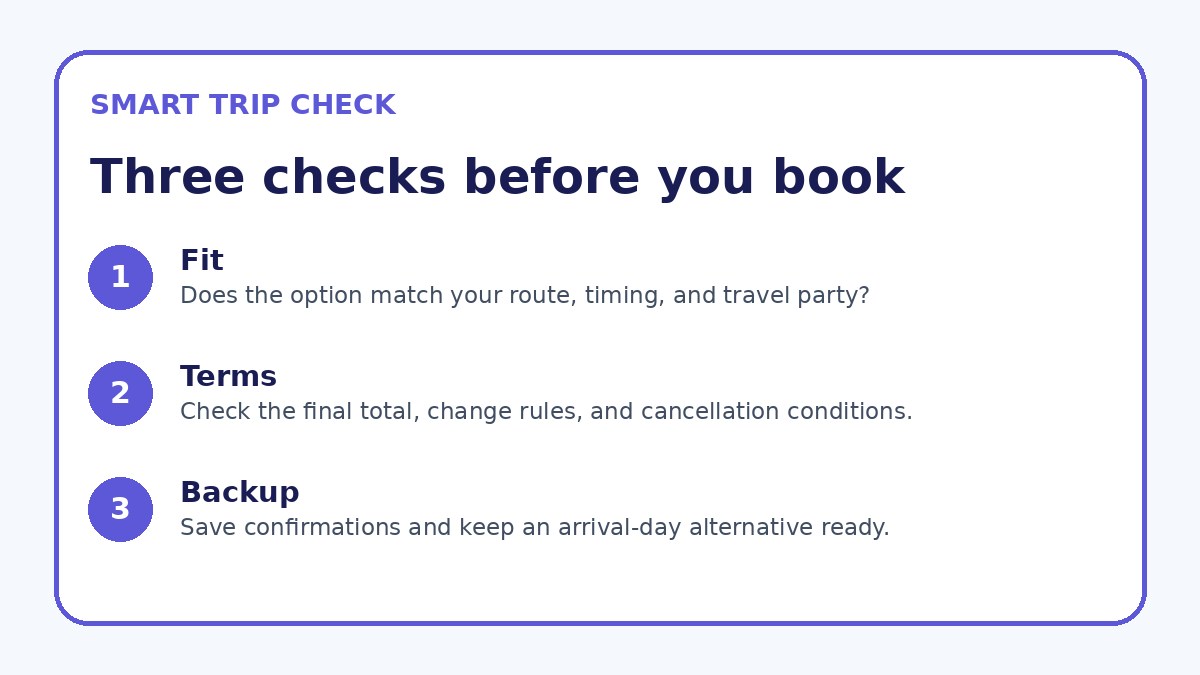
Schedule fit: departure windows and contingency time
Match the airport and flight options to the times of day that suit both of you. If you need to arrive in Paris by mid-afternoon for a hotel check-in or activity, an early-morning departure from a further airport might be less reliable than a later nonstop from a closer airport. Likewise, late evening flights can seem convenient but increase the impact of London traffic or rail disruptions when getting to the airport. For couples, adding a modest buffer—at least 90 minutes extra beyond typical travel time—to your airport transfer estimate reduces stress and gives breathing room for queuing, security, and minor delays.
Think about contingency plans for the day of travel: if a missed connection would force you into an overnight stay, choose the departure airport that gives you the most rebooking flexibility. Also consider how easy it is to return to your London base if you need to change plans last minute; shorter, more predictable transfers make quick plan changes less painful. When you compare flights, check the scheduled block time, planned departure and arrival windows, and leave room for the unpredictable—transport strikes, dense traffic, or longer-than-expected security lines.
Flight details to verify
- Confirm exact travel dates and both travellers’ full names as they appear on passports before searching fares.
- Write down preferred departure and arrival time windows and acceptable total door-to-door travel time limits.
- Compare transfer time, transport frequency, and typical journey reliability to each London airport for your planned departure hour.
- Open the airline’s final booking page to verify baggage allowances, seat-pairing options, and check-in cutoffs before payment.
- Check change and cancellation rules for the chosen fare class, and note any fees or flexibility included.
- Save or print the booking confirmation and fare rules for both travellers; keep a screenshot of the airline’s baggage and change policy pages.
Fare conditions and what to verify before booking
Don’t judge a flight solely by the headline fare: read the fare conditions for seat selection, change and cancellation penalties, and included baggage. Flexible fares or those allowing free changes are usually worth the premium for couples who value certainty over a small saving. If you’re splitting costs or one partner will pay and the other manages the itinerary, ensure both travellers’ names and contact info are entered correctly and confirm how changes are handled for jointly booked tickets. When comparing providers, always verify the exact baggage allowance, check-in cutoff times, and whether seats are guaranteed together on the provider’s final booking page.
Also check whether the airline or fare class charges for basics that matter to you—priority boarding, assigned seats, or a second carry-on—because these add-ons can tip the balance between two airport options. Some airports and carriers require longer check-in lead times; confirm those cutoffs on the airline’s site. If you use a third-party site like Trip.com to view availability, use it only to compare options, then verify all fare rules and baggage policies on the airline’s official booking page before paying. Keep a screenshot or PDF of the final rules and your booking confirmation for both travellers.
Flight Guide questions travelers ask
How do I compare total travel time when different London airports have very different ground transfer times?
Add together the scheduled flight time and realistic ground travel time to the airport from your London base to create a door-to-door estimate. Use published rail and coach timetables for the specific departure hour, then add a buffer for taxi or rideshare pickup, security queues, and baggage drop—90 minutes extra is a reasonable starting point for most departures. Compare the resulting totals rather than flight times alone: a slightly longer flight from a closer airport can still be faster overall and less stressful than a short flight preceded by a long coach or rail leg.
My partner and I both want to avoid checked bags; how should that influence airport choice?
If you both travel with carry-on only, prioritise airports and carriers that include sufficient cabin allowance and have flexible seating or seat-selection policies so you can sit together. This can make farther budget-airports attractive if they offer lower fares and generous carry-on rules. However, check cabin size limits and enforcement policies on the airline’s booking page—some carriers are strict about dimensions and weight. Also factor in how easy transfers will be if you need to catch a later connection; simpler airport access remains valuable even without checked bags.
What should couples verify about fare conditions to avoid surprises after booking?
Before paying, verify change and cancellation rules, the specific baggage inclusions, seat-assignment policies, and any fees for name corrections or itinerary changes on the airline’s official page. Confirm check-in and bag-drop cutoffs, as stricter deadlines at some airports can force earlier departures from your accommodations. If you booked through a reseller, cross-check the fare class and refund/changeability with the operating carrier. Finally, save screenshots or PDFs of the fare rules and the confirmation page so both travellers have clear documentation of what’s included.
Final decision note
For most couples, the most practical departure airport is the one that minimises complexity while fitting your timing needs: fewer transfers, predictable transport, and fare rules that match your baggage and change flexibility. Start by fixing dates and both travellers’ details, then compare door-to-door travel time, baggage risk, and the fare conditions on the airline’s final booking page. If the choice is a toss-up, favour the airport that reduces steps and uncertainty—that reduced stress often outweighs modest savings. Use rate-aggregation sites like Trip.com to view options if you wish, but always confirm baggage, seat, and change rules on the carrier’s official booking page before paying.
Continue planning
Check current options and final conditions
Use the provider page to confirm live availability, the final total, cancellation terms, and every condition that matters to your trip.
This evergreen planning guide was created with AI-assisted drafting and a structured quality review. It does not display live prices, schedules, availability, visa guidance, or provider rankings. Verify current details before booking. Some links are affiliate links; we may earn a commission at no additional cost to you.