Practical answer up front: before you search for Seoul to Da Nang flights, pick the exact travel dates, number of travelers, preferred departure airport in Seoul (ICN or GMP), and the arrival window in Da Nang, then check routing options, baggage allowances, connection risk, and fare change/cancellation terms. Those four details determine whether a lower fare is worth the added connection complexity. For a first-time visitor, prioritize schedule fit and baggage certainty over the smallest fare difference. Gather passport details, any visa notes you need to verify, and a flexible backup plan for missed connections so you can compare apples-to-apples when you view real-time options on airline sites or a comparison tool such as Trip.com.
See live routes for your exact travel day
Compare direct and connecting choices with the same baggage and traveler details.
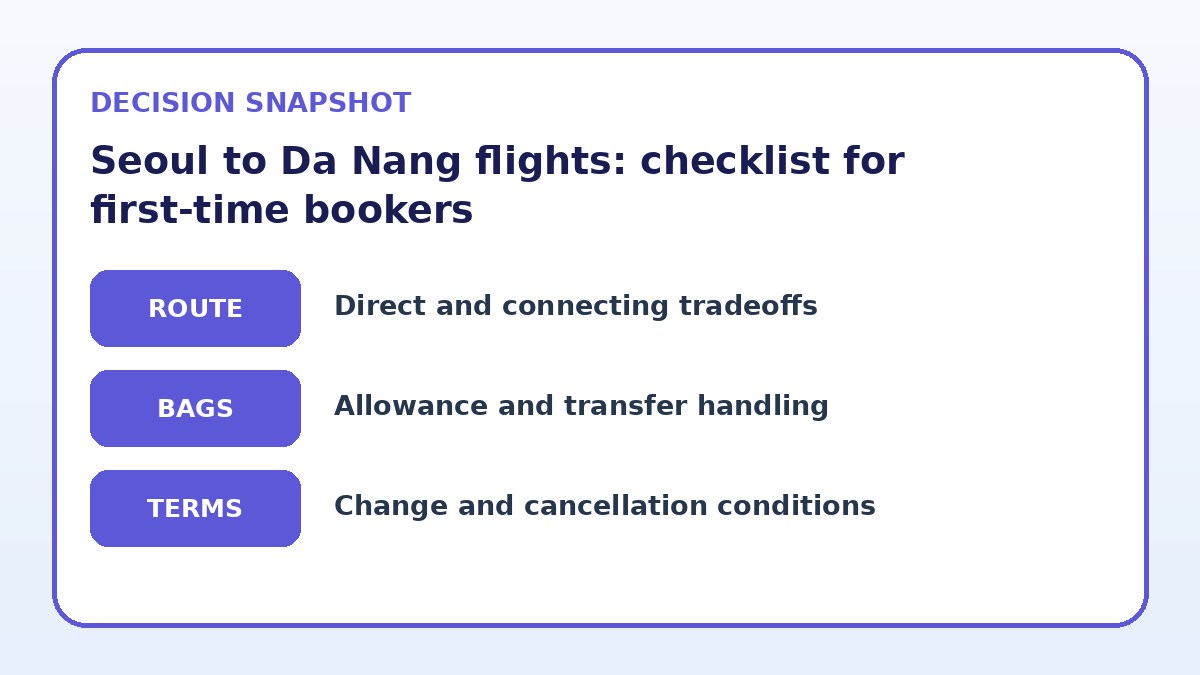
Routing: direct vs connecting and why it matters
Start by mapping the potential route shapes from Seoul to Da Nang. If direct flights are offered, they cut complexity and reduce the chance of a missed connection, but you may face fewer schedule options. Connecting itineraries can open earlier departures, later returns, or lower headline fares—however, each connection adds a hinge point where delays or missed flights can cascade into larger problems. For a first-time visitor, weigh whether the time saved or money saved is worth adding a second or third airline and airport transfer risk.
When comparing routes, look beyond total travel time and check minimum connection times and whether the connection occurs in an international or domestic transit environment. A self-transfer—where you must collect and recheck luggage or switch terminals—adds time and risk compared with a single-ticket protected connection. Also check whether the same carrier or alliance handles both legs; single-ticket itineraries typically provide more protection for delayed incoming flights than separate bookings across different providers.
Baggage and connection risk: verify before you buy
Baggage rules are one of the most common surprises for first-time flyers. Airlines vary on what is included in each fare class for checked bags and cabin allowance. A cheaper fare that excludes checked luggage can become more expensive than a higher fare that includes a bag if you need to check a suitcase. If you have a connecting itinerary with different carriers, confirm whether checked bags are through-checked to Da Nang or if you must claim and re-check them during the connection—this matters for immigration, extra time needed, and the chance of missed connections.
For connections, ask whether the booking is on a single ticket and what protections that yields in the event of delay. On a single ticket, airlines most often rebook missed connections and handle baggage transfers; on separate tickets, you typically carry the full risk. Verify connection minimums and any required terminal transfers at the connecting airport, and plan a buffer for immigration and security. If you’re traveling with valuable or time-sensitive items, consider packing them in carry-on to reduce the stakes of potential baggage delays.
Compare flight-selection strategies
| Flight strategy | Best for | Risk to check |
|---|---|---|
| Direct flight-focused selection | Travelers prioritizing simplicity and lower connection risk. | May offer fewer schedule choices and sometimes higher fares than multi-stop options. |
| Lowest-fare hunting across dates | Flexible travelers willing to accept longer or multiple connections. | Savings can vanish after baggage and change fees; higher connection risk. |
| Single-ticket multi-carrier routing | Passengers seeking more schedule options while retaining some protection for connections. | Fare rules can be complex; confirm which carrier's policy applies to each leg. |
| Short-layover, risk-tolerant plan | Short-trip travelers focused on minimizing total travel time. | Small delays may force rebooking and extra costs if connections are missed. |
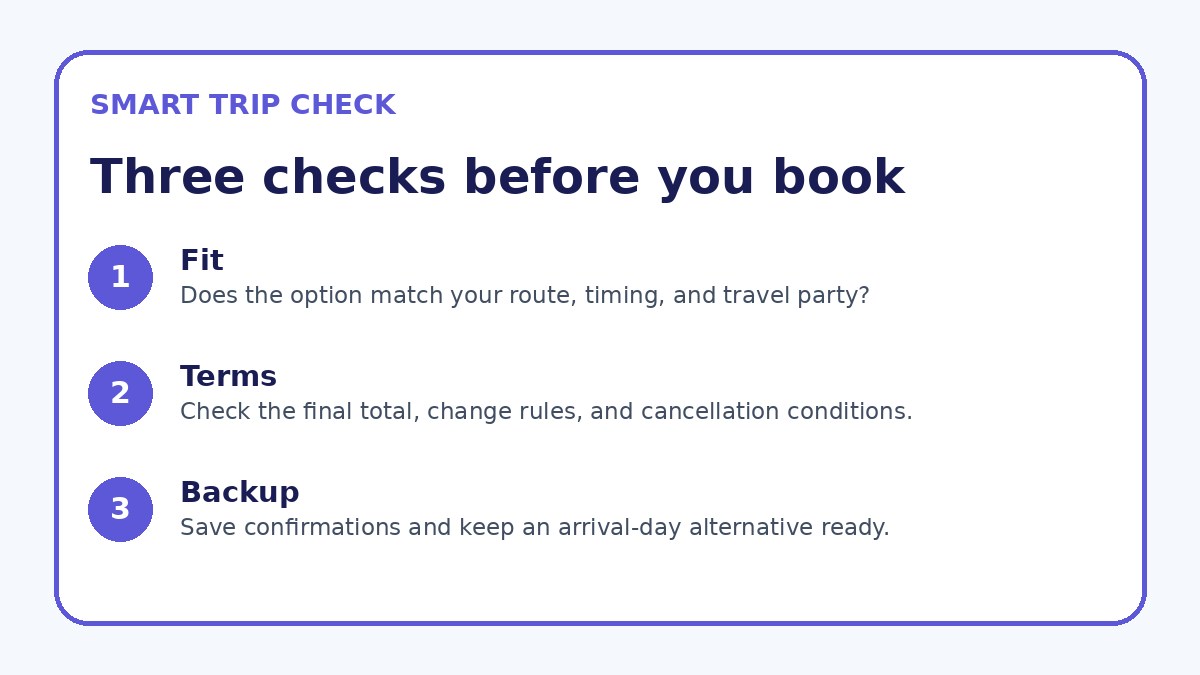
Recheck the complete itinerary
Confirm airports, connection handling, baggage, and change conditions before deciding.
Schedule fit and personal tolerance for travel time
Be realistic about your personal tolerance for travel time and overnight logistics. If you need to arrive in Da Nang by a specific time—say for a tour pickup or meeting—pick itineraries with conservative arrival buffers and fewer connections. Take into account the time of day you depart Seoul: early morning flights can reduce the chance of cascade delays, while late-night arrivals in Da Nang may affect ground transport options. Also consider airline schedules for returns if your trip is short; an inconvenient outbound can be compounded by a tight return.
Use your travel purpose to prioritize schedule criteria. Vacation travelers who value daytime sightseeing might accept a night flight to maximize daytime hours at the destination, while visitors on tight business schedules should opt for a margin of safety with earlier departures and longer connection windows. When planning, include extra time for passport control, potential visa checks on arrival, and airport transfer time in both Seoul and Da Nang so your chosen schedule actually fits the door-to-door plan.
Flight details to verify
- Lock in your exact travel dates, the number and type of travelers (adult, child, infant), and passport name spelling before searching fares.
- Choose preferred Seoul departure airport (Incheon ICN or Gimpo GMP) and note ground transit time to that airport from your accommodation.
- On each prospective itinerary, expand and save the fare rules page: note baggage allowance, change/cancellation fees, and refundability.
- Check whether the itinerary is a single-ticket protected connection or separate bookings; if separate, allow a longer buffer for transfers and baggage reclaim.
- Confirm the operating carrier for every segment and verify terminal/arrival details on the carrier’s site before you pay.
- Prepare contact details, a backup booking window, and a digital copy of your itinerary and fare rules to speed rebooking if a disruption occurs.
Fare conditions and what to verify on the booking page
Fare rules determine change and cancellation flexibility, baggage inclusion, seat selection costs, and whether you earn frequent flier credit. Before finalizing a booking, open the fare conditions on the airline or travel agent’s page and read the specific sections on refunds, change fees, same-day changes, and no-show penalties. If the booking shows code-share legs, confirm which carrier operates each segment and check that operator’s conditions. If a lower fare seems attractive, compare the full cost after adding expected baggage and seat fees and factoring in potential change fees.
When provider-specific facts could change, verify the following on the provider’s final booking page: the exact baggage allowance per passenger, which carrier operates each flight leg, connection minimums and whether transfers are protected, and the complete list of fees for changes or cancellations. Don’t rely solely on summary screens—expand the fare rules or printable itinerary to see black-and-white policy language. If you’re unsure, take a screenshot or save the fare rules PDF for reference before purchase.
Flight Guide questions travelers ask
Should I prefer nonstop flights from Seoul to Da Nang if they exist?
If a nonstop option fits your schedule, it usually reduces the chance of missed connections and simplifies baggage handling, which is especially valuable for first-time visitors. However, nonstop choices might be more limited in departure times or slightly higher in headline fare. Before choosing nonstop, compare the total door-to-door travel time, pick-up or transfer availability in Da Nang, and the included baggage rules. If nonstop isn’t available or the schedule is inconvenient, a single-ticket connecting itinerary with reasonable layovers is the next-best option.
How far in advance should I book Seoul to Da Nang flights?
There’s no single correct booking window—your ideal timing depends on travel flexibility and whether you need a particular departure time or seat type. If your dates are fixed because of events or work, book sooner to lock the schedule and fare class that includes the baggage and change terms you want. If your dates are flexible, monitor fares across a range of days and be ready with exact traveler details when a good combination of schedule and fare rules appears. Always confirm fare rules at purchase rather than relying on memory.
What do I do if an itinerary requires a terminal change or separate ticket connections?
If you must switch terminals or hold separate tickets, plan additional time for immigration, baggage claim, and recheck processes. Research the airports involved: identify transfer buses, shuttle timings, or recommended taxi options between terminals, and add conservative buffer time to avoid tight connections. For separate tickets, consider travel insurance that covers missed connections and check whether you can purchase a flexible ticket or priority services to reduce risk. If in doubt, choose a longer layover or a single-ticket itinerary that protects transfers.
Final decision note
Booking Seoul to Da Nang flights as a first-time visitor is mainly about matching your priorities—schedule certainty, baggage assurance, and acceptable connection risk—to the fare conditions on offer. Start by firming up dates and traveler details, then compare direct and connecting routes while reading the full fare rules on the airline or agent’s final booking page. Favor single-ticket itineraries when possible for protection, or add comfortable buffers for self-transfers. Keep digital copies of your itinerary and fare rules, and verify carrier operating details before payment so you can travel with confidence and fewer surprises.
Continue planning
Check current options and final conditions
Use the provider page to confirm live availability, the final total, cancellation terms, and every condition that matters to your trip.
This evergreen planning guide was created with AI-assisted drafting and a structured quality review. It does not display live prices, schedules, availability, visa guidance, or provider rankings. Verify current details before booking. Some links are affiliate links; we may earn a commission at no additional cost to you.