If your itinerary stays inside Manhattan, Brooklyn, and close Queens neighborhoods, driving usually adds cost and friction without much time saved. Rent a car when you have out-of-town day trips from New York City—long drives to the Hudson Valley, the Hamptons, or northern New Jersey—where door-to-door convenience outweighs parking and congestion headaches. For solo travelers, the practical question becomes: will a car improve access enough to justify higher fees and insurance complexity? This article gives a clear decision path, explains the common insurance phrases you’ll see on reservation pages, outlines pickup and return pain points, and offers a public-transit or rideshare fallback if you opt not to drive. Read the quick checklist before booking and verify final policy language on the rental company’s booking page; Trip.com can be used to compare availability but always confirm wording with the supplier.
Decide whether driving improves your New York City plan
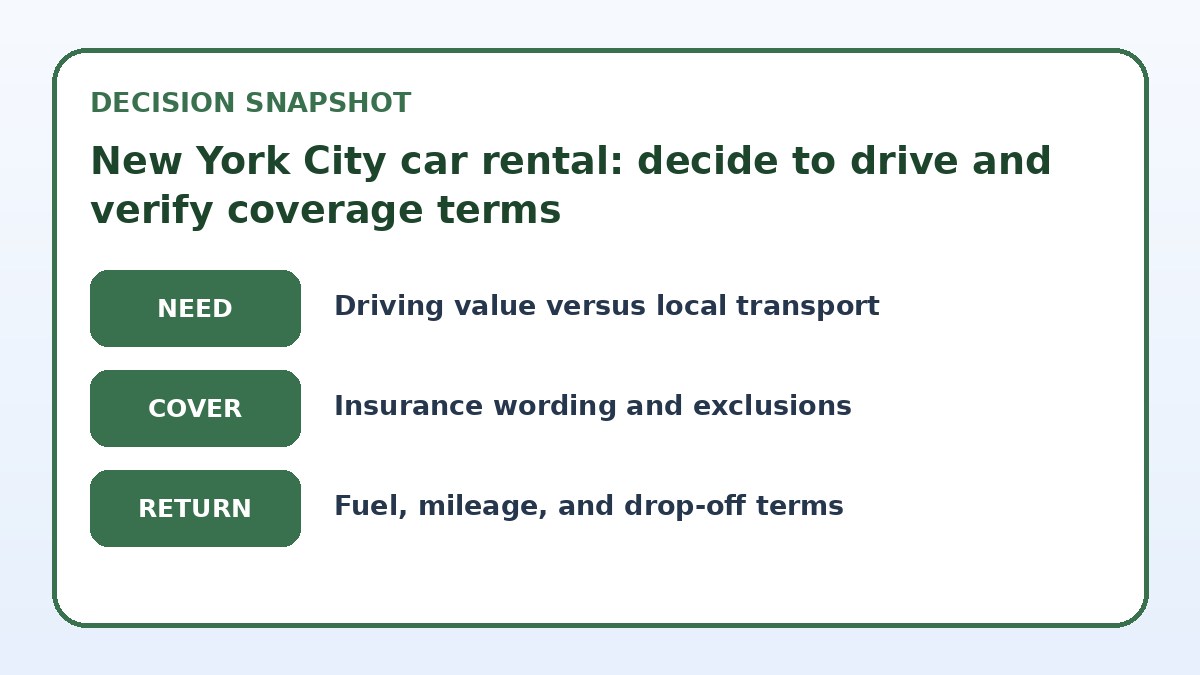
Start by matching the car to the route value. A rental makes clear sense when your solo itinerary includes multi-stop day trips outside the dense urban core, like exploring wineries or hiking trails beyond the commuter rail reach. Driving becomes less attractive if your schedule is focused on museums, restaurants, or a hotel in Midtown, where traffic, one-way streets, and high parking costs will reduce the time and money you gain from having a vehicle.
Weigh time savings against friction: parking availability near your destinations, likely garage costs, and the mental load of navigating heavy traffic. For a solo traveler who values flexibility for remote destinations or carrying equipment (camera, outdoor gear), the car is a functional tool. If you prioritize relaxing travel without the responsibility of keys, insurance puzzles, and potential fines, the non-driving option usually wins.
Decide whether driving earns its place
| Mobility strategy | Best for | Cost or friction to check |
|---|---|---|
| Rent a car for the whole trip | Solo travelers with multiple out-of-city day trips and gear to carry | Higher insurance complexity, parking costs, and pickup/return responsibilities |
| Rent only for specific day trips | Those staying in the city but planning one or two long excursions | Extra pickup/return time and potential one-way fees; must coordinate timing tightly |
| Public transit plus commuter rail | Sightseeing-focused solo travelers who want low cost and city convenience | Can be slower for some suburban destinations and may require early planning |
| Transit plus on-demand rideshares or taxis | Travelers who prefer flexibility without dealing with insurance or parking | Higher per-trip costs and variable availability during peak times or late nights |
Check live rental choices only after the route test
Use the exact driver, dates, pickup point, and return plan to compare current conditions.
Understand common insurance wording on rental pages
Rental pages use acronyms and short policy names that pack important differences. LDW or CDW (Loss Damage Waiver / Collision Damage Waiver) relieves you from financial responsibility for damage to the rental vehicle, but it often has exclusions and may not cover certain costs like administrative fees or loss of use. Liability coverage protects other people and property if you cause an accident; states set minimum requirements, but the rental company’s supplemental liability offer increases the limits and may be worth considering for an underinsured solo traveler.
Watch for terms that sound similar but differ in scope: 'supplemental liability' expands third-party coverage, 'personal accident insurance' covers medical costs for you and passengers, and 'personal effects coverage' protects belongings inside the vehicle. Also check for 'loss of use' and 'administrative fees' clauses—these are billed when the vehicle is out of service. Always read exclusions about unauthorized drivers, driving in restricted areas, and off-road use; the final booking page will list exact limits, deductibles, and exclusions you must confirm.
Compare the full rental conditions
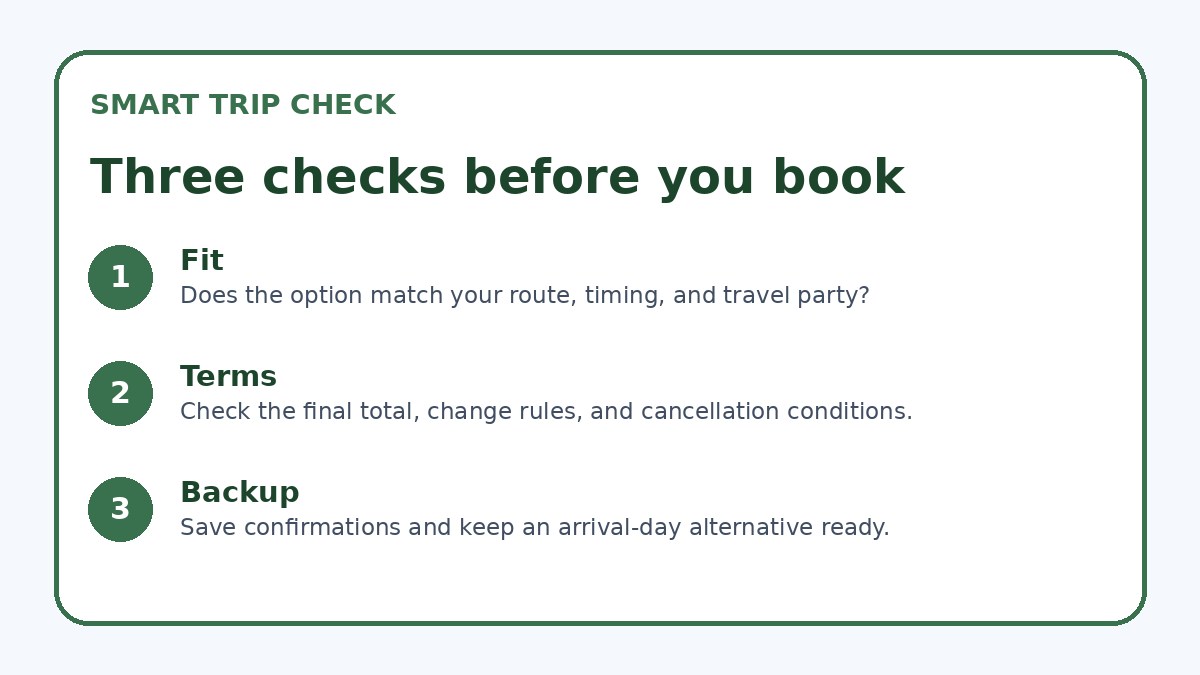
Confirm insurance wording, exclusions, deposit, fuel, mileage, and return terms on the final page.
Pickup and return friction every solo traveler should expect
At pickup, the soft signs matter: bring the card used to book, your driver’s license, and any proof of pre-paid protections. Inspect the car thoroughly with staff and document all existing damage with timestamps in photos or a short video. Ask the agent to note any dents or mechanical concerns on the rental contract; if they resist, insist on adding comments. Confirm fuel policy, authorized drivers, mileage limits, and where to return outside normal hours. These steps reduce surprise charges and give you leverage if disputes arise after returning the vehicle.
Return friction often creates the most post-trip headaches: verify office hours and out‑of‑hour drop-off instructions, note the final odometer reading, and photograph the car in the return bay or lot. If you refuel before returning, keep the pump receipt. Get a copy or confirmation email showing the final inspection and charges; if the company only emails a provisional bill, save screenshots of the vehicle condition and the meter to challenge later. The supplier’s final invoice page is the authoritative document for costs, so verify damage and administrative fees there.
Car rental terms to verify
- Decide whether your planned destinations are inside the five boroughs or require out-of-city driving; if inside, skip the rental unless you need cargo space.
- On the rental booking page, read the exact LDW/CDW, liability limits, deductibles, and exclusions before accepting any protection.
- Take time-stamped photos and a short video of every side of the car and the odometer at pickup and return; keep copies off your phone cloud.
- Confirm the fuel policy and get the return instructions in writing; if returning outside office hours, document the drop-off location and timestamp.
- If you have personal car insurance or a credit card rental coverage, verify coverage limits, permitted countries/states, and whether loss of use and administrative fees are excluded.
- Keep a digital copy or screenshot of the final inspection and invoice emailed by the rental company; dispute charges promptly with photo evidence and timestamps.
Non-driving fallback: efficient alternatives for solo travelers
If you choose not to drive, plan a layered mobility approach: subway and buses for dense neighborhoods, commuter rail (LIRR, NJ Transit, Metro-North) for suburban day trips, and targeted rideshares or taxis for late nights or awkward connections. For some day trips beyond commuter lines, regional buses or group tours can substitute for a rental vehicle while avoiding parking, insurance, and navigation. Consider booking point-to-point rail or a one-way commuter trip ahead of time to ensure seat availability and reduce in-city transfers.
Combine digital tools and a realistic daily plan: check transit schedules, reserve tickets where possible, and allow buffer time for transfers or delays. For destinations where shared mobility still leaves a last-mile gap, rideshare or a short local taxi trip can fill in without the long-term cost of a rental. This hybrid approach minimizes insurance exposure, removes the need to parse policy wording, and often ends up less stressful and cheaper for solo travelers focused on sightseeing and urban experiences.
Car Rental & Road Trip questions travelers ask
Does my personal auto insurance usually cover New York City rentals for a solo traveler?
Many personal auto policies extend coverage to rental vehicles, but policy limits and terms vary widely. Before booking, call your insurer to confirm whether collision, comprehensive, and liability apply to a rental in New York State, and ask about deductibles and whether the policy covers loss of use and administrative charges. If your existing coverage is limited, a supplemental rental policy might close gaps. Always get the insurer’s written confirmation or policy reference number and bring it to the rental counter.
Will my credit card rental coverage be enough for a solo rental in New York City?
Some credit cards offer secondary or primary rental coverage that can cover damage or theft, but coverage terms differ—especially about liability, permitted drivers, and geographic limits. Check whether the card’s benefit excludes certain vehicle classes, requires you to decline the rental company’s LDW/CDW, or does not reimburse loss of use or administrative fees. Call the card benefits line and request a benefits guide that you can show at pickup; keep that guide and a claim contact number handy in case you need to file after the trip.
What specific insurance wording should I verify on the rental company’s final booking page?
On the supplier’s final page, look for LDW/CDW details (what is covered and any exclusions), the deductible amount, liability limits, whether supplemental liability or personal accident insurance is offered, and how loss of use and administrative fees are charged. Also verify authorized drivers, roadside assistance terms, and restrictions on driving areas. The final booking page should list exclusions (for example, off-road damage, unauthorized drivers, or driving outside certain states) — use those exact phrases to compare with your personal or card coverage documents.
Final decision note
For most solo travelers staying mainly inside New York City, foregoing a rental avoids parking headaches, extra fees, and insurance ambiguity. Rent when your plan includes rural or suburban day trips where driving saves time and enables carrying gear. Reading the exact insurance wording on the rental company’s final booking page is non-negotiable: confirm LDW/CDW scope, liability limits, deductibles, and how loss-of-use or administrative fees are handled. At pickup and return, document the vehicle thoroughly and save all invoices and photos. If you prefer to avoid insurance complexity, a hybrid approach using transit plus targeted rideshares often gives the best balance of flexibility and low risk.
Continue planning
Check current options and final conditions
Use the provider page to confirm live availability, the final total, cancellation terms, and every condition that matters to your trip.
This evergreen planning guide was created with AI-assisted drafting and a structured quality review. It does not display live prices, schedules, availability, visa guidance, or provider rankings. Verify current details before booking. Some links are affiliate links; we may earn a commission at no additional cost to you.