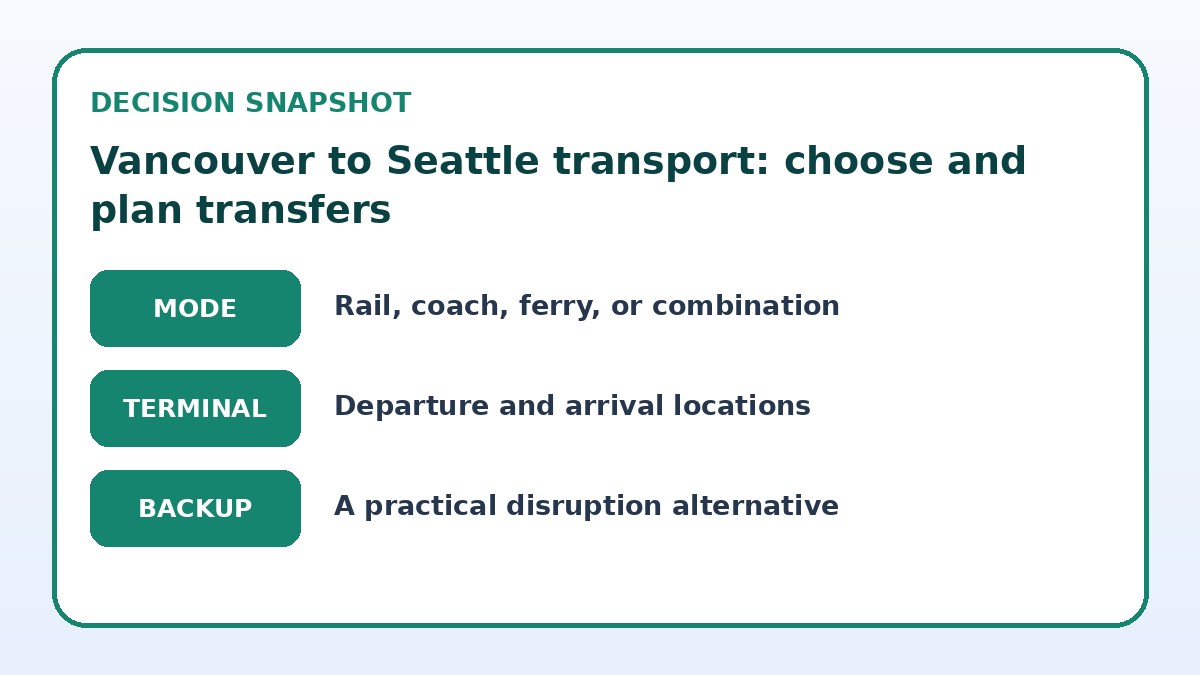
The practical answer: choose the mode (rail, coach, ferry or mixed) that best matches your luggage needs, where you start and end in each city, and how tolerant you are of tight connections. For many first-time visitors, a direct coach or train that arrives at a central terminal reduces transfer time and taxi complexity; if you care more about scenic travel, a ferry-inclusive itinerary may add complexity but reward the journey. Start by mapping your arrival/departure addresses in Vancouver and Seattle, then compare where each provider’s terminal or station sits relative to those addresses. That immediate, door-to-door view tells you whether you need an extra taxi, a city transit ride, or an overnight stay before continuing. Below I explain terminal fit, luggage and transfer friction, timing flexibility, and a simple disruption backup plan so you can pick the most practical option for your trip.
How to choose between rail, coach, ferry, or a mixed route
Decide first whether your priority is speed, simplicity, comfort, or scenery. Trains and coaches aim to simplify station-to-station movement: they often use central terminals that connect well to local transit. Ferries add a scenic leg but introduce terminals that may be farther from downtown and require extra transfers. A mixed route (for example, coach plus ferry) can combine strengths — coach for speed to a ferry terminal, ferry for scenery — but increases the number of transfers you must plan and time carefully.
Assess the door-to-door implications before you book. Map the exact addresses of the stations and terminals and compare them with your origin and final destination in each city. If a terminal is outside the downtown core, factor in taxi or transit time, luggage handling, and potential waits. For travelers wanting fewer unknowns on arrival day, a single direct coach or train that stops at central locations often wins. If you prefer the ride itself and accept extra transfers, a ferry-inclusive itinerary can be very satisfying — just plan the transfer legs and leave wide buffers.
Choose the end-to-end journey plan
| Journey approach | Best for | Friction to check |
|---|---|---|
| Direct coach or single-mode train to central terminals | Travelers prioritizing simplicity, minimal transfers and central arrival points | May be less scenic and could have limited departure times compared with mixed routes |
| Ferry-inclusive route (coach/train + ferry) | Travelers who want scenic travel and can tolerate extra transfers | Adds transfer complexity and potential walking between dock and local transit |
| Mixed multimodal plan using coordinated transfers | Flexible travelers looking to optimize comfort and schedule across modes | Requires careful timing, luggage planning, and backup options for missed connections |
| Door-to-door private transfer or rideshare connections | Those valuing direct end-to-end convenience and minimal public transfer walking | Usually more expensive and depends on vehicle access and downtown drop zones |
Check live intercity options
Look beyond the ride itself and compare terminals, transfers, luggage, and arrival fit.
Terminal fit and luggage/transfer friction
Terminal fit is about more than distance: consider pedestrian access, available drop-off areas, luggage facilities, and how easy it is to hail a car or walk to transit. Some terminals have sheltered drop-off/pick-up zones and luggage assistance; others are primarily curbside with limited protection and require short walks. If you travel with large suitcases, check whether the station has staff to help, baggage storage, or elevators. Relying on a terminal without good baggage handling raises the chance of bottlenecks and extra time moving between platforms or docks.
Transfer friction also comes from passport and customs steps on cross-border journeys. Even when you pick the most convenient terminal, you may need to account for immigration processing at a border facility or on board. That processing can lengthen your total travel time and affects how tightly you can schedule connections. When planning, assume transfers will take longer during peak hours and holidays and plan luggage and walking time conservatively. Where possible, choose services that minimize steps: single-ticket journeys with through-checking of luggage or central terminals with quick public transit links lower friction.
Timing flexibility and planning realistic buffers
Prioritize time buffers between legs rather than shaving minutes off your schedule. For a first-time visitor, a comfortable buffer accounts for late arrivals, security or customs checks, and the simple logistics of moving luggage between vehicles. Aim to build at least one reasonably long cushion when a transfer requires switching modes — for example, from a train to a bus or from a ferry dock to a downtown hotel transfer. If you prefer minimal waiting, choose itineraries with single-mode or direct services that reduce the need for close connections.
Use local transit and taxi reliability to set realistic windows. Traffic congestion and downtown loading zones can add unpredictable minutes to terminal transfers, especially during rush hours or event days. Check typical travel times between terminal addresses with a mapping app at the hour you expect to travel and then add a margin for disruption. If your schedule is inflexible — meeting time or onward transport with strict departure — select a service that arrives with time to spare or plan an overnight buffer to eliminate connection stress.
Compare the practical alternatives
Use the final page to confirm what is actually offered on your dates and save a workable fallback.
Intercity travel checklist
- Map exact station and terminal addresses for both Vancouver and Seattle and measure door-to-door travel time with a mapping app.
- Verify luggage handling policies and whether bags can be through-checked or must be carried between legs on the provider’s booking page.
- Check where passport and customs processing occurs for your chosen service and plan extra time if processing is off-site or on arrival.
- Identify two later same-day departure options and note their terminal locations in case you miss your planned connection.
- Save local taxi and rideshare contact options, and download offline maps for terminal areas in case mobile data is limited.
- Keep essential documents and a small carry-on with valuables and immediate needs to simplify sudden terminal-to-terminal moves.
Simple disruption backup plan
Prepare two immediate backups: a later same-day option and a nearby hotel or transit alternative. Before departing, identify the last few departures you could use that day; being aware of later services reduces panic if your first leg is delayed. Save contact details for local taxi operators and a reliable rideshare app so you can move between terminals quickly if public options are interrupted. Make sure your phone can use mobile data across the border or that you have offline maps downloaded to avoid hunting for directions on arrival.
Also prepare a contingency for luggage or document problems. Carry photocopies or digital photos of your passport and travel documents, and keep essential items in a small carry-on that’s easy to move. If crossing the border, verify the provider’s immigration instructions on their booking page so you know where processing happens and whether you must disembark with your bags. Finally, consider travel insurance or flexible tickets that allow rebooking; check specific change and cancellation terms directly with the provider before you commit.
Rail & Intercity Transport questions travelers ask
Which terminal should I choose if my hotel is near downtown Seattle?
If your hotel is downtown, prioritize services that arrive at central stations or terminals with direct transit links to your neighborhood. Map the terminal location against your hotel address, then assess walking distance and transit connections. If the terminal is outside downtown, factor taxi time and potential additional fares. For cross-border travel, also confirm where immigration is processed so you know whether you’ll be routed through an outlying facility before reaching the downtown terminal.
How much extra time should I allow for luggage and transfers?
Allow more time than you think you need: include walking between platforms or docks, potential lines for boarding, and passport or customs checks on cross-border legs. For first-time visitors, a safe approach is to add a generous buffer beyond published journey durations, especially when connections require mode changes. Check terminal layouts and accessibility — long ramps, stairs, or distant curbside pickup areas increase transfer time. If you have large suitcases, plan for slower movement and potential waiting for lifts or staff assistance.
What should I verify on provider pages before booking?
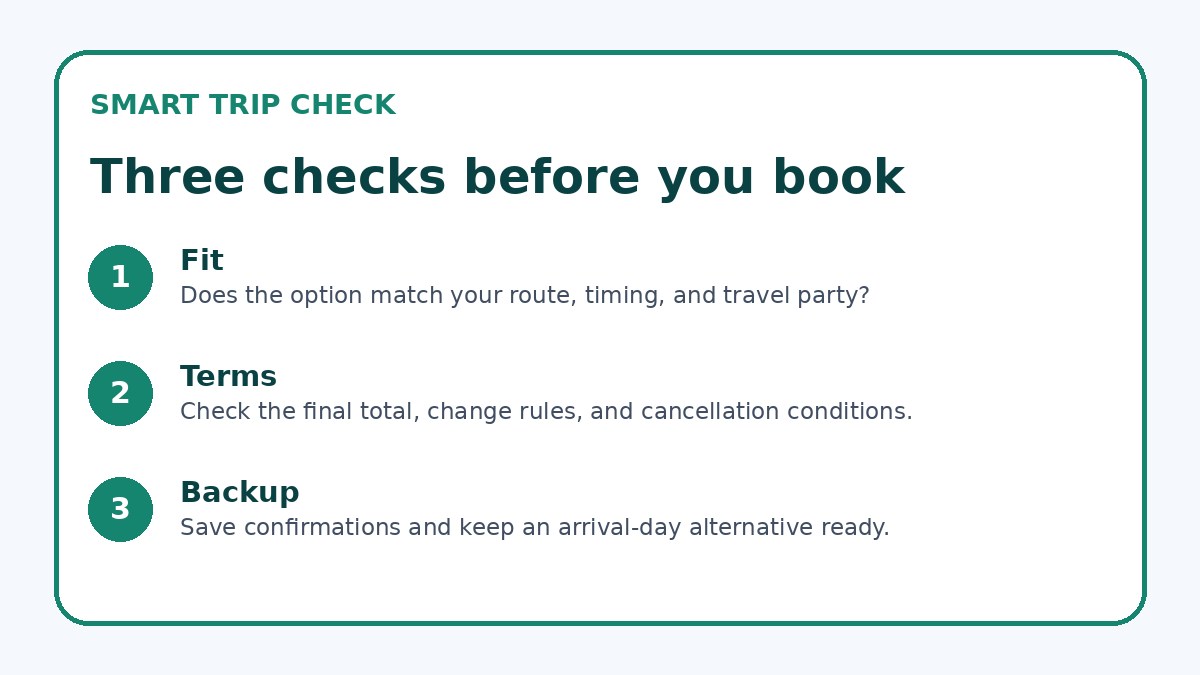
On the provider’s final booking page verify exact terminal names and addresses, baggage policy, where and when border control happens, and any required documents for crossing the border. Also check refund/change terms and whether tickets are transferable or allow rebooking. Confirm boarding rules — for example, curbside versus indoor check-in — and whether the operator provides assistance with luggage. If you want convenience, look for through-ticketing or services that explicitly mention minimal transfers; use Trip.com or provider sites to compare current availability, but always rely on the operator’s own terms for final details.
Final decision note
Choosing the best Vancouver to Seattle transport option comes down to door-to-door practicality: where your journey starts and ends, how many times you want to move between terminals, and how much buffer time you need. Map terminal addresses first, then weigh luggage handling and passport/customs steps before you book. If simplicity matters most, favor direct coach or train services that stop at central terminals; if you prioritize scenery and don’t mind extra steps, a ferry-inclusive or mixed plan can be rewarding. Whatever you choose, verify terminal details, baggage rules, and border-processing instructions on the provider’s booking page, save later same-day backups, and keep local transfer contacts handy so you can adapt if plans shift.
Continue planning
Check current options and final conditions
Use the provider page to confirm live availability, the final total, cancellation terms, and every condition that matters to your trip.
This evergreen planning guide was created with AI-assisted drafting and a structured quality review. It does not display live prices, schedules, availability, visa guidance, or provider rankings. Verify current details before booking. Some links are affiliate links; we may earn a commission at no additional cost to you.