If you're planning Toronto to Montreal transport for the first time, start by deciding whether rail or coach suits your end-to-end needs, then map each terminal-to-terminal transfer before you book. Trains and coaches both serve central stations but differ in where they drop you off in each city, how easy those stations are to reach from hotels, and how much time and effort luggage handling will add. This article gives a clear, practical approach: choose mode by terminal fit and door-to-door time, anticipate transfer friction with luggage, build in flexible timing, and prepare a simple disruption backup. Read on for criteria to compare options, realistic tradeoffs, and checklists that make booking and arriving smoother.
Choosing between train and coach: terminal fit and door-to-door time
Begin by mapping where each provider arrives and departs in both cities. A rail option may use a central station with direct transit links to downtown hotels, while a coach might stop at a bus terminal that is closer to suburban neighborhoods. For a true door-to-door comparison, estimate the time and cost of the transfer between each terminal and your lodging, including walking, local transit, rideshare, or shuttle options. Don’t assume identical convenience—what looks shorter on a map can take longer in practice when you include luggage handling and waiting times.
Think about the total travel window rather than just in-vehicle time. If a train saves twenty minutes on paper but drops you at a station unfamiliar to your host, that advantage can vanish. Conversely, a coach that stops near your hotel might keep you off busy city transit and save hassle. Use the terminal fit test: prefer the option where the terminal-to-hotel path is simplest, fastest, and offers minimal stairs or long corridors when you’re carrying bags.
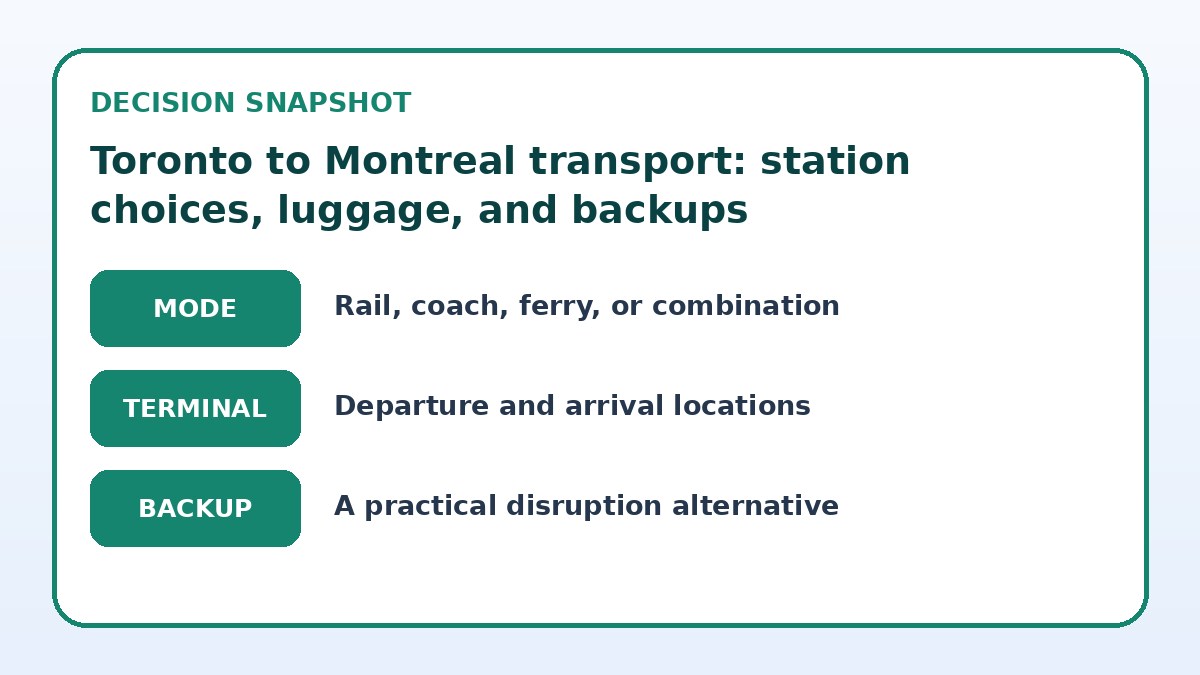
Choose the end-to-end journey plan
| Journey approach | Best for | Friction to check |
|---|---|---|
| Direct train to central station and short transit to hotel | Travelers prioritizing straightforward station-to-hotel transfers and fewer traffic variables | May cost more or require early arrival at a central terminal; verify terminal-to-hotel connections |
| Coach that drops near neighborhood or bus terminal | Those who value doorstep proximity to a specific area or lower station transfer needs | Terminal may lack step-free access or have fewer frequency options; check luggage handling policies |
| Combination: train into city then local coach or shuttle to suburb | Travelers whose destination lies outside main transit corridors and need last-mile coverage | Adds a transfer step and more luggage handling; requires precise timing and a backup plan |
| Flexible ticketing with buffer nights or day-of alternatives | Those who want scheduling flexibility and lower risk from disruptions | Typically requires more planning and possibly higher upfront cost; confirm change rules on provider pages |
Check live intercity options
Look beyond the ride itself and compare terminals, transfers, luggage, and arrival fit.
Luggage and transfer friction: what to pack and how to move it
Luggage affects every transfer. Evaluate how many pieces you’ll take, whether you can comfortably carry them between platforms or terminals, and if elevators or escalators are reliable at the stations involved. For heavy or bulky suitcases, prioritize routes with step-free access or on-site porters. If you plan connecting across different terminals (for example, central rail station to a coach terminal across town), factor in potential taxi or rideshare costs and the extra time required to collect and recheck bags.
When booking, check the provider’s luggage allowances on its official booking page and confirm how they handle oversize items; the booking page is the authoritative source for current rules. Also plan for small items you’ll want during the trip—keep them in a daypack or carry-on that’s easy to access. Packing lighter simplifies transfers, reduces the chance of missed connections, and gives you more flexibility if you need to change plans on the fly.
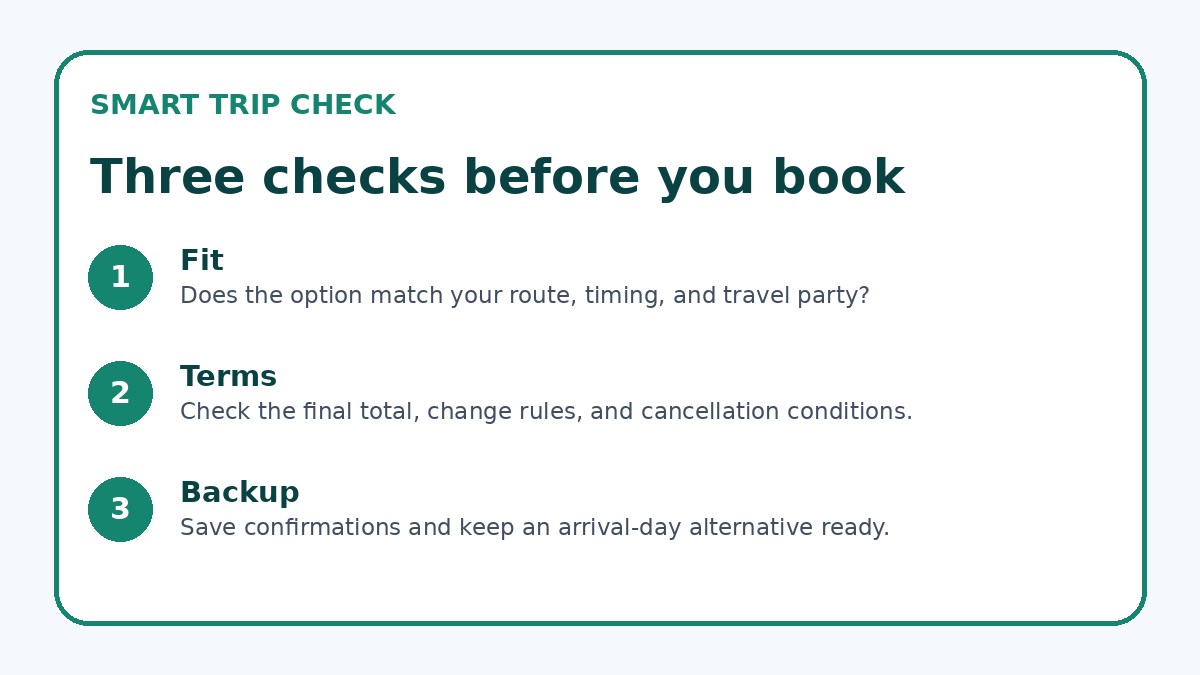
Timing flexibility: building buffers without wasting time
Build realistic buffers into your schedule. Allow extra time for peak-hour congestion, platform changes, and security or ticket checks. If your arrival connects with local transit or a pre-booked ride, add at least 20–40 minutes beyond scheduled arrival to account for minor delays and the time to collect luggage. For morning departures, plan earlier check-ins; for evening arrivals, factor in reduced transit frequency or longer ride-share waits.
Balance buffer size with convenience. If you don’t want to sit for long at a station, aim for options with reliable frequency so you can shift to the next departure without losing hours. Look for services that publish frequent departures or have flexible ticketing policies, but always verify those change and refund rules on the provider’s official pages before committing. A modest buffer reduces stress and often beats risking a missed connection when timing is tight.
Compare the practical alternatives
Use the final page to confirm what is actually offered on your dates and save a workable fallback.
Intercity travel checklist
- Map the exact arrival and departure terminals for each option and measure the transfer route to your lodging using a transit map or mapping app.
- Check luggage allowance and oversize-item rules on the provider’s official booking page and pack accordingly to avoid recheck delays.
- Reserve a rideshare or taxi app on your phone and preload payment details for a quick terminal-to-terminal transfer if needed.
- Save screenshots of alternate departure times and the local transit map so you can reroute without mobile data.
- Build a time buffer in your itinerary of at least 20–40 minutes beyond scheduled arrival to collect luggage and transfer between terminals.
- Note customer service contacts and the exact booking reference for your ticket so you can rebook or request assistance quickly.
Disruption backup: practical alternatives and how to prepare
Plan two concrete backups in case your chosen service is delayed or canceled. First, identify the next few departures on the same mode and another mode (train vs coach) and note their terminals. Second, know how quickly you can switch to a taxi or rideshare between terminals if needed. Keep screenshots or saved pages of alternate schedules and the local transit map on your phone; if you lose connectivity, a quick screenshot can save time and confusion.
Also prepare a simple budget and contact plan: set aside enough for one taxi or rideshare between terminals, and have your accommodation or meeting contacts informed about a possible late arrival. If you must rebook with the provider, go to their official booking page or customer service for the latest options; Trip.com can be used to compare availability but always confirm terms on the provider’s own site before changing tickets.
Rail & Intercity Transport questions travelers ask
Which station is best for arriving if my hotel is in downtown Montreal?
For downtown Montreal, choose the arrival option that lands you closest to your hotel on a practical, low-effort route. That means looking beyond distance: consider whether the terminal has elevators, a direct subway or tram link, or easy taxi access. Compare the time and steps from the terminal to your hotel rather than the map distance. Before booking, verify the exact station stop and the local transit connections on the provider’s official booking page to ensure the advertised stop aligns with your arrival plan.
How much extra time should I allow between a train arrival and a coach departure in Toronto?
Allow enough time to collect luggage, move between platforms or terminals, and reach the coach departure point, keeping peak traffic and elevator waits in mind. A practical window is larger than just the scheduled gap: aim for a buffer that suits your comfort level—typically at least 20–40 minutes for same-terminal transfers and more if you must cross the city. Always check real-time schedules and platform information on the provider’s booking and status pages before you travel, and have a rideshare option lined up if timing gets tight.
What’s the simplest backup if my train or coach is canceled en route?
The simplest backup is a short list of concrete alternatives: the next departures on the same mode, the next coach or train on a different line, and a rideshare or taxi plan to take you directly to your final destination. Keep those options easily accessible—screenshots, saved pages, or a small printed itinerary—and ensure you have payment methods ready. If you need to change a ticket, use the provider’s official booking channel for current rebooking rules; Trip.com can help compare alternatives, but confirm any change terms on the original provider’s site.
Final decision note
Planning Toronto to Montreal transport successfully comes down to thinking end-to-end: which terminal places you nearest your destination, how much luggage and transfer friction you’ll tolerate, and what buffers and backups you’ll accept. Choose the mode that minimizes time and effort between terminals and your final door, verify luggage and change rules on the provider’s official booking pages, and prepare concrete alternatives in case of disruption. With a simple checklist, saved backup options, and realistic timing cushions, first-time travelers can turn a multi-step transfer into a predictable, manageable part of the trip.
Continue planning
Check current options and final conditions
Use the provider page to confirm live availability, the final total, cancellation terms, and every condition that matters to your trip.
This evergreen planning guide was created with AI-assisted drafting and a structured quality review. It does not display live prices, schedules, availability, visa guidance, or provider rankings. Verify current details before booking. Some links are affiliate links; we may earn a commission at no additional cost to you.