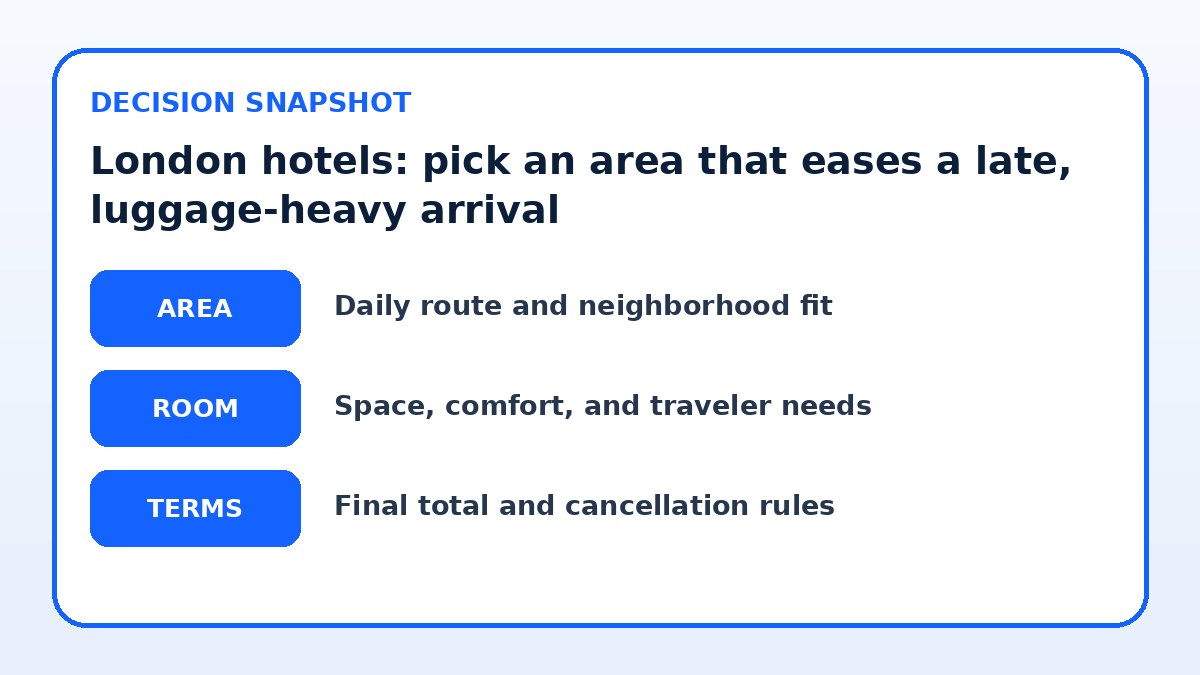
If you arrive in London late and are carrying extra or oversized luggage, prioritise your hotel area first: choose somewhere with straightforward onward options, 24-hour access or easy late check-in, and nearby short-term storage or transport choices. For many travellers that means choosing an arrival-friendly neighborhood near a major rail link or an airport coach stop, or a quieter area with straightforward taxi or rideshare access. This article gives the quick answer up front—which areas fit different needs—and then unpacks daily-route friction, the right room setup for luggage, and what to verify on booking pages. By the end you’ll be able to shortlist one neighbourhood approach (central-transfer hub, airport-adjacent, quieter residential close-by, or flexible-nightlife zone) before you search live inventory or contact hotels directly.

Check live stays in the areas that fit
Use your dates and party size to compare current rooms after you narrow the neighborhood fit.
Neighborhood fit: choose by arrival method and onward plans
Start by matching your arrival mode to nearby neighbourhoods. If you arrive at Heathrow or Gatwick late, an airport-adjacent district or a hotel near the express coach or rail link reduces extra transfers. If you land at a city-centre airport or arrive by Eurostar, favour hotels near the arrival station so you can reach your room quickly. For late evening flights followed by a taxi or rideshare, quieter residential neighbourhoods with good night-time access can be calmer and easier for dropping bags immediately.
Consider what you need the morning after arrival. If you plan to head into central London early, staying close to a Tube or National Rail station reduces morning friction. If you’ll spend the day moving through museums or meetings with large luggage, pick an area with short-term luggage services, nearby left-luggage facilities, or hotels that explicitly store bags until pickup. Match the area to both your arrival and your first-day itinerary to avoid unnecessary backtracking.
Choose an area-selection strategy
| Area approach | Best for | Tradeoff to check |
|---|---|---|
| Stay near a major rail/coach hub (Victoria, Paddington, St Pancras) | Minimum transfers after late train or coach arrival | Can be busy late at night and less peaceful for sleeping; hotel prices may reflect proximity. |
| Airport-adjacent hotel (near Heathrow/Gatwick links) | Late flights with short onward commute and minimal handling of luggage | Further from central attractions; may require extra travel time the next day. |
| Residential neighbourhood near good night-time taxi access | Calmer arrival, easy drop-off, and quieter sleep for families | Less immediate public-transport connectivity; morning travel may take longer. |
| Central nightlife or 24-hour service area (Soho, King’s Cross vicinity) | Flexible late-night arrivals and late check-in options | Noise and foot traffic can affect rest; sidewalks and entrances may be crowded. |
Daily-route friction: transport, stairs, elevators, and carrying distance
Think beyond distance on a map: measure friction. How many public-transport changes will you make with heavy suitcases? Does the station have lifts or step-free access between platforms and entrances? Some London stations and interchanges still have stairs or limited lift access—verify step-free routes if you plan to use trains with luggage. If your arrival is late and you prefer a taxi, confirm whether the hotel has a practical drop-off point and an unobstructed route to the reception or entrance.
Also factor in building-level obstacles at the hotel: older buildings in central London sometimes have narrow stairs and no elevator to upper floors. If you need easy in-room access, filter for ground-floor or lift-served rooms, or ask the hotel about porter service and bulk-bag handling. Where short-haul transfers are unavoidable, consider a neighbourhood with frequent, late-night transport options to minimize the time you spend lugging bags outdoors.
Now compare like with like
Keep the same dates, guests, room needs, and cancellation preferences while you compare the final choices.
Room and party needs: space, bed layout, and luggage storage
Decide whether to prioritise extra floor space or additional sleeping capacity. For two people plus several large suitcases, a larger double or a twin room with clear floor area will keep suitcases out of walkways. If you’re travelling with family or a small group, a room with an extra bed or a connecting room can let you keep luggage in one place while others sleep undisturbed. Specify your need when booking and ask the hotel how they stage bulky items during housekeeping.
If you expect to leave luggage for a few hours or a full day, confirm secure storage availability and any restrictions on oversized items. Some hotels accept last-minute oversized bags but may charge or require pre-arrangement; always verify on the hotel’s booking page. Consider also whether you should book an early checkout with storage until evening, or choose a hotel that coordinates with private luggage-storage services nearby for pick-up later.

Hotel booking check before payment
- Confirm the hotel’s official late check-in procedure and exact key collection instructions on its booking page or by email.
- Ask the hotel whether they provide secure luggage storage for oversized items and whether there are size or time limits.
- Request a room on a lower floor or with lift access if you need easy in-room access for heavy bags.
- Verify drop-off and pickup logistics: is there a practical taxi/drop-off point and an unobstructed route to reception?
- Check cancellation and modification terms in case your arrival time shifts and you need to change the reservation.
- Save contact details for the hotel and the local luggage-storage services near your chosen neighbourhood.
Booking terms and verification: what to check before you confirm
On a hotel’s booking page check three essentials: the exact late check-in process (key collection, 24-hour desk, or lockbox), the luggage storage policy (hours, size limits, and any charges), and access details (step-free entrance, lifts). Don’t rely on generic descriptions—look for the property’s own text and contact them directly if you need clarification. If the hotel lists a third-party agent or partner for arrivals, verify how you will reach the agent and where you will pick up keys.
Also confirm cancellation or modification flexibility if your late arrival might change, and read the section about extra guests or rollaway beds if you need more sleeping space. For transfers linked to your booking (airport shuttles or arranged taxis), always check the provider’s terms and how late they operate. If you want to compare current availability and specific offerings, Trip.com is an optional place to check inventory and provider pages, but always verify details on the hotel’s own site before finalising.
Hotel Guide questions travelers ask
How late can I expect London hotels to accept check-ins, and what if I arrive after reception closes?
Many hotels in London offer late check-in or 24-hour receptions, but policies vary. Some properties use key safes, lockboxes, or partner desks for after-hours arrivals. Always read the hotel’s check-in policy on the booking page and contact the property to confirm how they handle arrivals after a specified hour. If the hotel requires advance notice for late check-in, tell them your expected arrival time. If information is unclear, ask for step-by-step arrival instructions and a mobile contact number for the night staff.
Can I store oversized or extra luggage at a London hotel if I arrive late and need to sightsee the next day?
Many hotels will store luggage for guests before check-in or after checkout, but rules differ on oversized items and time limits. On the booking page look for luggage-storage policies and any notes about size, liability, or fees. If you rely on this service, contact the hotel ahead of arrival to confirm they accept oversized suitcases and how to label or sign for stored items. As a backup, identify nearby paid luggage-storage facilities; make sure to check their hours and pick-up procedures before you plan your day.
Should I choose a station-adjacent hotel or a quieter residential area if I arrive late with multiple bags?
If your priority is minimizing transfers immediately after arrival, a station-adjacent hotel is usually best because it reduces walking and handling. If you value calm and easier taxi drop-offs, a residential neighbourhood with straightforward night access may be preferable. Balance the morning-after plan as well: staying near transport helps if you have an early start, while residential areas may increase morning travel time. Decide based on whether you value immediate convenience on arrival or quieter rest and then confirm access and storage details with the hotel.
Final decision note
When handling a late arrival to London with extra luggage, pick the neighbourhood first: match the hotel area to your arrival method and morning plans. Prioritise step-free access, clear late-check-in procedures, and secure luggage storage. Decide whether you want minimal transfers (station or airport-adjacent) or a quieter drop-off (residential zone), and then filter rooms for extra floor space or lift access. Before you book, confirm the hotel’s exact late-arrival instructions, luggage rules, and any advance-notice requirements on the provider’s page. With the neighbourhood shortlisted and those checks complete, you’ll be ready to compare live hotel inventory with confidence.
Continue planning
Check current options and final conditions
Use the provider page to confirm live availability, the final total, cancellation terms, and every condition that matters to your trip.
This evergreen planning guide was created with AI-assisted drafting and a structured quality review. It does not display live prices, schedules, availability, visa guidance, or provider rankings. Verify current details before booking. Some links are affiliate links; we may earn a commission at no additional cost to you.