If your priority is seeing Gyeongju’s scattered heritage sites and rural coastlines efficiently, renting a car can improve flexibility—but only if you choose the pickup location that fits your plan. For first-time visitors the practical answer is: pick up at the airport if you arrive late, plan long day trips, or want one-way convenience; pick up in town if you’ll stay mostly inside central Gyeongju, want to avoid extra airport queues, or prefer a shorter initial drive. Below I’ll outline the key tradeoffs: how much distance and time you actually save, what to read in the insurance wording, how pickup and return friction affects your schedule, and reliable fallback mobility if you decide not to drive. Use these criteria to match vehicle pickup to your itinerary rather than defaulting to whichever option looks easiest at booking.

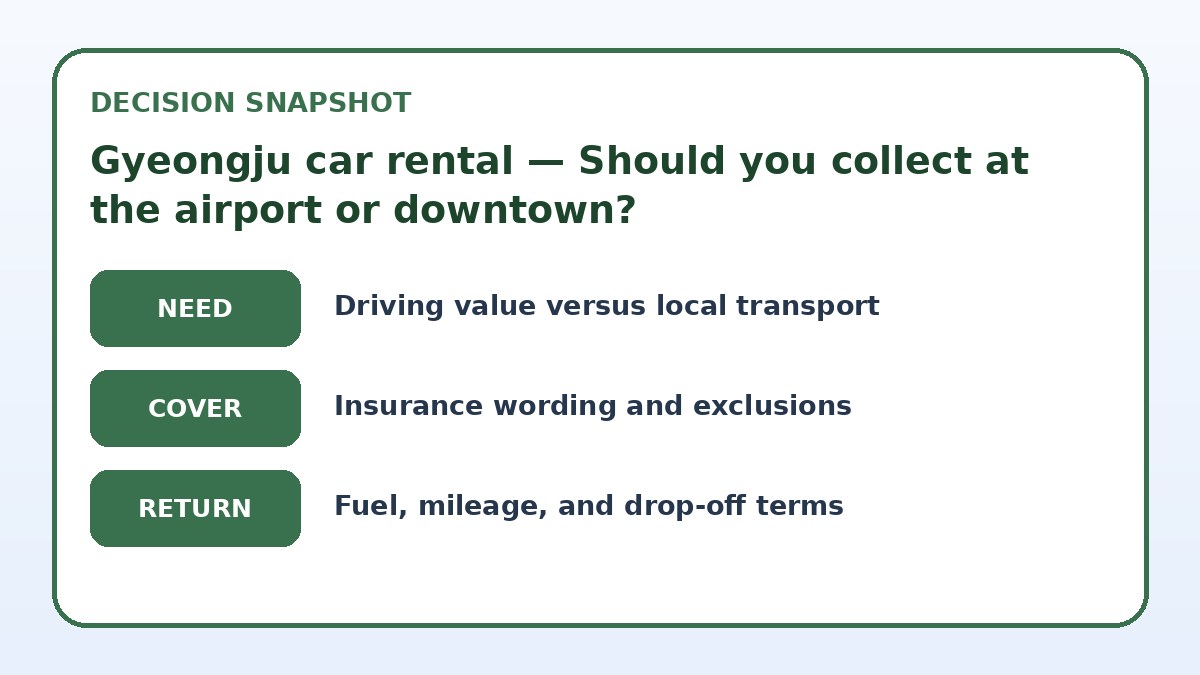
Does driving add value to a first trip in Gyeongju?
Driving gives clear advantages when your plan includes multiple dispersed sites—such as Bulguksa and Seokguram, outlying burial mounds, coastal spots near Pohang, or rural temple roads where buses run infrequently. If your itinerary clusters around the historic centre, museums, and nearby tumuli, much of that area is walkable or well served by local buses and short taxi rides. Evaluate the time you’d spend waiting and transferring on public transport against the time you’d spend parking, navigating unfamiliar roads, and paying tolls. Consider how much spontaneity matters to you: if stopping at a scenic overlook or changing the route mid-day is important, driving delivers that flexibility.
Also weigh driving comfort in a country where signage, lane discipline, and parking norms may differ from your home country. Night driving outside the city in rural Gyeongju can feel isolated, and GPS coverage is essential. If you prefer not to drive on unfamiliar highways, factor in travel stress as a real cost. Ultimately ask: does a rental reduce total travel time and increase site access enough to justify the added logistical and cognitive load of driving? Use that answer to pick a pickup location that best supports the driving choice you make.
Decide whether driving earns its place
| Mobility strategy | Best for | Cost or friction to check |
|---|---|---|
| Airport pickup and return (drive entire trip) | Arrivals with luggage who want immediate mobility and multi-day routes starting from arrival point | Longer airport procedures, possible shuttle transfers, and stricter return timing tied to flight schedules |
| City pickup and return (rent in Gyeongju centre) | Short stays focused on central sites, travelers who prefer easier handovers and central parking | Requires transfer from the airport into town and may add driving time for outlying attractions |
| One-way rental (pickup at airport, return in city or vice versa) | Linear itineraries that end in a different city or when avoiding a round trip to the airport | Often higher drop-off fees and more complex booking; verify one-way availability and charges before booking |
| No car (public transport, taxis, and tours) | Visitors staying mainly in the historic core or those who prefer avoiding driving in unfamiliar traffic | Less flexibility for remote sites and reliance on schedule-based services; may increase travel time between distant spots |
Check live rental choices only after the route test
Use the exact driver, dates, pickup point, and return plan to compare current conditions.
Insurance wording and what to verify before you book
Insurance language often determines whether a rental is useful or risky. Look for explicit wording about third-party liability limits, collision damage waiver (CDW) scope, and whether deductible amounts are refundable or can be fully waived. Confirm whether roadside assistance is included and whether it covers tyre, battery, or fuel issues. Pay attention to geographic restrictions—some contracts restrict travel across prefectural lines or on unpaved mountain roads, which matters if you plan a day trip beyond North Gyeongsang Province. If damage to glass, tyres, or undercarriage is excluded, decide if you need supplemental coverage.
On the final booking page of a provider you must verify: the exact deductible amount, whether theft protection is included, what documentation is required for claims, any age-related driver surcharges, and if additional drivers are permitted and insured. When comparing offers, don’t rely on headlines—open the full policy PDF or terms and read for exclusions and claim procedures. If the wording is unclear, ask the provider directly and save written confirmation. Trip.com can be used to compare current availability and conditions but verify the insurance wording on the rental company’s contract page before accepting.

Compare the full rental conditions
Confirm insurance wording, exclusions, deposit, fuel, mileage, and return terms on the final page.
Pickup and return friction: airport versus downtown
Airport pickup often looks simpler on paper—collect a car as soon as you land and drive on. In practice, airports introduce extra steps: shuttle transfers to offsite depots, longer queues at the counter, and luggage handling between terminal and lot. Returning to the airport may require stricter timing because flights demand buffer time for check-in and security. If your arrival or departure falls during off-peak hours, airport counters may be closed or operating reduced hours, so verify counter opening times and after-hours collection or drop-off procedures on the rental page.
City pickup typically means shorter formalities and easier access to central hotels, with many downtown outlets offering simpler handovers and flexible returns. Picking up downtown can avoid airport congestion, but you may need an extra transfer from the airport to the city by bus, train, or taxi—so factor that cost and time. Also check where free parking is available at both pickup locations and whether the company charges for one-way drop-offs if you plan to return at a different site. Confirm exact pickup/return addresses and any shuttle or key-box procedures before you commit.
Car rental terms to verify
- Read the full rental terms and insurance PDF; confirm deductible amounts, excluded damage types, and roadside assistance coverage.
- Verify pickup and return addresses, counter hours, and after-hours procedures for both airport and city locations before booking.
- Check whether the rental allows travel to your planned sites (coastal roads, mountain temples) and if there are geographic restrictions.
- Compare one-way drop-off policies and fees if you plan to return the vehicle at a different location.
- Confirm driver eligibility requirements: age limits, required ID, license acceptance rules, and any additional driver fees.
- Plan your non-driving fallback: note key bus/train timetables, taxi ranks, and at least one guided tour that covers a hard-to-reach site.
Non-driving alternatives and when to choose them
If you decide against driving, Gyeongju still offers reliable alternatives. The city core is compact and bike-friendly in places; taxis are plentiful for shorter hops; and regional trains or intercity buses link Gyeongju with Busan, Daegu, and Pohang. Guided day tours can reach remote sites that are otherwise awkward by public transit. For visitors uncomfortable with rural driving or unfamiliar traffic rules, these options reduce stress and eliminate insurance worries.
Decide to skip a car when the bulk of your itinerary centers on the historic district, when you plan single-day, fixed-schedule guided tours, or when your group size fits public transport comfortably. When using alternatives, plan connections carefully: check last bus and train times, reserve taxis for early starts, and verify pickup points for tours. Keep a simple contingency fund for occasional taxis if a bus schedule changes. Ultimately, the right choice balances convenience, cost, and how much control you want over timing and routes.
Car Rental & Road Trip questions travelers ask
Will picking up a car at the airport save me time compared with collecting in Gyeongju city?
It depends on your arrival time and itinerary. Airport pickup saves the transfer from the terminal to the city if you plan immediate travel or multiple out-of-town stops. However, airports often require extra time for shuttles, counter queues, and luggage handling, which can offset that advantage. If your arrival coincides with off-peak hours downtown or you intend to stay chiefly inside the historic core, picking up in the city may be faster overall. Check counter opening times and any required shuttle transfers before choosing.
What insurance items should I prioritize when booking a Gyeongju car rental?
Prioritize clear liability limits, the scope of collision damage waiver (CDW), deductible amounts, and whether theft protection and roadside assistance are included. Look for explicit language about what is excluded—glass, tyres, undercarriage, and off-road damage are commonly excluded in many contracts. Also verify whether coverage applies across different prefectures and how claims are handled. Always save screenshots or PDFs of the contract and confirm unclear points with the provider in writing before collection.
If I change my mind and decide not to drive, how easy is it to switch to public transport in Gyeongju?
Switching to public transport is straightforward for most core sightseeing in Gyeongju. The city centre is compact and connected by local buses and frequent taxis; trains and intercity buses connect to major nearby cities. For remote sites, you may need to rely on prebooked guided tours or plan longer transit times using combinations of bus and taxi. If you’ve already booked a rental, check cancellation or modification policies on the booking page and arrange onward transport options before cancelling to avoid gaps in your itinerary.
Final decision note
For first-time visitors to Gyeongju the right choice depends on where you plan to go and how comfortable you are driving in unfamiliar conditions. Airport pickup suits arrivals that immediately need mobility, multi-site day trips, or one-way itineraries; downtown pickup reduces initial driving stress and is more convenient if you stay mainly in the historic core. Always read the insurance wording, verify pickup/return procedures and fees, and plan a non-driving fallback if needed. Use the criteria above to match pickup location to your priorities rather than defaulting to convenience at booking; when in doubt, double-check policy details on the rental provider’s final page before confirming.
Continue planning
Check current options and final conditions
Use the provider page to confirm live availability, the final total, cancellation terms, and every condition that matters to your trip.
This evergreen planning guide was created with AI-assisted drafting and a structured quality review. It does not display live prices, schedules, availability, visa guidance, or provider rankings. Verify current details before booking. Some links are affiliate links; we may earn a commission at no additional cost to you.