If you need a practical answer right away: choose the mode and ticket that match how fixed your schedule is, how much luggage and walking you can handle, and how willing you are to accept transfer complexity. For many solo travelers the shinkansen-style rail (or fast intercity train) with a refundable or exchangeable ticket balances low transfer friction and simple terminals. If you prefer lower cost and tolerate longer rides, coach tickets with flexible change policies can work, but factor in drop-off locations and luggage limits. Ferries are occasional alternatives for parts of the route or scenic combinations but usually add more time and transfer planning. This article compares flexibility across rail, coach, ferry, and mixed journeys, focusing on terminal fit, luggage and transfer friction, timing flexibility, and what to do if something goes wrong en route.
Terminal fit and door-to-door practicality
Terminal fit means more than a station name on a ticket. For rail, major Osaka stations (check which one your departure ticket names) typically connect to local metro and taxi options, reducing door-to-door friction. In Hiroshima, arrival stations are usually close to city transit, but not every train stops at the same platform or exit; check which station exit links to your accommodation so you know whether a short walk, local tram, or taxi is needed. Coach terminals may sit outside central districts; that can add a local transfer even when the ride itself is cheaper.
Ferries require extra attention to port access and last-mile options. Ports can be farther from central hotels and may have limited public transport late at night. When comparing tickets, map all terminal addresses and estimate door-to-door travel time, not just in-transit time. For solo travelers with big bags, prefer tickets that arrive at terminals with elevators, clear signage, or frequent taxis; verify terminal facilities on the operator’s final booking page before you commit.
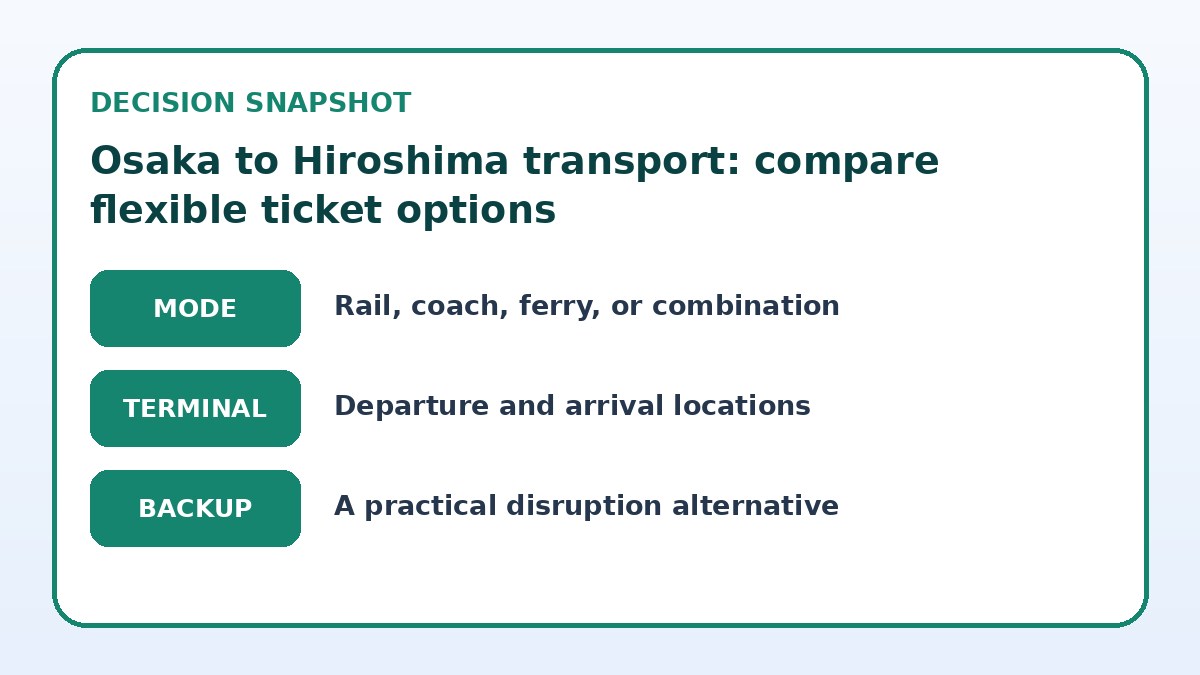
Choose the end-to-end journey plan
| Journey approach | Best for | Friction to check |
|---|---|---|
| Flexible single-mode rail ticket (train only) | Solo travelers prioritizing low transfer friction, short door-to-door time, and straightforward rebooking. | Often costs more than non-flex options and may require booking in advance to secure seats on busy services. |
| Flexible coach ticket (bus only) | Cost-conscious solo travelers who accept longer travel times and can manage fewer onboard amenities. | Longer rides and potentially distant terminals increase transfer and luggage friction despite more flexible change policies. |
| Ferry-inclusive route | Travelers seeking a scenic or mixed-experience route who can tolerate additional transfers and schedule constraints. | Typically increases total door-to-door time and requires careful coordination of port transfers and luggage handling. |
| Mixed-mode itinerary (rail + coach/ferry) | Solo travelers balancing cost and schedule who are comfortable with extra transfers for better routing or prices. | Adds complexity: more handoffs, higher disruption risk, and the need to verify multiple operators’ change and refund rules. |
Check live intercity options
Look beyond the ride itself and compare terminals, transfers, luggage, and arrival fit.
Luggage, transfers, and physical friction
Luggage rules and transfer friction often decide the best ticket more than schedule differences. Trains and coaches have different typical allowances — some coaches store large suitcases under the coach, others limit onboard storage. If you have one large suitcase and a daypack, prioritize tickets that explicitly list generous luggage allowances or allow easy checked baggage at the terminal. Also factor in the number of transfers: a direct train ticket that gets you off at a central station is less physically taxing than a cheaper option forcing multiple tram or bus changes.
When mixed modes are under consideration, assume more handling. Every time you move between platform, bus terminal, or ferry pier you add steps, waiting time, and risk of misplaced items. For solo travelers, that means favoring fewer handoffs unless you’re comfortable with extra time and navigation. If you expect to travel in off-peak hours or have mobility constraints, verify station elevator availability, ramp access, and whether staff assistance can be arranged on the operator’s final booking page.
Timing flexibility and ticket-change policies
Look for tickets that match how rigid your dates and times are. Fully flexible tickets let you swap departure times or get a partial refund with minimal fees; semi-flexible options allow changes but with restrictions like date-bound reissue windows. Fixed, non-changeable tickets are usually less expensive but riskier if your plans might shift. For solo travelers, a modest premium for easy changes can be worth the stress saved, especially when tight connections or evening arrivals are involved.
Always read the change and refund rules on the provider’s final booking page. Confirm whether ticket exchanges require visiting a counter versus online rebooking, whether changes are permitted on the day of travel, and how refunds are calculated. If you plan multiple legs with different providers, understand how one leg’s delay might invalidate a separate ticket — sometimes flexible multi-operator arrangements or a single provider covering several legs reduces that complexity.
Compare the practical alternatives
Use the final page to confirm what is actually offered on your dates and save a workable fallback.
Intercity travel checklist
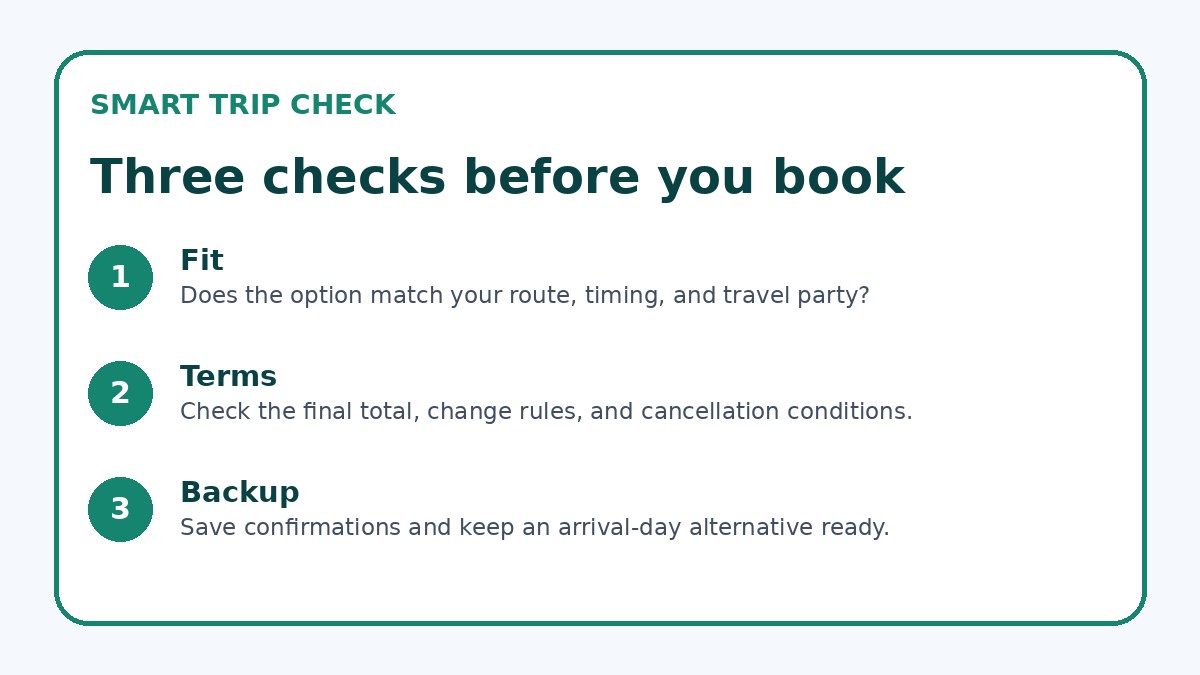
- Map the exact departure and arrival terminal addresses and estimate door-to-door time including local transit or taxi.
- Confirm luggage allowances and handling procedures on each provider’s final booking page before purchasing.
- Read the ticket change and refund policy carefully and note how to request an exchange (online, phone, or counter).
- Check elevator, escalator, and staff-assistance availability at terminals if you have a lot of luggage or mobility needs.
- Identify at least two backup departure options and the process to rebook if your original leg is delayed or canceled.
- Keep digital and printed copies of tickets, receipts, and contact numbers for each operator to speed up disruption response.
Disruption backup: what to do when plans change
Prepare a clear backup plan before you leave: build time cushions into itineraries, locate alternative departure options, and pre-check local taxi or rideshare services reachable from each terminal. If you hold a flexible ticket, identify the quickest change route (online change, phone, or service counter). If disruption occurs, act early — rebooking sooner usually preserves more seat options and better alternatives. For solo travelers, a simple decision rule helps: if you miss a connection, prioritize the next direct service to minimize transfers.
When combining modes, account for how a delay on one leg affects the rest. If a bus delay means missing a connecting ferry, know which operator covers the subsequent leg and whether they accept proof of delay for a free transfer or reissue. Keep digital copies of tickets, receipts, and contact numbers. You should verify policies for delay protection or rebooking directly on provider pages and consider adding travel insurance that covers missed connections and sudden cancellations for an extra layer of protection.
Rail & Intercity Transport questions travelers ask
Is the train usually the most flexible way to travel between Osaka and Hiroshima?
Trains often offer the best balance of low transfer friction and frequent departures, which most solo travelers find convenient. However, ticket flexibility depends on the fare class or ticket type you buy: flexible or refundable train tickets let you change times with fewer penalties, while deeply discounted train fares can be restrictive. Always check the provider’s exact change and refund terms on the final booking page. If you need late changes often, compare flexible train options against flexible coach tickets to see which fits your tolerance for transfer walking and overall door-to-door time.
Can mixing modes increase ticket flexibility or make disruptions worse?
Mixing modes can sometimes increase practical flexibility—for example, adding a coach leg that offers easy same-day rebooking—but it usually increases the number of operators and rules you must manage. That means more points of failure: a delay on one leg can ripple and make rebooking the next harder. If you opt for a mixed itinerary, verify each operator’s change policy on their booking pages and consider whether a single-provider through-ticket (if available) or travel insurance would simplify rebookings after disruptions.
What should solo travelers verify on the booking page before they pay?
Before buying, confirm the exact station or terminal names and addresses, luggage rules and sizes allowed, the ticket’s change/refund policy including any fees and deadlines, and whether seat reservations are included or optional. Also check whether rebooking can be done online or requires visiting a counter, and whether there are blackout times or date restrictions. If you plan connections, verify whether operators recognize delays from other services for free reissue or require proof to process changes.
Final decision note
Choosing the right ticket for Osaka to Hiroshima hinges on how fixed your schedule is, how much luggage and walking you can accept, and how comfortable you are juggling transfers. For straightforward door-to-door journeys, flexible single-mode rail tickets usually minimize physical friction and simplify rebooking. Coach options can be flexible and economical but add travel time and possible terminal transfers; ferries or mixed-mode itineraries suit travelers who prioritize experience over speed. Before booking, map terminals, confirm luggage rules, and read change/refund policies on the provider’s final booking page. If unsure, a slightly more flexible ticket or travel insurance gives solo travelers breathing room when plans change.
Continue planning
Check current options and final conditions
Use the provider page to confirm live availability, the final total, cancellation terms, and every condition that matters to your trip.
This evergreen planning guide was created with AI-assisted drafting and a structured quality review. It does not display live prices, schedules, availability, visa guidance, or provider rankings. Verify current details before booking. Some links are affiliate links; we may earn a commission at no additional cost to you.