If you need to travel from Dubai to Doha for business, the most practical early question is whether you should prioritize a flexible fare or the lowest upfront price. For short business trips the tradeoff is clear: flexible tickets or refundable fares reduce stress and allow schedule changes, but they often come with higher base fares or different baggage allocations. Your decision should start with exact travel dates, whether you expect meeting changes, and which company card or travel policy will pay for the ticket.
Before you search live inventory, gather passenger names as on passport, preferred travel windows, and whether you require immediate exchanges or refunds for last-minute cancellations. Check both direct and connecting options where available, and prepare to verify the airline’s change fees, refund process, fare rules, and any required documentation on the provider’s final booking page. Trip.com can be used once to compare current availability and conditions, but treat any supplier page as definitive.

See live routes for your exact travel day
Compare direct and connecting choices with the same baggage and traveler details.
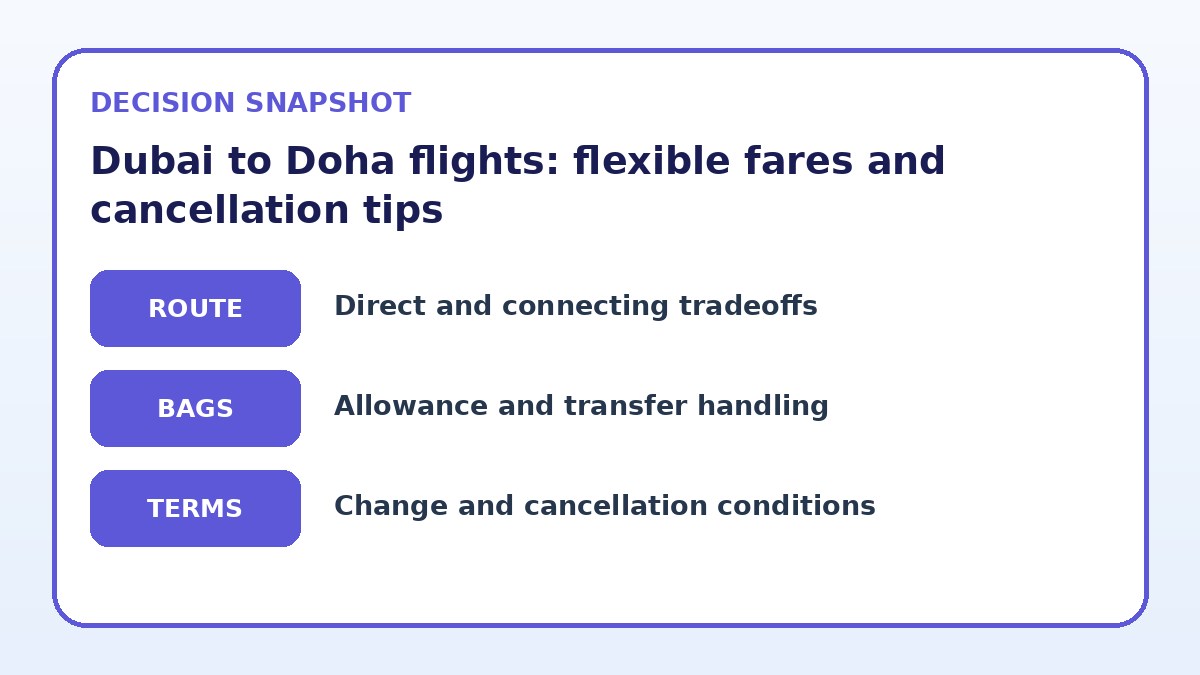
Routing: direct versus connecting options
On the Dubai to Doha corridor you’ll commonly find direct services and occasionally connecting itineraries depending on carrier schedules. For business travelers the key consideration is connection risk: a direct flight reduces the chance of missed meetings due to long layovers, transfer delays, or misdirected luggage. If your company policy penalizes missed meetings, prioritize direct routing even if the fare is higher. Conversely, if you have a large cushion between meetings and saving costs is required, a connecting option can be reasonable—provided you evaluate the connection time and the reliability of the transfer airport.
When comparing routing choices, inspect how carriers handle disruptions for each itinerary. For direct flights check the change/reissue terms related to the fare class; some flexible classes explicitly allow free or low-cost changes within a set period, while the cheapest classes may not. For connecting itineraries, determine whether the entire ticket is protected by a single carrier or itinerary code-share: single-ticket connections often include re-protection if a missed connection is airline fault, but separate tickets generally do not. Verify these details on the final booking confirmation and the airline’s contract of carriage.
Baggage and connection risk for business travelers
Baggage allowances are part of the fare bargain and matter more for business travelers who carry briefcases, laptop bags, and conference materials. Lower fare buckets can exclude checked baggage or limit weight and dimensions; this forces either paying at booking or risking higher airport fees. If your itinerary involves a tight connection—especially when switching carriers or terminals—checked bags may miss the connection and arrive late. For short Dubai–Doha trips some travelers get by with carry-on only, but always confirm your firm’s baggage policy and the carrier’s allowance before booking.
Connection risk also includes the time needed for immigration and security when transferring versus staying airside. If a connecting itinerary requires you to exit and re-enter through immigration, that increases risk and potential delay, which is critical for same-day business schedules. For multi-segment trips check whether bags are tagged through to the final destination or need re-checking. If you require guaranteed same-day arrival with all luggage, favor direct services or single-ticket connections with adequate minimum connecting time published by the carrier; verify specifics on the booking page and in the airline’s baggage policy.
Compare flight-selection strategies
| Flight strategy | Best for | Risk to check |
|---|---|---|
| Flexible refundable fare | Travelers who expect itinerary changes or require peace of mind | Higher upfront cost and potentially different baggage terms |
| Semi-flex fare with change fee waived under some conditions | Those who want lower cost than refundable tickets but may change plans | May still require fare difference and have specific time windows for free changes |
| Lowest non-refundable fare | Fixed schedules with no expected changes and tight budget control | Little to no refund or free change options; added cost if plans shift |
| Connecting multi-ticket savings strategy | Cost-focused travelers willing to accept connection and rebooking risk | Higher risk of missed connections and separate-ticket denial of protection |
Recheck the complete itinerary
Confirm airports, connection handling, baggage, and change conditions before deciding.
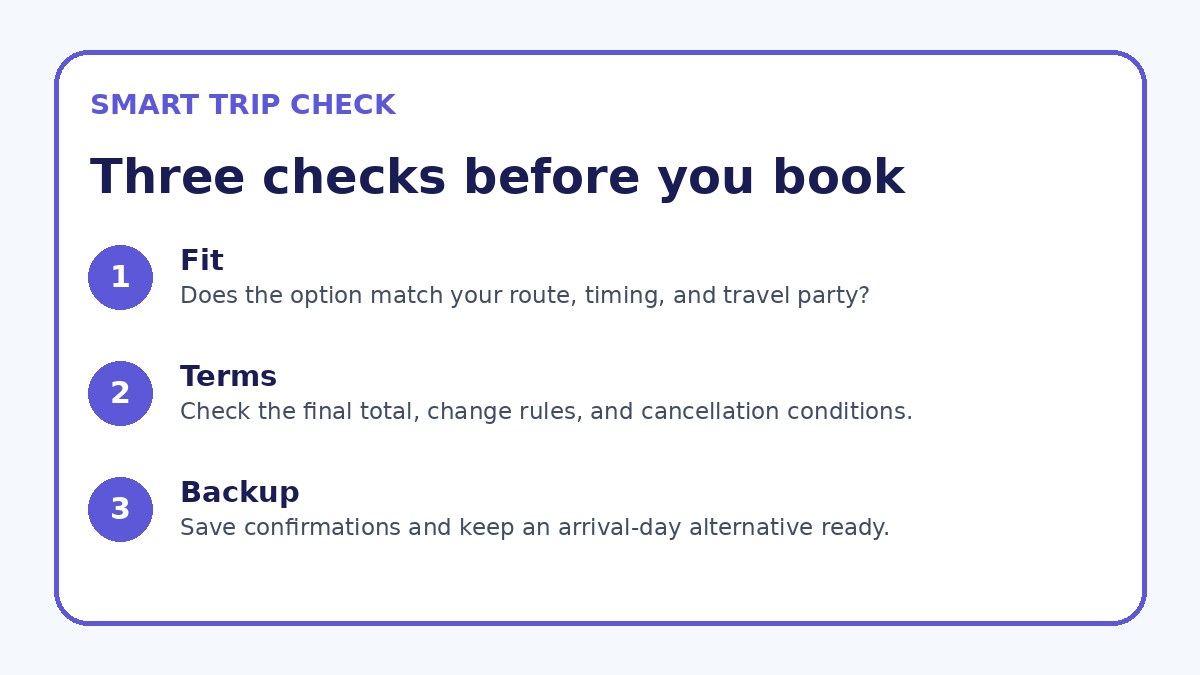
Schedule fit: aligning flights with meetings and buffers
A successful business trip tightens around how flights fit your meeting schedule. Start with the absolute earliest departure you can accept and the latest arrival you can accept; build in buffers for delays, ground transport, and any pre-meeting preparation. If meetings in Doha begin early, an overnight flight or early-morning service that lands with enough time before the first appointment is essential. Consider time-of-day factors: morning flights are less likely to be delayed than late-night departures in many markets, but verify this against current carrier schedules before booking.
Also weigh return flexibility. If your meeting could create a same-day change, a flexible outbound or return fare class may prevent expensive reissue fees. Confirm the minimum connection times and any airport transfer durations so you don’t book back-to-back meetings too tightly. For multi-leg itineraries, choose connections that allow recovery time between segments; for direct options, check the airline’s on-time performance policies and change fee structure on their final booking page to ensure the schedule you select aligns with your tolerance for disruption.
Flight details to verify
- Record exact traveler name as on passport, preferred travel dates, and mobile contact before searching fares.
- Screenshot or save the fare rules and refund/change policy from the airline’s final booking page for expense reporting.
- Compare baggage allowances for each fare class and add checked baggage online if your policy requires it.
- Confirm minimum connection times, whether your bags are through-checked, and if airport transfers require re-clearing immigration.
- Check how refunds or credits are issued and the expected processing timeline listed by the carrier.
- If booking through an agency, verify who handles reissues and what phone number or portal your company must use for changes.
Fare conditions: penalties, refunds, and reissue rules
Fare rules determine your actual flexibility. Look for explicit language about rebooking fees, fare difference payments on changes, and refundability. Some business-friendly fare classes permit changes with only the fare difference due or a small administrative fee, while others impose percentage-based penalties or block refunds entirely. For refunds also verify whether the airline issues cash refunds, credit vouchers, or travel bank credit, and what timelines and forms are required for processing. Always download and save the fare rules PDF from the provider’s booking page for future reference and expense reporting.
When reviewing conditions, check the allowed change window and whether name corrections or itinerary changes are permitted without full reissue. Also confirm involuntary change protections: if the airline cancels or materially changes flight times, many carriers will re-accommodate or refund, but the exact remedies differ. For corporate bookings check whether your travel policy or corporate agreement with the carrier overrides standard retail rules. Before confirming any purchase, verify refund processing time, any administrative fees, and whether changes can be made online, by phone, or must be completed at the airport.
Flight Guide questions travelers ask
Should I always pick a refundable fare for short business trips between Dubai and Doha?
Not always. Refundable fares provide maximum flexibility, which is valuable if meetings are subject to change. But refundable tickets cost more and your company might restrict their use. If your schedule is firm and your company prefers cost control, a semi-flex fare or the cheapest fare with travel insurance may be appropriate. Evaluate the probability of change, the cost difference, and whether your corporate card or travel policy covers last-minute reissues. Check the airline’s final booking page to confirm what "refundable" covers and how quickly refunds are processed.
If I buy a cheap non-refundable ticket and need to change, what should I verify first?
First, check the exact change and cancellation conditions on the airline’s fare rules: some cheap fares allow changes for a high fee plus any fare difference, while others are non-changeable and only allow name corrections. Also verify whether the airline offers travel credit instead of cash refunds, how long credits are valid, and whether any reissue must be handled by phone or in person. If you purchased through an agent, confirm who handles changes and any agent-specific fees. Save screenshots of the final terms when you purchase the ticket.
How do I manage risk when a connecting itinerary is noticeably cheaper than a direct option?
If the connecting itinerary saves money, quantify the risk: check the minimum connection time, whether baggage is checked through, and if the itinerary is on a single ticket. Single-ticket connections often provide re-protection if the airline is at fault; separate tickets typically do not. Consider purchasing a slightly longer connection to reduce stress or add travel insurance that covers missed connections. Also check whether the airline has specific rebooking commitments for missed connections—verify these obligations on the carrier’s contract of carriage or booking confirmation before committing to the cheaper option.
Final decision note
For business travel between Dubai and Doha, the most practical booking decision balances schedule certainty against fare cost. Start by defining your must-have travel windows, luggage needs, and how likely plans are to change. If you need flexibility, favor refundable or semi-flex fares and confirm the exact change and refund mechanics on the airline’s booking page. If saving money matters more, weigh the cost of potential reissue fees and connection risks. Before finalizing any reservation, collect traveler details, save the fare rules, and verify how refunds, credits, or reissues are processed. Use a comparison tool like Trip.com to view live options, but always treat the provider’s final booking page as authoritative.
Continue planning
Check current options and final conditions
Use the provider page to confirm live availability, the final total, cancellation terms, and every condition that matters to your trip.
This evergreen planning guide was created with AI-assisted drafting and a structured quality review. It does not display live prices, schedules, availability, visa guidance, or provider rankings. Verify current details before booking. Some links are affiliate links; we may earn a commission at no additional cost to you.