Practical answer first: when you’re travelling London to Paris with extra luggage, choose the flight option that explicitly includes or allows the exact baggage you need and that has clear change and cancellation terms you can afford. That usually means paying for a fare class with checked-bag allowance or a flexible add-on, and confirming whether changes or refunds apply to the fare component and any baggage fees. If you must balance cost and certainty, compare (1) direct flights where baggage handling and missed connection risk are lower, (2) connecting itineraries that may be cheaper but add transfer and luggage-forwarding uncertainty, and (3) fully refundable or changeable fares that cost more but reduce stress if plans shift. Read the airline’s final booking page for permitted weight, change fees, refundability, and how baggage charges are treated on changes or cancellations.

See live routes for your exact travel day
Compare direct and connecting choices with the same baggage and traveler details.
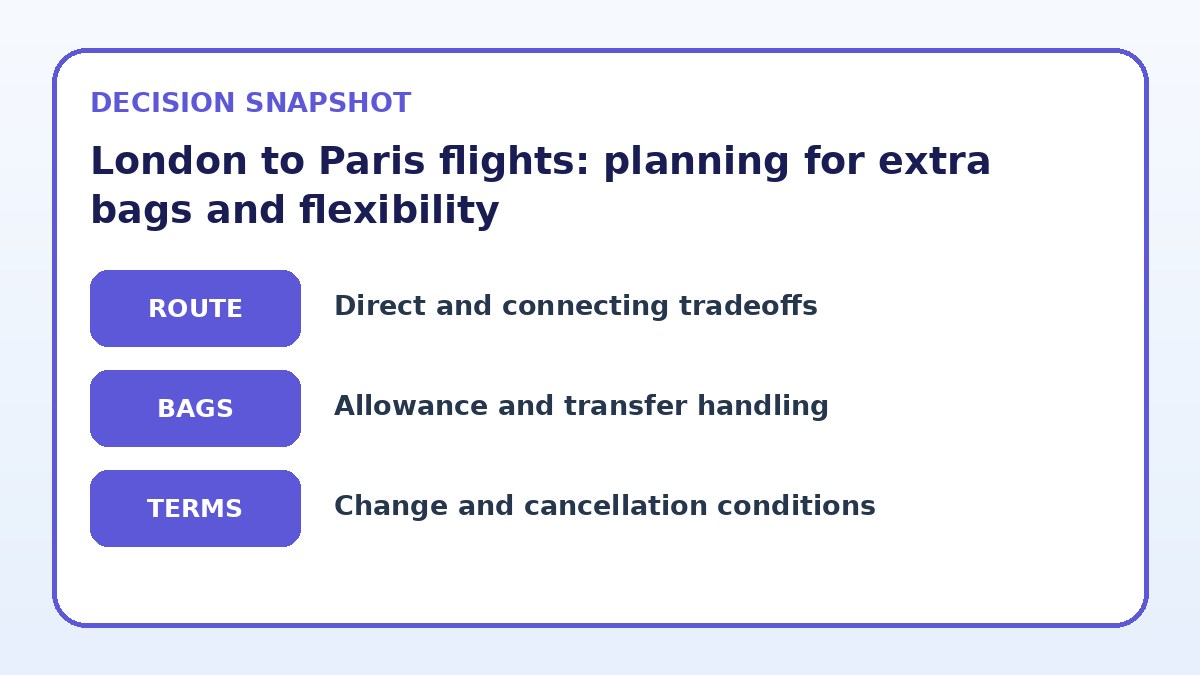
Routing: direct versus connecting for luggage peace of mind
Routing is the first decision for travellers with extra baggage. A direct flight from London to Paris means your checked bag is loaded and unloaded by the same aircraft operation, which lowers handling complexity. If you pack bulky items or fragile gear, a direct service reduces the number of times your baggage is transferred between ground crews. Directs also cut the risk that a missed short connection leaves your bags behind; check whether the flight is marketed as nonstop or if the search result hides a stopover that could complicate transfers.
Connecting itineraries sometimes appear cheaper and offer more schedule options, but they add variables. When you change planes, baggage handling involves two or more handlers and the airline(s) must transfer your bags; verify whether the connection is on the same ticket and whether the carrier guarantees through-checked baggage. If separate tickets are used, you may need to collect and re-check bags at the intermediate airport, which is time-consuming and risky. Always check minimum connection time and confirm baggage transfer policies on the airline or alliance booking page before committing.
Baggage and connection risk: how fees and policies interact
Baggage rules are not uniform: allowances can differ by fare class, route, and whether you buy a bundle or add-on. For extra luggage, compare how each booking treats weight, dimensions, and the number of checked pieces. Some low-cost or basic economy fares exclude checked bags entirely and charge per piece; other fare families include one or more checked bags and let you prepay additional pieces at a lower rate than airport prices. Look for the explicit statement about whether a paid baggage add-on remains valid if you change or cancel the flight.
Connection risk ties directly into baggage fees when itineraries involve multiple carriers. On a single-ticket itinerary operated by one airline or partner airlines, your bags are normally through-checked, and fee treatment on changes follows the ticket rules. On separate tickets, you often must re-pay baggage fees at each leg and physically move your bags—this increases cost and stress. Verify on the airline’s final booking page whether baggage is through-checked on connections, how refunded fees are handled, and if there are specific transfer desk procedures you must follow at each airport.
Compare flight-selection strategies
| Flight strategy | Best for | Risk to check |
|---|---|---|
| Book a direct standard fare that includes checked baggage | Travelers who prioritise low handling risk and predictable baggage treatment | Higher base fare but simpler baggage handling and clearer change rules |
| Buy a basic fare and add checked-bag options separately | Cost-sensitive travellers who want to customize baggage without full fare upgrade | Lower ticket price but risk of non-refundable add-ons and complex rebooking fees |
| Choose a refundable or fully flexible fare with baggage included | Travelers who need maximal schedule flexibility and baggage protection | Highest upfront cost, though reduces rebooking stress and fee surprises |
| Use separate tickets (cheapest leg-by-leg) and handle baggage yourself | Seasoned travellers confident in transfers who prioritise lowest fares | Lowest price but high risk of having to collect and re-pay for bags during connections |
Recheck the complete itinerary
Confirm airports, connection handling, baggage, and change conditions before deciding.
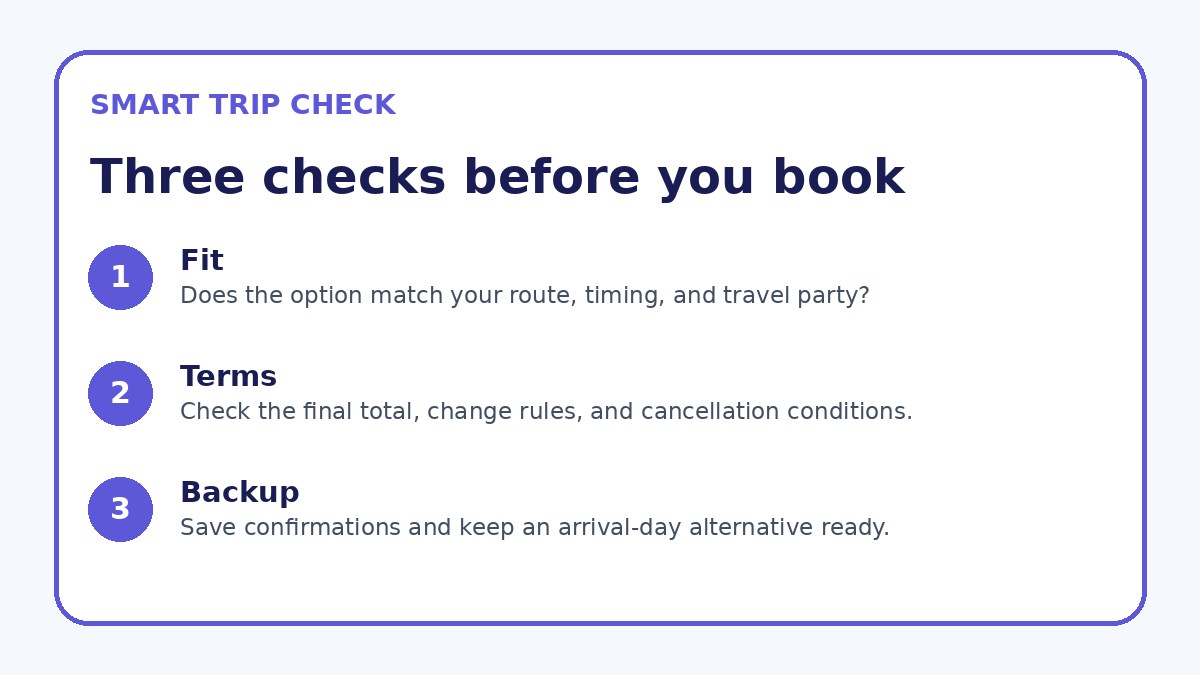
Schedule fit: pick timings that protect tight, bag-heavy trips
When travelling with extra luggage, lean toward schedules with comfortable airport time buffers. Longer check-in windows—you may need extra time to drop oversized or excess baggage—reduce the chance of last-minute holds. For late evening or early morning services, confirm baggage drop deadlines, since some airport desks close early. If you plan to use self-service bag drop or a dedicated oversized-baggage counter, verify opening hours and any appointment requirements on the airline’s page before you travel.
Think about ground transfers on both ends: if you arrive in Paris with heavy or bulky bags, consider which arrival airport and terminal gives you the simplest onward connections to your final destination. On the London side, departing from a less busy terminal can speed security and bag-drop. Also check potential schedule disruption windows: short connection times increase exposure to delayed incoming flights, meaning you may need to claim delayed-baggage procedures. Always model a few realistic schedule-change scenarios before booking and be ready to pay for a more flexible itinerary if needed.
Flight details to verify
- Confirm exact travel dates and passenger names before checking fare rules to ensure baggage add-ons attach to the correct booking.
- On the airline’s final booking page, verify whether your chosen fare includes checked baggage, allowed weight/dimensions, and charges for extra pieces.
- If planning a connecting itinerary, confirm whether baggage is through-checked on a single ticket or must be reclaimed on separate tickets.
- Check the fare rules for change and cancellation fees and whether purchased baggage fees are refundable or transferable on changes.
- Note baggage drop deadlines and terminal arrival recommendations for both London departure and Paris arrival airports listed on the carrier page.
- Save screenshots or PDFs of the booking confirmation, fare rules, and baggage receipts to speed claims or rebooking later.
Fare conditions: change, cancellation, and how baggage is treated
Fare conditions determine your financial exposure if plans change. Read the fare rules on the airline’s final booking page to see change fees, refundability, and how baggage charges are handled. Key things to verify are whether changes are allowed and whether an applied baggage fee is refundable or transferable to a reissued ticket. Some carriers waive change fees but still consider baggage add-ons non-refundable; others apply the new fare difference plus a smaller reissue charge. Don’t assume that pre-purchased baggage moves automatically to a new booking without cost.
Also confirm what happens when the carrier changes the schedule: many airlines permit free rebooking or refunds for significant flight-time changes, and these remedies often include any paid baggage components, but the definition of ‘significant’ varies. If your trip is time-sensitive or the luggage cost is high, choose a fare that explicitly states baggage treatment on changes or select travel insurance that covers baggage fees for cancellations. Always save screenshots or PDFs of the fare rules and baggage receipts at booking, because those are what you’ll reference during any dispute or rebooking.
Flight Guide questions travelers ask
If I add a checked bag during booking, will that fee be refunded if I cancel the flight?
It depends on the fare rules and the carrier. Some airlines refund pre-paid baggage when the ticket is refunded; others treat baggage add-ons as non-refundable. You must check the airline’s final booking page where the fare rules clearly state refundability for add-ons. If the fare is refundable but the baggage add-on is not, you may get a ticket refund but still lose the baggage fee. Keep the confirmation of the add-on purchase and the fare rules; those documents are what customer service will reference when processing refunds.
Can I rely on an airline to transfer my extra baggage on a London–Paris connection?
If your entire journey is on one ticket operated by the same airline or partner carriers, through-checking baggage is common, but not guaranteed—policies vary by carrier and airports involved. If you booked separate tickets, you should assume you must collect and re-check bags at the transfer airport. Always verify transfer baggage policies and minimum connection times on the airline’s or alliance’s booking page, and confirm at check-in whether the agent will tag your bag through to the final destination.
How should I choose between saving on fares and buying flexibility when I have heavy luggage?
Balance the value of your time and the cost of your baggage. If the baggage cost and potential rebooking fees are small relative to your flexibility needs, a cheaper fare plus add-ons may work. If heavy or expensive-to-replace luggage is involved, or your schedule may change, a more flexible or refundable fare that includes baggage can reduce stress and unexpected costs. Before booking, run scenarios: calculate worst-case extra fees for rebooking and lost or delayed baggage, then compare that total to the premium for a flexible fare.
Final decision note
For London to Paris travellers with extra luggage, the core planning task is to match baggage needs to fare rules and route choices. Direct flights and inclusive fare classes simplify handling and reduce connection risk, while basic fares with add-ons can save money if you confirm refund and change treatment in advance. Always check the airline’s final booking page for explicit statements on baggage allowances, change and cancellation fees, and whether paid baggage carries across reissued tickets. Have your dates, traveler names and exact bag measurements ready before you search, save the fare rule screenshots at booking, and consider a refundable option if the baggage cost or timing uncertainty would materially increase your risk.
Continue planning
Check current options and final conditions
Use the provider page to confirm live availability, the final total, cancellation terms, and every condition that matters to your trip.
This evergreen planning guide was created with AI-assisted drafting and a structured quality review. It does not display live prices, schedules, availability, visa guidance, or provider rankings. Verify current details before booking. Some links are affiliate links; we may earn a commission at no additional cost to you.