Short answer: for a family road trip that uses New York City as either start, endpoint, or a must-see stop, a rental car can help you reach nearby parks, beaches, and small towns on your own schedule — but in-city driving, parking, and tolls often erase those gains. If your itinerary concentrates on Manhattan and transit-rich Brooklyn or Queens, skip the car and rely on transit plus rideshares for occasional day trips. If your plan includes the Hudson Valley, Long Island beaches, or multi-stop regional loops with kids, a car usually wins for convenience and packing space. This guide gives clear decision criteria: route value, pickup/return friction, insurance and liability wording, and a sensible non-driving fallback. Read it to decide before you click reserve, and use the checklist to verify the essential terms on the rental provider’s final booking page.

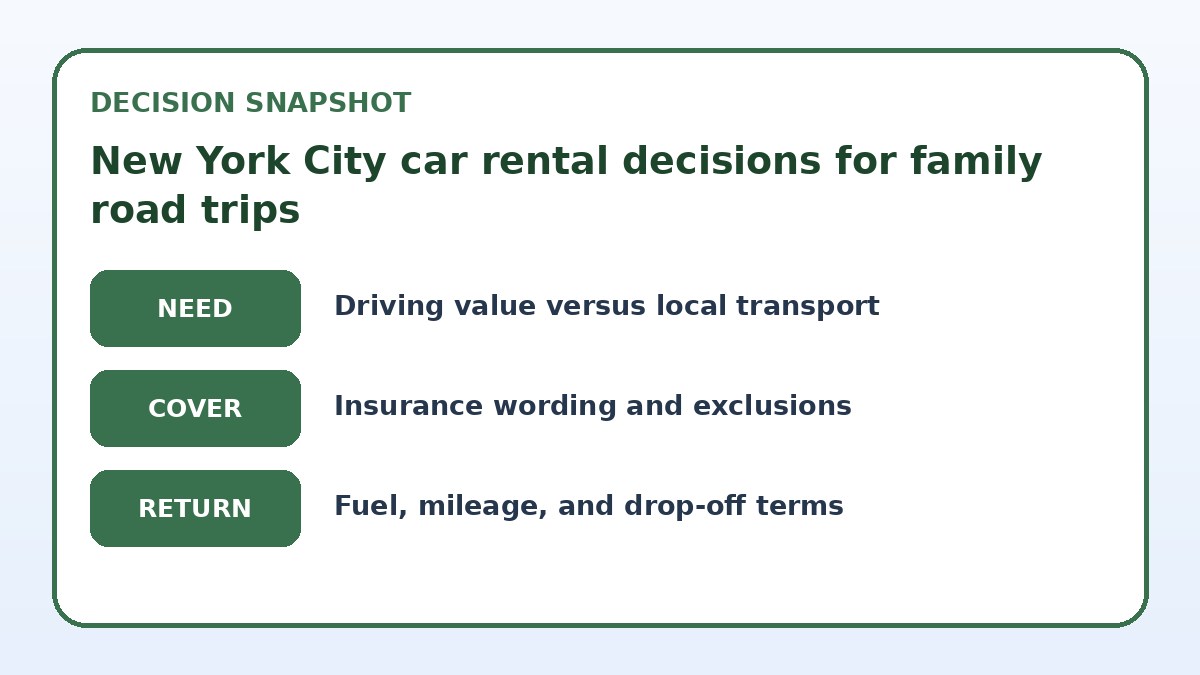
Route value: when the car actually adds family-friendly mileage
Decide whether driving improves your trip by mapping the places you must visit against realistic travel times. A New York City–centered schedule with museums, playgrounds, and short neighborhood hops rarely needs a car; transit and short rideshares reduce walking with kids. Conversely, if you want to visit the Hudson Valley wineries and farm stands, Long Island beaches, or a string of state parks and small towns over several days, driving saves hours door-to-door and removes the need to coordinate multiple transfers. Consider midday flexibility: with children, being able to leave a site when schedules slip matters more than shaving minutes off travel time.
Weigh distances between stops and the frequency of public transit options. If many destinations sit outside rapid transit corridors or require long waits for a bus, the cumulative time and child-care friction often justify a rental. Also account for luggage, strollers, booster seats, and gear: porta-cribs, beach umbrellas, and picnic supplies are manageable in a compact SUV or minivan but cumbersome on trains. Finally, check whether your planned overnight towns provide easy parking and family-friendly lodging that can accommodate a car; if they do, the driving option grows stronger.
Decide whether driving earns its place
| Mobility strategy | Best for | Cost or friction to check |
|---|---|---|
| Rent a car for the entire trip | Families doing multi-day regional loops to parks, beaches, or small towns with heavy gear. | Higher parking, toll, and drop-off complexity inside the city; more to manage with kids in traffic. |
| Rent only for specific day(s) | City-based stays that need a car for 1–3 day trips outside transit corridors. | Extra pickup/return steps and potential hourly costs, but less city parking hassle. |
| No car — transit, rideshares, and day tours | Families staying mainly in Manhattan/Brooklyn/Queens wanting use of transit and low parking stress. | Less flexibility for dispersed outdoor sites and more coordination of luggage and schedules. |
| Car-share or hourly rentals | Short errands, airport pickups, or flexible single-leg needs without full-day commitment. | Availability can vary by neighborhood and models may lack space for family gear. |
Check live rental choices only after the route test
Use the exact driver, dates, pickup point, and return plan to compare current conditions.
Insurance wording: what to verify before you accept or decline coverage
Insurance language on the rental provider’s final page determines your real exposure. Don’t rely on summary blurbs — open the full rental terms and confirm the liability limits, collision damage waiver (CDW) scope, and whether loss of use and administrative fees are charged after an accident. Many personal auto policies extend some coverage to rentals, but limits and exclusions vary by insurer and state. Credit cards sometimes provide secondary collision coverage; you must verify whether it is primary for international rentals and whether it covers liability, roadside assistance, or towing expenses.
Ask specific questions and write down the answers you receive from providers or insurers: what deductible applies to physical damage, which charges are non-waivable, and whether the provider requires pre-authorization holds on your card. For families, add child-specific items: whether booster seats or car seats are supplied, their installation policy, and whether the rental requires an extra fee. If the policy language is confusing, request a downloadable policy or terms PDF before booking and compare it carefully to any coverages offered by your auto insurer and credit card issuer.

Compare the full rental conditions
Confirm insurance wording, exclusions, deposit, fuel, mileage, and return terms on the final page.
Pickup and return friction: logistics that become parenting stress points
Pickup and return locations can create hidden time costs. Airport counters are often convenient for flights but can involve long queues, off-site lots, or shuttle rides that add time with tired children. Downtown pickup points may be closer to your accommodation but could be limited in hours, require walking with luggage, or lack staff for quick service. Compare hours of operation, shuttle or public-transit access, and policies for after-hours returns. For family trips, a smooth, short handoff is worth a slightly higher rate — it reduces the chance of meltdowns at the start or end of a day-long drive.
Also check fuel and mileage policies, child-seat availability, and the provider’s approach to unexpected delays. Some companies charge for returns outside the contracted window; others levy cleaning fees for soiling. If you expect to pick up late because of a delayed flight, explicit written confirmation of late pickup policies can prevent unpleasant surprises. Note precisely what forms of ID and proof of address are required at pickup to avoid last-minute trips back to the hotel. Finally, plan buffer time both ways to account for traffic and roadside stops that are common when traveling with kids.
Car rental terms to verify
- Map each planned stop and calculate realistic door-to-door times versus transit schedules or rideshare estimates.
- Open the rental’s full terms and note deductible amounts, CDW scope, and any non-waivable fees before booking.
- Confirm pickup and return hours, location details, shuttle requirements, and after-hours return policy directly with the provider.
- Verify whether your personal auto policy or credit card offers rental coverage; request written confirmation of covered items and limits.
- Reserve or bring appropriate child safety seats and confirm installation assistance or seat fees with the rental company.
- Plan alternative transit or private-transfer options for each major day in case you cancel the car or encounter unexpected delays.
Non-driving fallback: a practical plan if you decide not to rent
Create a workable non-driving itinerary before cancelling a car reservation. Identify the transit lines that cover your primary neighborhood and the main transit-to-destination legs for your day trips. For longer suburban or rural outings, research private shuttle services, regional buses, or bookable day tours that accept families and strollers. Keep an estimate of taxi or rideshare costs for specific legs where public transit is slow or nonexistent so you can compare total time and expense against the rental option.
Arrange luggage and gear differently: choose apartments or hotels that provide cribs and kitchens, and pack collapsible strollers to move easily on transit. If you’ll occasionally need a car for a single day, consider one-day rentals or car-sharing services that allow hourly pickup. Plan for late-afternoon wind-downs in places with child-friendly dining near transit to avoid long transfers with tired kids. Finally, save contact numbers for local family services — pediatric urgent care, pharmacies, and childcare options — so the family can adapt smoothly without a vehicle.
Car Rental & Road Trip questions travelers ask
Do I need a car seat for my child when renting in New York City?
Yes — New York State law requires appropriate child restraints for children under a specified age/size; rental companies often supply car seats for a fee. Before you finalize a reservation, verify the rental provider’s car-seat availability, cost, and whether a trained staff member will install it or demonstrate proper installation. If you prefer to bring your own, confirm the vehicle type and anchor points to ensure compatibility. Always check the provider’s final booking page for exact terms about car seat charges and installation services.
How do tolls, congestion, and parking typically affect family road-trip planning in NYC?
Tolls and parking can significantly increase both travel time and expense, especially when driving into Manhattan or crossing bridges and tunnels. Many rental bookings list toll-processing fees and electronic transponder policies on the final page; confirm whether they charge additional administrative fees for tolls and if you can opt out by using your own transponder. Research parking options at hotels and attractions in advance — some accept only off-street lots with fixed rates. Because these details change, verify toll and parking policies on the rental and accommodation booking pages before committing.
What should I do if my flight is delayed and I have a rental pickup or return scheduled?
Contact the rental provider immediately and get written confirmation of any modified pickup or return arrangements. Many companies hold reservations for a certain grace period, but policies on late pickups and returns vary widely and can include additional fees. If you expect a long delay, ask about after-hours pick-up options, alternate nearby locations, and whether your booking can be moved without penalty. Keep reference numbers and the staff member’s name, and re-check the provider’s final booking terms for the official policy on delays and no-shows.
Final decision note
For families, the car-rental decision for a New York City–centered road trip hinges on where you want to go and how much time you’ll spend outside the transit network. Choose a full rental when multiple regional stops, gear, and flexible departure times outweigh parking and toll friction. Opt for short-term rentals, car-share, or no car if your trip stays within the city core and you prefer to avoid parking complexity. Whatever you choose, read the rental’s full terms, confirm insurance coverage in writing, reserve child seats if needed, and plan a non-driving backup. If you want additional live availability to compare providers, Trip.com can be used as one place to check options — but always verify final fees and policies on the provider’s official booking page before you commit.
Continue planning
Check current options and final conditions
Use the provider page to confirm live availability, the final total, cancellation terms, and every condition that matters to your trip.
This evergreen planning guide was created with AI-assisted drafting and a structured quality review. It does not display live prices, schedules, availability, visa guidance, or provider rankings. Verify current details before booking. Some links are affiliate links; we may earn a commission at no additional cost to you.